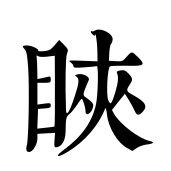
Pronounced shī rǎn (falling tone), same as "shǎn". Describing the appearance of eyes blinking frequently. Written as "覢" in "Yunhui" (Yunhui). "Jiyun" (Jiyun) states it is interchangeable with "睒" (shǎn). The original form of the character 䀹 was from "㚒" (jiā), not "夾" (jiā). "Tangyun" (Tangyun) annotates the pronunciation as zǐ yè (entering tone), and "Jiyun" (Jiyun) annotates it as jí shè (entering tone), same as "jiē". "Shuowen Jiezi" (Shuowen Jiezi) explains it as eyelashes. The sentence "hū hū chéng 䀹" appears in "Records of the Grand Historian: Biography of Bian Que" (Shiji - Shǐbiàn Què Zhuàn). "Jiyun" (Jiyun) states it is sometimes also written as "睫" (jié).
Also, "Jiyun" (Jiyun) annotates the pronunciation as shī shè (entering tone), same as "shè". Describing the appearance of eyes rolling. Same as [character missing, should be "䀹" or related character based on context].
Also annotated as cè qià (entering tone), same as [missing character, likely close to "zhǎ" based on phonological system]. Describing the blinking of eyes. Same as the character "眨" (zhǎ).
Also annotated as wǔ qià (entering tone), same as [missing character, likely close to "zhǎ" based on phonological system]. 㛼䀹 (zhǎ 䀹), describing a playful or mocking appearance.
Also annotated as qì qià (entering tone), same as "jiā". Refers to the blinking of eyelashes. Another explanation is to squint or look with half-closed eyes. "Han Feizi: Discussion of Forests" (Han Feizi - Shuo Lin Pian) records: Hui Zi said: If a person comes to see you, but looks at you with one eye 䀹 (squinting or blinking one eye), what would you do? Duke Zou said: I would surely kill him. Hui Zi said: A blind person cannot help but 䀹 (close or squint) both eyes, why don't you kill him? Duke Zou said: A blind person cannot help but 䀹. "Jiyun" (Jiyun) states it is the same as the character "䀫" (lě).