You Collection, Lower Volume
Radical: Carriage (chē)
Kangxi Strokes: 13
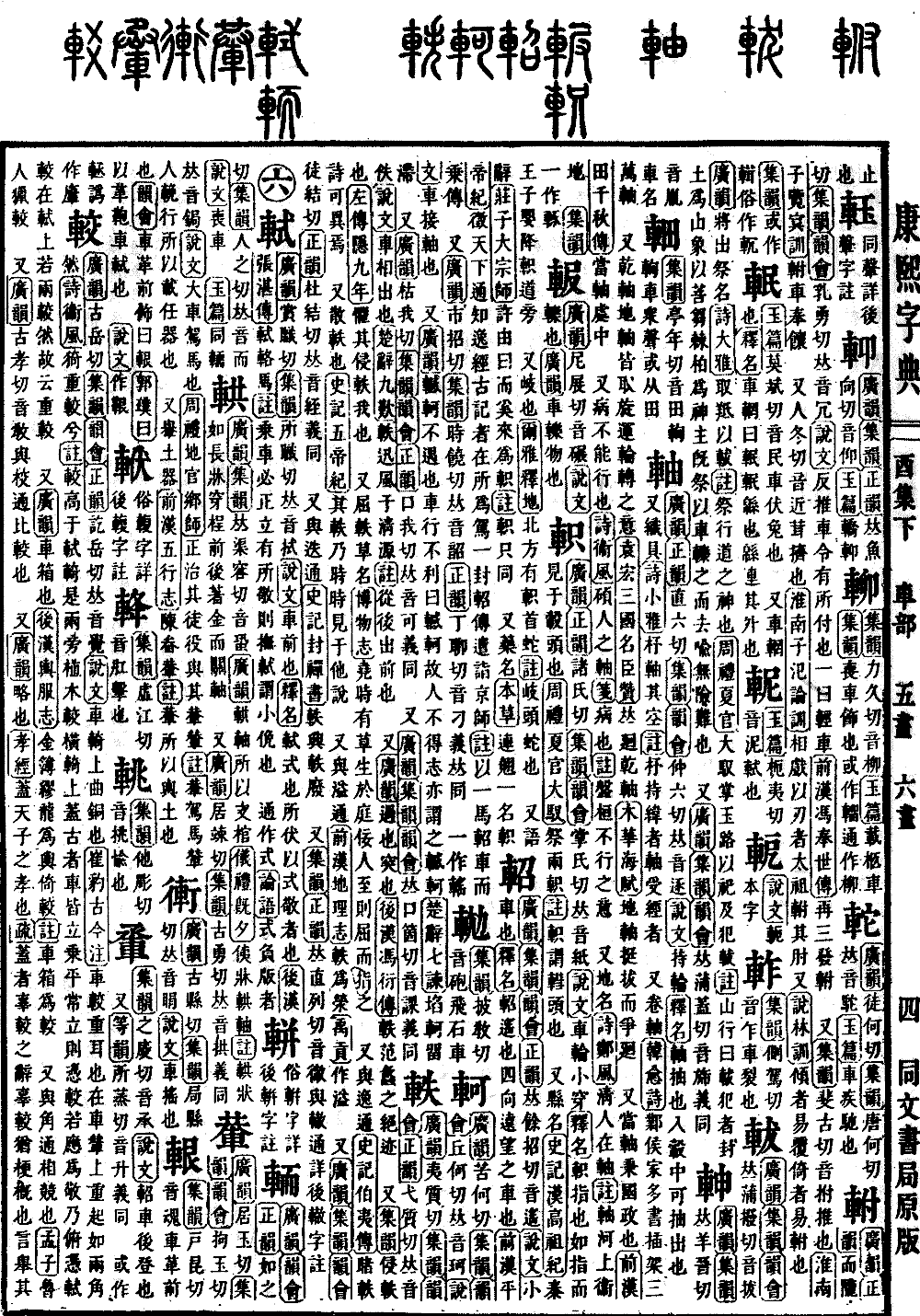
Page 1242, Entry 31
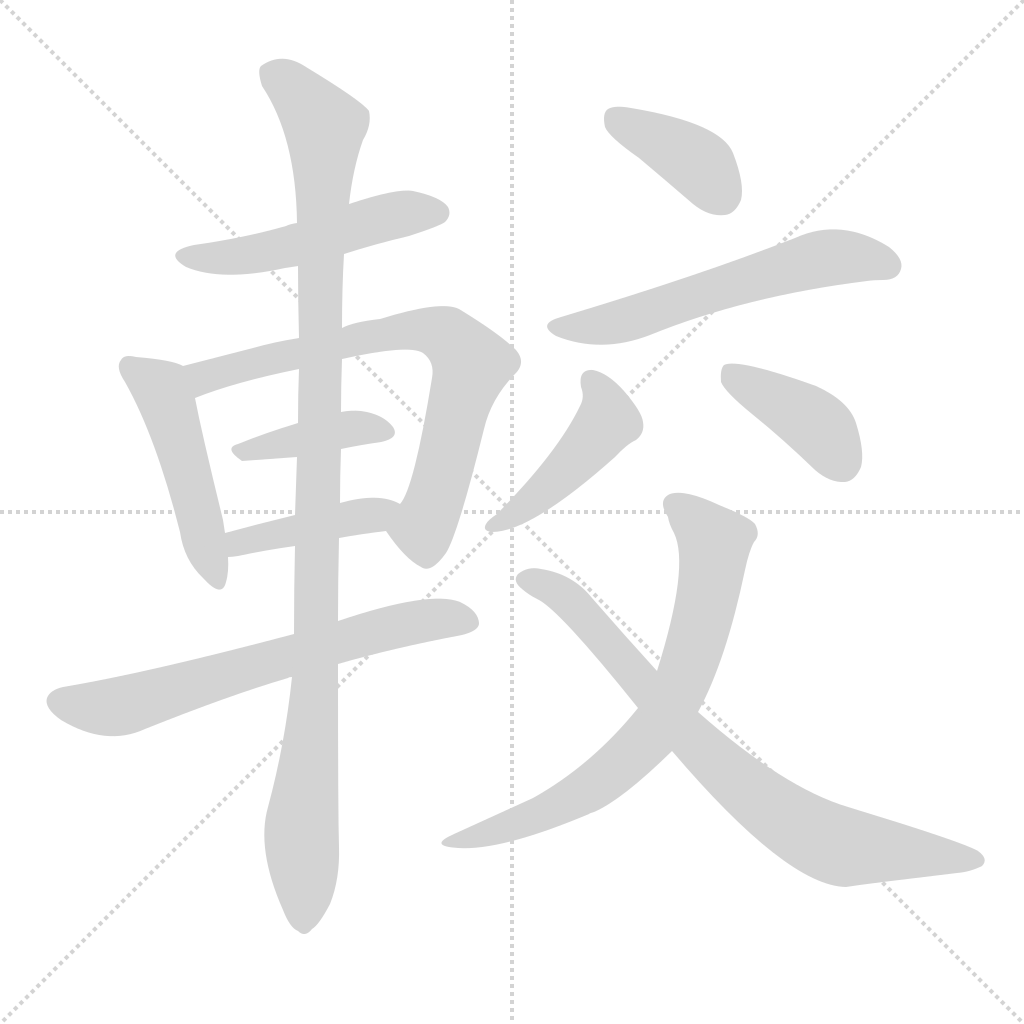
Pronounced jue. According to the Analytical Dictionary of Characters (Shuowen), it refers to the curved bronze part on the side railings of a carriage. According to Cui Bao in Records of Past and Present (Gujin Zhu), the carriage railing is a secondary ear-like structure; it rises above the carriage body like two horns. In the Book of Odes (Shijing), it is mentioned as having a double railing; the commentary notes that the railing is higher than the crossbar. The side railings are the vertical wooden posts, and the cross-rail is laid upon them. In ancient times, one stood in the carriage; normally, one would lean on the railing, but to show respect, one would bow and lean on the crossbar. Since the railing is above the crossbar and resembles two horns, it is called a double railing.
Also, the carriage box. In the History of the Later Han (Houhan Shu), records of carriages and attire mention gold-plated coiled dragons on the carriage box railings; the commentary notes that the carriage box is the railing.
Also interchangeable with the word for horn; to compete or contend. In the Mencius, it mentions the people of Lu hunting and contending.
Pronounced jiao. Interchangeable with the word for school or comparison; to compare.
Also, an outline. In the Classic of Filial Piety (Xiaojing), the term appears as a prefix for royal filial piety; the commentary explains that this is a term for a broad summary, meaning to present the general outline.
Also, the appearance of being bright and clear. In the History of the Former Han (Hanshu), it is written that it was very clear.
In the Dictionary of Rhymes (Jiyun), sometimes written as a variant form. It is now commonly written as this character.
Textual research: In the History of the Later Han (Houhan Shu), records of carriages and attire, the original text used gold-leaf, which has been corrected to gold-plated.