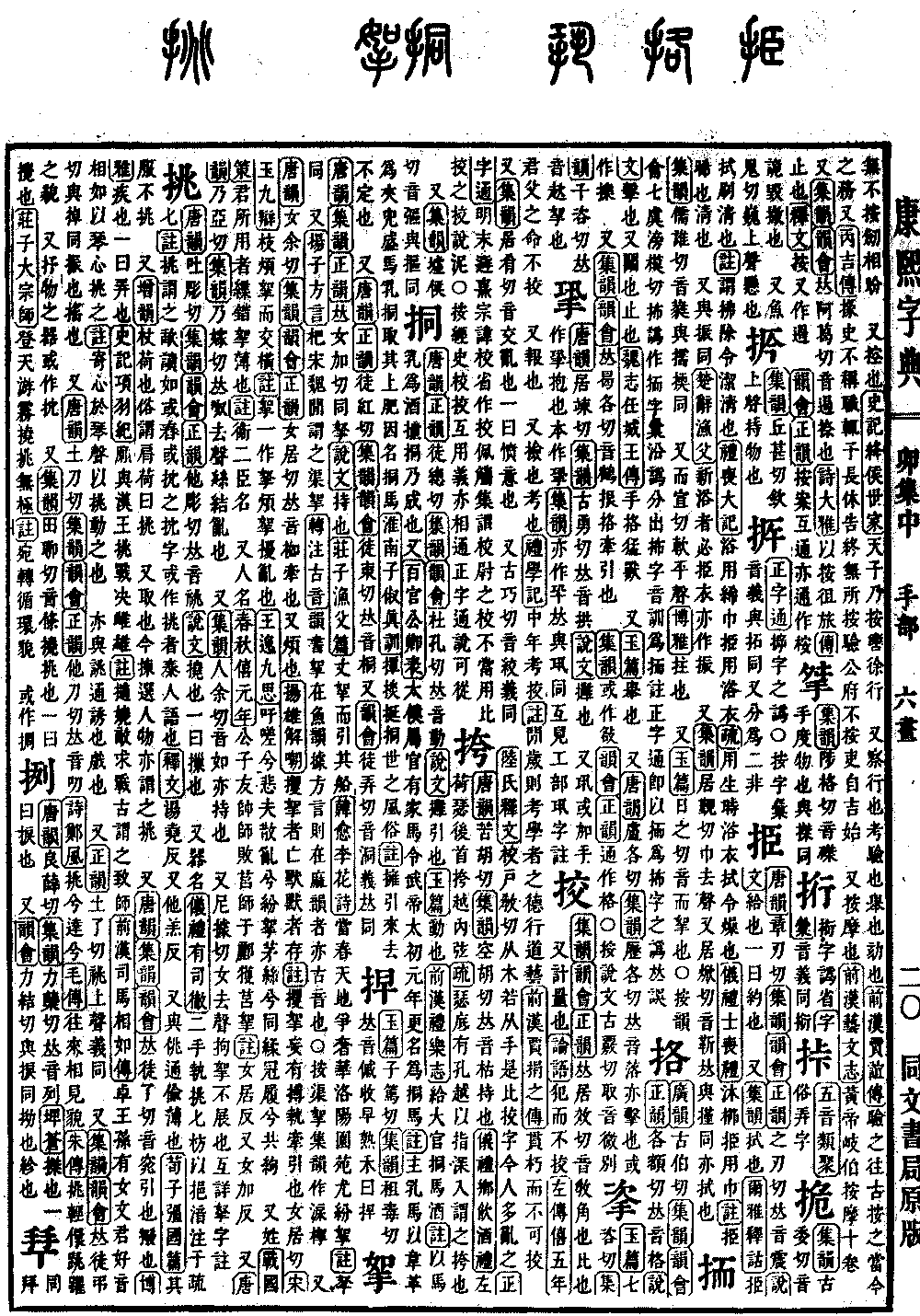
Mao Collection, Middle Volume
Radical: Hand (shǒu)
Kangxi strokes: 10
Page 430, Entry 12
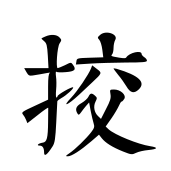
Pronounced jiao (falling tone). To contend or compare. Also, to measure or calculate.
Analects (Lunyu): To offend without harboring resentment.
Zuo Tradition (Zuozhuan), Fifth Year of Duke Xi: The command of the sovereign and father is not to be debated.
Also, to requite. Also, to examine or investigate.
Book of Rites (Liji), Record of Learning (Xueji): In the middle of the years, examine and assess.
Commentary: Every other year, investigate the student’s virtue and their proficiency in the arts.
History of the Former Han Dynasty (Qianhan shu), Biography of Jia Juanzhi: The cords used to string coins rotted away, making them impossible to calculate.
Also, pronounced jiao (level tone). Disordered. One account says it signifies a feeling of resentment.
Also, pronounced jiao (rising tone). Meaning is the same.
Lu’s Explanation of Terms (Lu shi shiwen): Regarding the character jiao, it should be pronounced as jiao (falling tone) and written with the wood radical. If written with the hand radical, it is the character for comparison, though people today often confuse the two.
Rectification of Characters (Zhengzitong): At the end of the Ming dynasty, to avoid the taboo name of the Xizong Emperor, the character jiao was abbreviated to the current form. The Collection of Pendants (Peixi ji) states that the jiao in military officer should not be written with the same character used for comparison, but this interpretation is overly pedantic. In the classics and historical records, the two forms are used interchangeably, and their meanings are consistent. The view held by the Rectification of Characters (Zhengzitong) is acceptable.