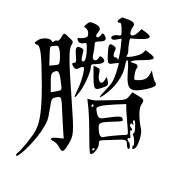
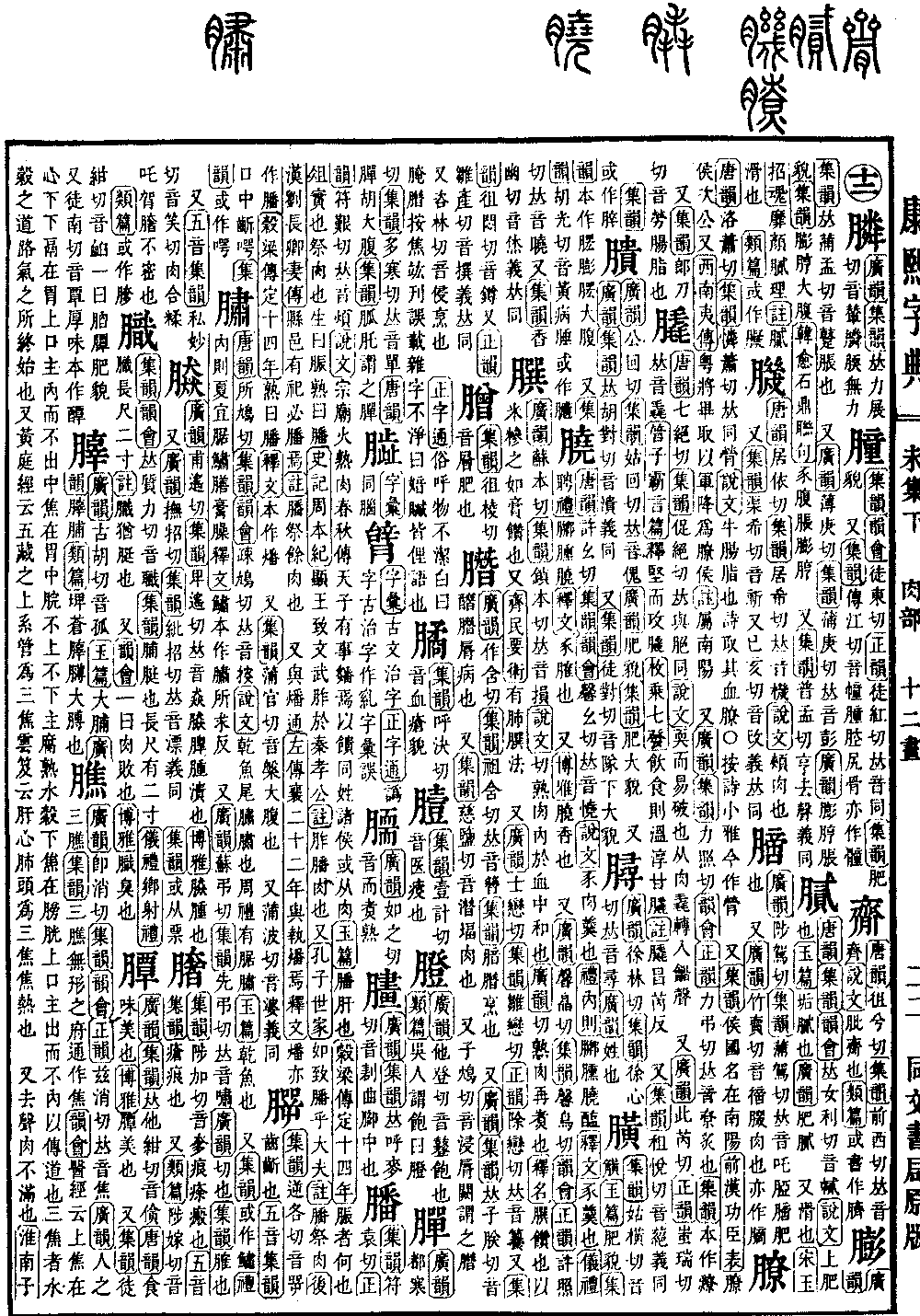
Pronounced han (falling tone) in Guangyun (Guangyun), and zu han (falling tone) in Jiyun (Jiyun), same pronunciation as "zan" (zan). Jiyun (Jiyun) explains: 腤䐶 (wan tan) means to cook.
Also, pronounced zi zhen (falling tone) in Guangyun (Guangyun) and Jiyun (Jiyun), same pronunciation as "zhen" (zhen). Refers to a disease of the lips.
Also, pronounced ci yan (rising tone) in Jiyun (Jiyun), same pronunciation as "qian" (qian). Refers to meat cut into pieces.
Also, pronounced zi zhen (falling tone), same pronunciation as "jin" (jin). A missing lip is called 䐶 (tan).
Also, pronounced zi lin (rising tone), same pronunciation as "qin" (qin). Means to cook. Zhengzitong (Zhengzitong) records: In common folk usage, something not clean is called 腌䐶 (yan tan). According to the miscellaneous characters recorded by Jiao Hong (Jiao Hong) in Kanwu (Kanwu), "not clean" is called 㛺赃 (jing zang), both are folk sayings.