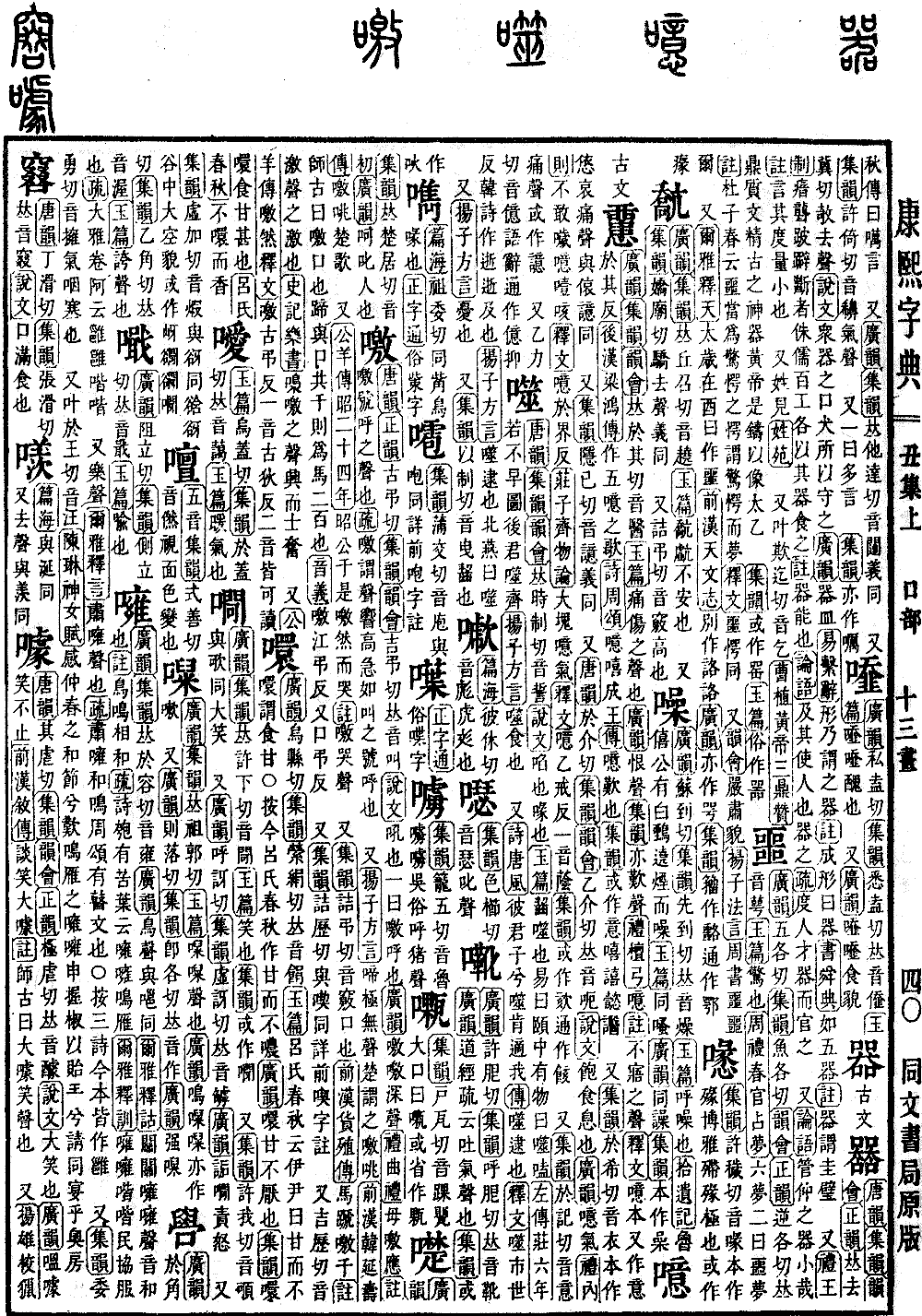
Chou Collection, Upper Volume
Radical: Mouth (kǒu)
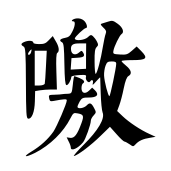
Character: jiao
Kangxi stroke count: 16
Page 210, Entry 20
Pronounced jiao.
According to the Explaining Graphs and Analyzing Characters (Shuowen Jiezi), it means to roar. Another meaning is to shout out.
According to the Extended Rhymes (Guangyun), jiao jiao means a deep sound.
In the Book of Rites (Liji), it states: Do not answer with a shout. The commentary notes that jiao is the sound of calling out. The sub-commentary explains that jiao refers to a sound that is high-pitched and urgent, like a loud cry.
Also, according to the Dialects (Fangyan) by Yang Xiong, to weep to the point of being soundless is called jiao tao in the Chu region.
In the History of the Former Han (Qian Hanshu), Biography of Han Yanshou, it mentions jiao tao and songs of Chu.
In the Gongyang Commentary (Gongyang Zhuan), 24th year of Duke Zhao, it states: Duke Zhao then wept with a jiao sound. The commentary notes that jiao is the sound of weeping.
Also pronounced qiao. Meaning mouth.
In the History of the Former Han (Qian Hanshu), Treatise on the Exchange of Goods, it mentions horse hooves and jiao totaling one thousand. The commentary by Yan Shigu states: Jiao means mouth. If the hooves and mouths together total one thousand, then there are two hundred horses.
Also written in a variant form (qiao).
Also pronounced ji. Meaning the sharp sound of a voice.
In the Records of the Grand Historian (Shiji), Book of Music, it states: When the sounds of jiao are raised, the warriors are encouraged.