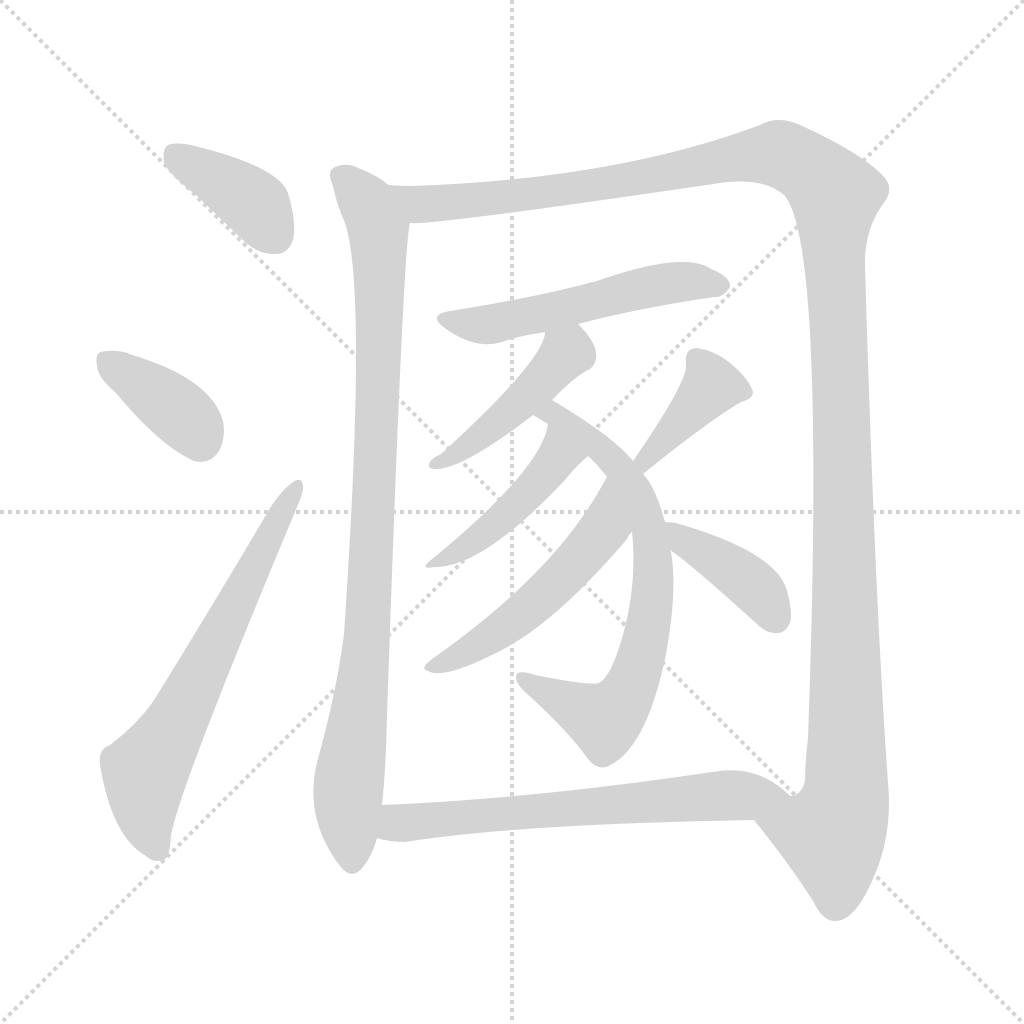
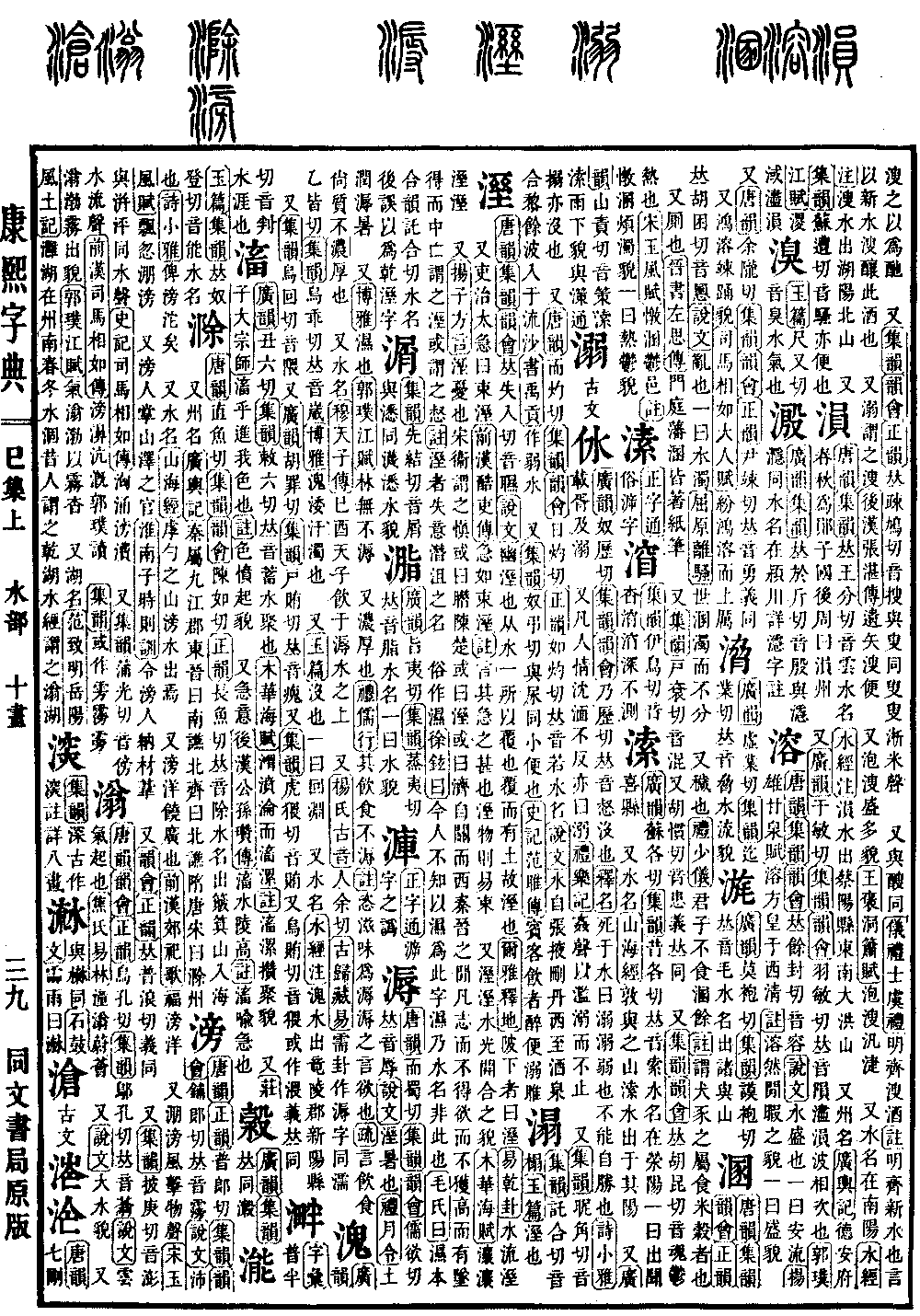
Si Collection, Upper Volume
Radical: Water (shuǐ)
Kangxi Strokes: 14
Page 641, Entry 07
Tang Rhymes (Tangyun), Collected Rhymes (Jiyun), Rhyme Compendium (Yunhui), Correct Rhymes (Zhengyun): Pronounced hun (falling tone).
Shuowen Jiezi (Shuowen): Disorder. Another meaning is muddy water.
Qu Yuan, Encountering Sorrow (Lisao): The world is murky and indistinguishable.
Also means filthy. Used interchangeably with the form (hun). Book of Rites (Liji), Minor Rites (Shaoyi): A gentleman does not eat the fat of a pig. Book of Rites (Liji), Rites of the Evening (Jixi Li): Zheng Xuan's commentary notes that (hun) is written as (hun).
Also means a latrine. History of Jin (Jinshu), Biography of Zuo Si: The courtyard and the latrine were all filled with paper and writing brushes.
Also, Collected Rhymes (Jiyun): Pronounced hun (falling tone). Also, pronounced huan (falling tone). The meaning is the same.
Also, Collected Rhymes (Jiyun), Rhyme Compendium (Yunhui): Pronounced hun (rising tone). Oppressive heat. Song Yu, Rhapsody on the Wind (Feng Fu): Depressed and stifled. Commentary: Duihun, the appearance of being troubled and murky. Another definition is the appearance of oppressive heat.
Textual Research: Book of Rites (Liji), Minor Rites (Shaoyi): A gentleman does not eat the surplus of the sty. Commentary: This refers to dogs and pigs that eat grain. We observe that in the original text of Minor Rites, the term is written with the character (hun) without the water radical. The character (yu) is not written as the character (yu). Checking the Book of Etiquette and Ceremonial (Yili), Rites of the Evening (Jixi Li), the commentary by Zheng Xuan notes that (hun) is written as (hun). It is hereby corrected to state that it is used interchangeably with (hun). Book of Rites (Liji), Minor Rites (Shaoyi): A gentleman does not eat the fat of a pig. Book of Rites (Liji), Rites of the Evening (Jixi Li), the commentary by Zheng Xuan notes that (hun) is written as (hun).