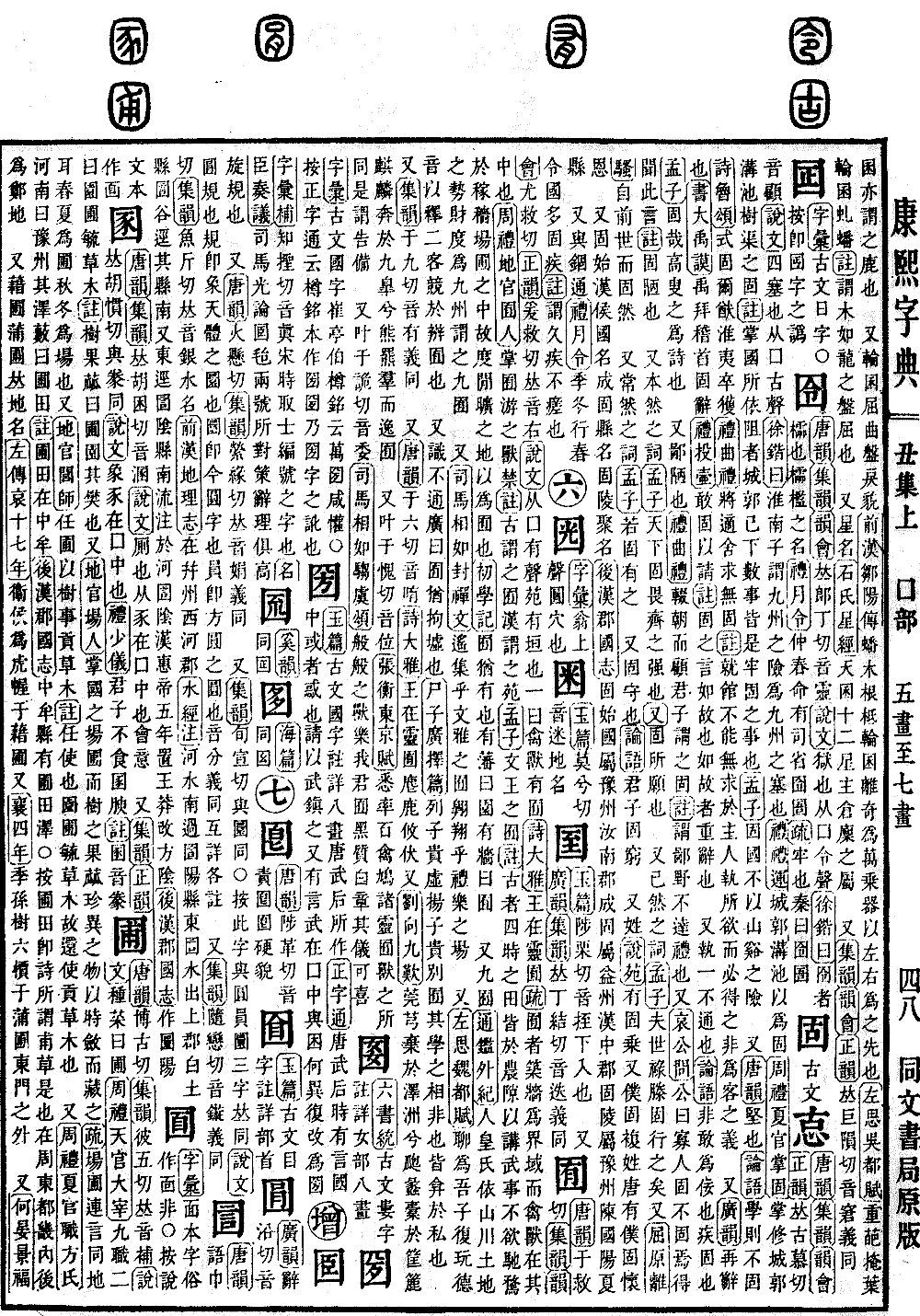
Chou Collection, Upper Volume
Radical: Enclosure (wéi)
Hun
Kangxi strokes: 10
Page 218, Entry 20
According to the Tang Rhyme (Tangyun) and the Collected Rhymes (Jiyun), the pronunciation is hun (falling tone).
According to the Explaining Graphs and Analyzing Characters (Shuowen), it refers to a privy. The form of the character is a compound ideograph consisting of the character for pig inside the character for enclosure.
Additionally, according to the Collected Rhymes (Jiyun) and the Correct Rhymes (Zhengyun), the pronunciation is huan (falling tone). It is equivalent to the character for feeding animals (huan).
From the Book of Rites (Liji), specifically the section Small Decorum (Shaoyi): The superior person does not eat the meat of animals fed on grain. The commentary notes that this refers to animals such as dogs and pigs fed on grain.
Textual research: The Explaining Graphs and Analyzing Characters (Shuowen) states it resembles a pig in an enclosure. The Book of Rites (Liji), section Small Decorum (Shaoyi), states: The superior person does not eat the meat of animals fed on grain. The term hun is pronounced huan. We observe that the citation from the Explaining Graphs and Analyzing Characters (Shuowen) regarding a pig in an enclosure is redundant with the previous citation, and the explanation of a pig in an enclosure corresponds to the pronunciation huan (falling tone). We have therefore amended the citation from the Book of Rites (Liji), section Small Decorum (Shaoyi) to state that the superior person does not eat the meat of animals fed on grain, with the commentary defining these as animals such as dogs and pigs fed on grain.