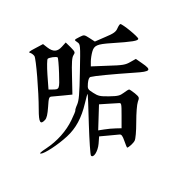
Tangyun states that this character is pronounced hou. Jiyun, Yunhui, and Zhengyun state that it is pronounced hou. The pronunciation is the same as the character mentioned. Shuowen Jiezi explains it as: a sound indicating extreme anger. Note: Jiyun considers it to have the same meaning as the characters hou, hong, and hou, which is incorrect. A detailed explanation can be found in the previous commentary for the character hou.
Additionally, Guangyun provides the pronunciation as lou. Jiyun provides the pronunciation as xu. The pronunciation is the same as the character kou. The meaning is the same as the above.
Furthermore, Guangyun explains it as shame. In the Records of Elder Dai (Da Dai Liji), the inscription on the machine says: one must always remain respectful, for the mouth will give birth to the shame-sound. The commentary explains: the character signifies shame, or it signifies scolding.
Additionally, Yupian and Guangyun provide the pronunciation as hou. The pronunciation is the same as the character hou. Yupian explains it as to spit out. Guangyun explains it as wanting to vomit. Jiyun states that this character was originally written as gou. It is sometimes also written in a variant form (zhou). Verification: In the inscription on the machine from the Records of Elder Dai, carefully following the original text, the character machine (ji) is replaced with machine (ji).
Zi Collection, Page Position: Upper
Radical: Mouth (kǒu)
Page 195, Entry 02