Wei Collection, Middle Volume
Radical: Net (wǎng)
hǎn
Kangxi Stroke Count: 9
Page Number: 946, Entry 35
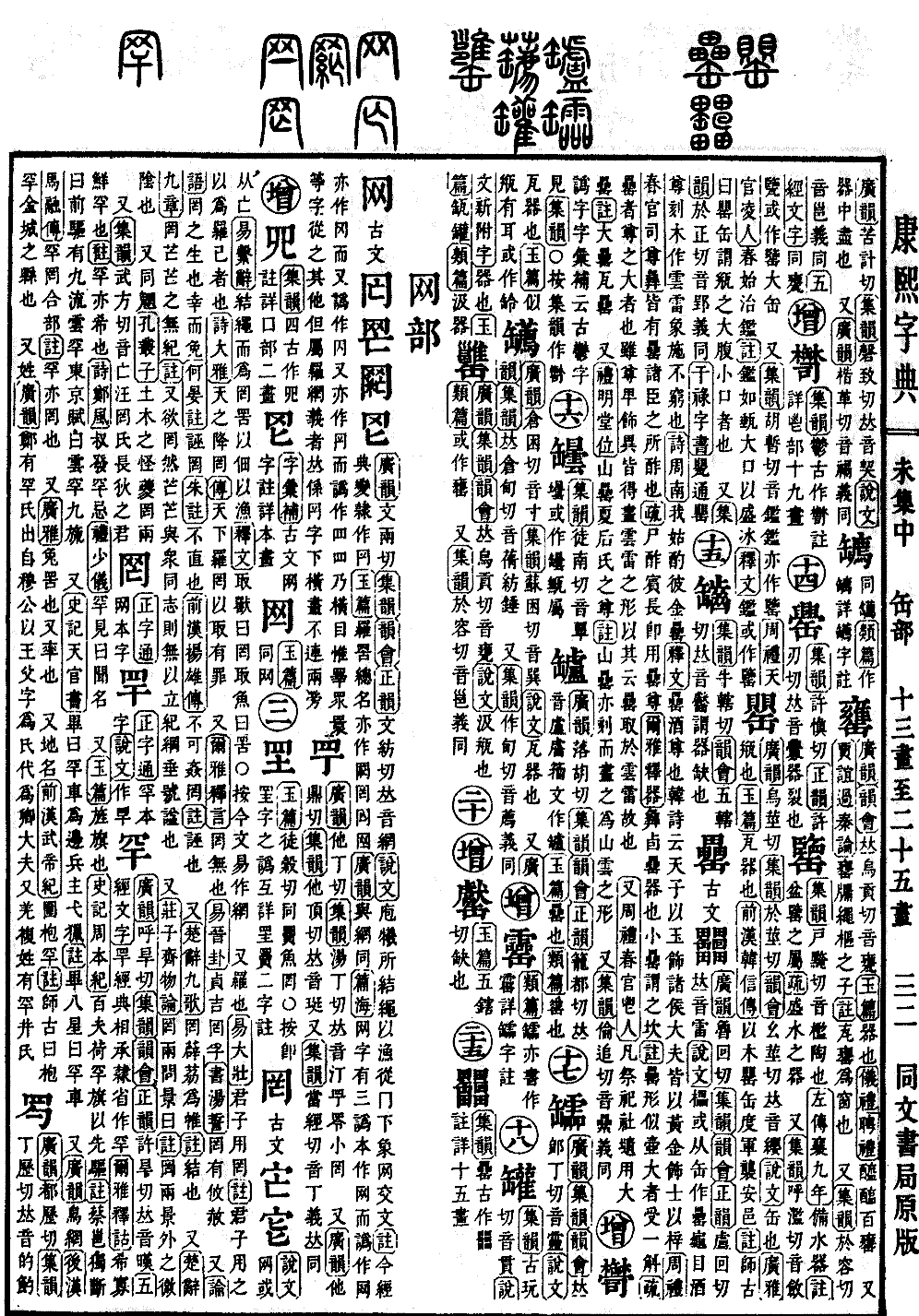
According to the Guangyun, pronounced hū hǎn qiè. According to the Jiyun, Yunhui, and Zhengyun, pronounced xǔ hǎn qiè, the sound is similar to hàn. The Wujing Wenzi states that in classical transmission, it is abbreviated as hǎn in clerical script. The Erya, in the Explanation of Words, states: "Rare, few, scarce, these are hǎn." The commentary adds: "hǎn also means rare." In the Book of Odes (Shijing), Zheng Feng: "Shu Fa is rarely envied." In the Book of Rites (Liji), Shaoyi: "Rarely seen is called 'heard the name'." Also, according to the Yupian, it means "banner" or "flag." In the Records of the Grand Historian (Shiji), Basic Annals of Zhou: "A hundred men carry hǎn flags, to lead the vanguard." The commentary states: "Cai Yong's Du Duan says: The vanguard has nine-streamered yunhǎn banners. The Eastern Capital Rhapsody says: yunhǎn with nine streamers." Also, in the Records of the Grand Historian, Treatise on Astronomy: "The Pleiades are called hǎnchē, representing border soldiers, presiding over fowling and hunting." The commentary adds: "The eight stars of the Pleiades are called hǎnchē." Also, according to the Guangyun, it means "bird net." In the Book of the Later Han (Hou Hanshu), Biography of Ma Rong: "hǎnwǎng combines and forms a section." The commentary adds: "hǎn also means wǎng (net)." Also, according to the Guangyun, it means "rabbit snare." Also, "to lead." Also, a place name. In the Book of Han (Hanshu), Annals of Emperor Wu: "Besieged Fǎohǎn." The commentary by Yan Shigu says: "Fǎohǎn is a county in Jincheng." Also, a surname. According to the Guangyun, the state of Zheng had the Hǎn clan, originating from Duke Mu, who took their grandfather's style name as their surname, and served as high ministers and grand masters for generations. Also, among the Qiang people, there is the compound surname Hǎnjǐng.