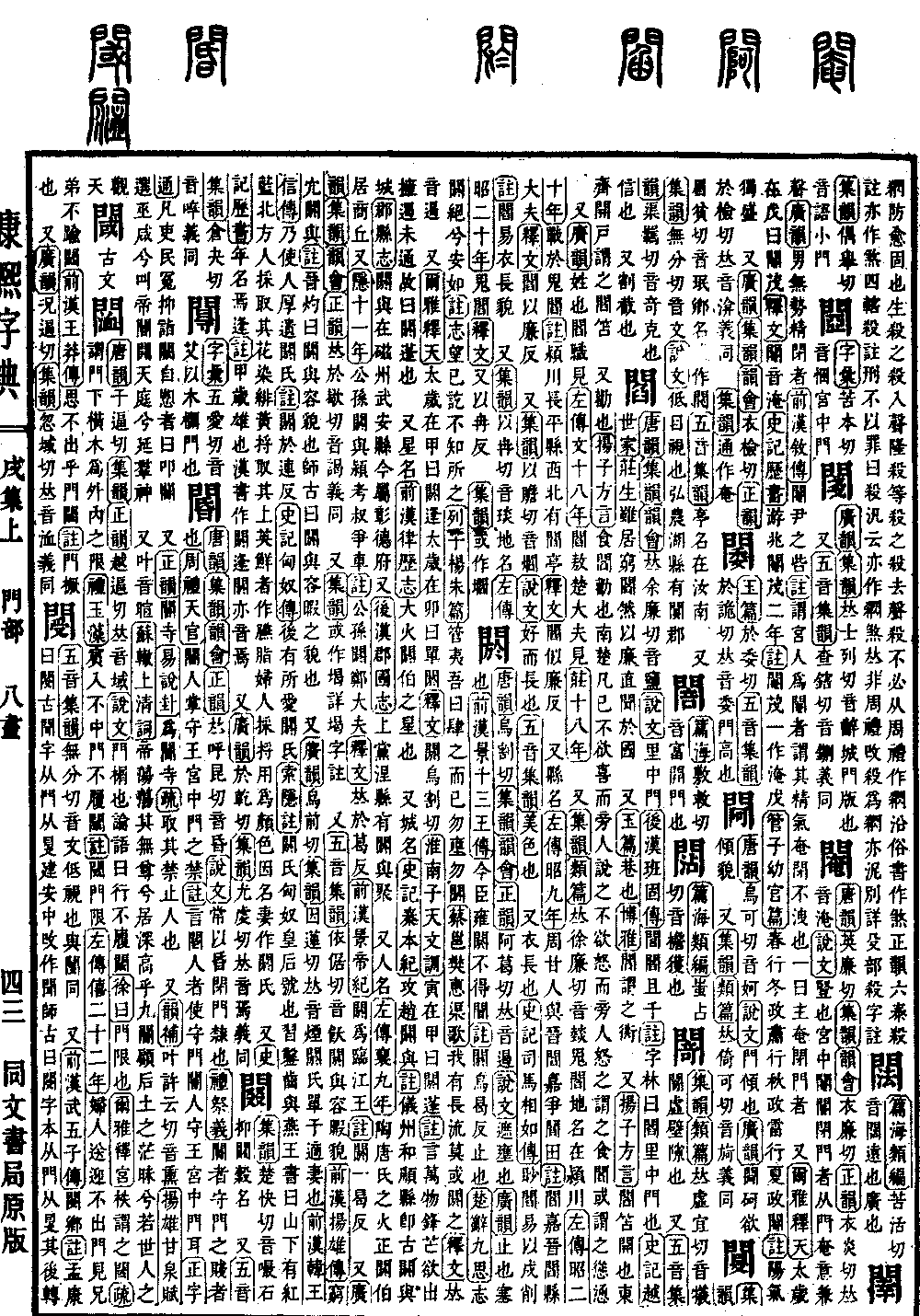
Xu Collection, Upper Volume
Radical: Gate (mén)
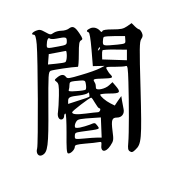
Hun
Kangxi strokes: 16
Page 1337, Entry 16
Pronounced hun
Shuowen Jiezi (Shuowen): Refers to the servant responsible for closing the city gates at dusk.
Book of Rites (Liji), Sacrificial Meanings: The gatekeeper is a person of low status among those who guard the gates.
Rites of Zhou (Zhouli), Offices of Heaven: The gatekeeper manages the prohibitions regarding the central gates of the royal palace.
Commentary: The reason they are called gatekeepers is that they are tasked with guarding the central gate of the royal palace.
Zhengzitong (Correct Meaning Encyclopedia): Anyone, whether official or commoner, who has a grievance and goes to the palace gate to appeal is said to be knocking at the gate (kouhun).
Zheng Yun (Standard Rhymes): Refers to a eunuch or court attendant.
Book of Changes (Yijing), Discussion of Trigrams: Symbolizes gatekeepers and eunuchs.
Sub-commentary: The meaning is derived from their role in prohibiting people from entering or exiting at will.
Rhyme Supplement (Yunbu): Rhymes with the pronunciation xun.
Yang Xiong, Ganquan Fu (Rhapsody on Sweet Springs): Selecting Wu Xian to knock at the palace gate of the Celestial Emperor, opening the heavenly court to welcome the myriad spirits.
Also rhymes with xuan.
Su Zhe, Shangqing Ci (Ode to Highest Clarity): The Celestial Emperor is vast and without a concrete form, residing in the deep reaches of the nine-layered heavenly gates. Looking back at the darkness of the earthly realm, it is like the world looking up at the vast sky.