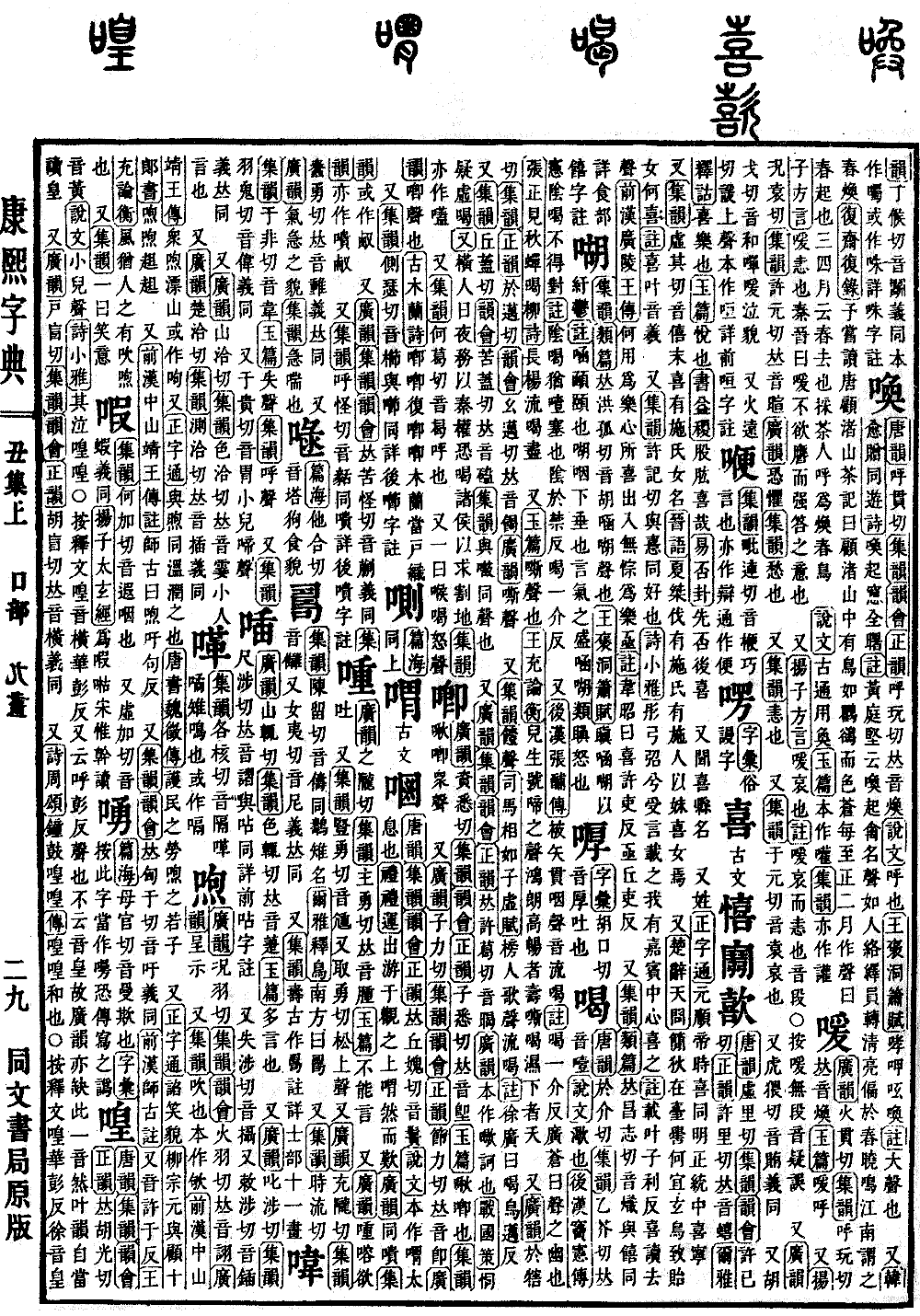
Chou Collection, Upper Volume
Radical: Mouth (kǒu)
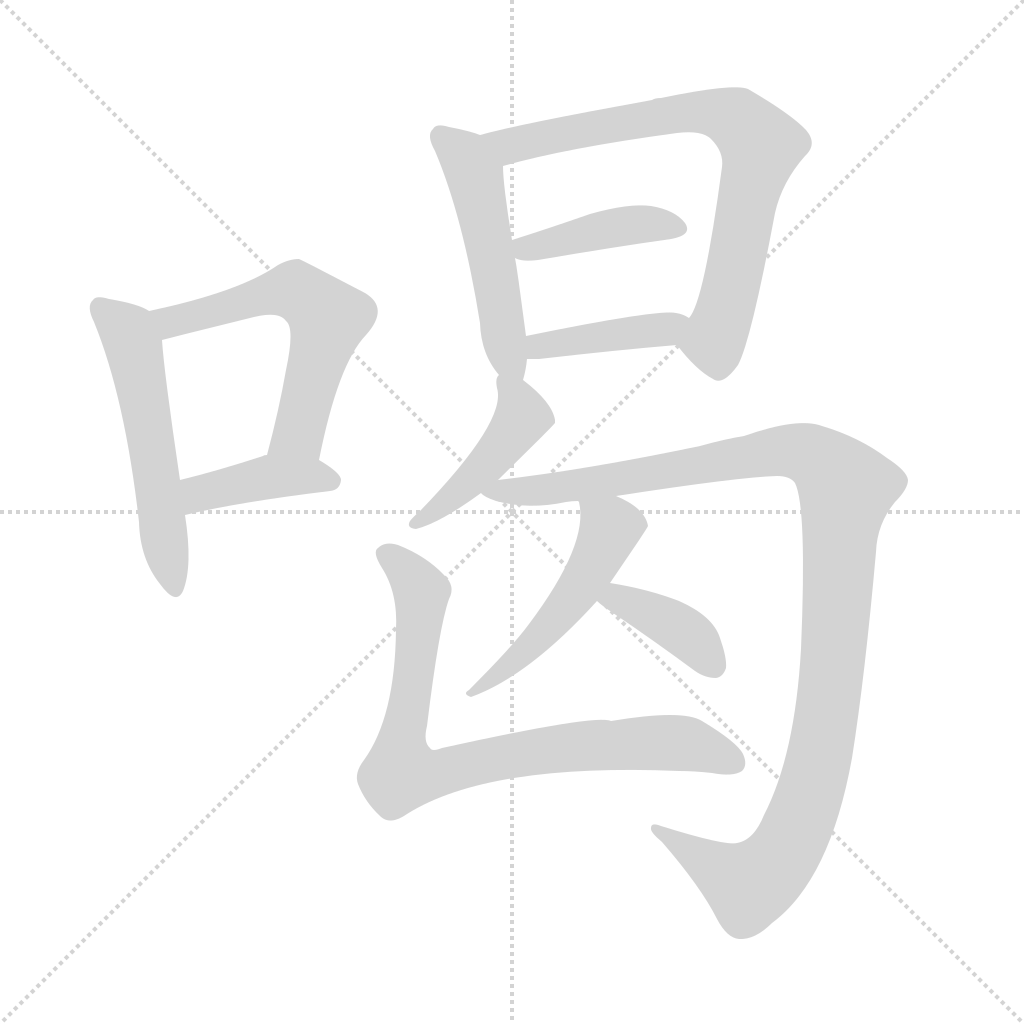
喝
Kangxi stroke count: 12
Page 199, Entry 11
Tang Rhymes (Tangyun): Pronounced ye (falling tone)
Collected Rhymes (Jiyun): Pronounced ye (falling tone)
Combined, pronounced ye (rising tone).
Explaining Graphs (Shuowen): Also means to choke.
Book of the Later Han (Hou Hanshu), Biography of Dou Xian: Xian was secretly choked and could not respond.
Commentary: Secretly choked, similar to being obstructed or blocked. Secretly, pronounced jin (rising tone). Choked, pronounced jie (rising tone).
Again, Book of the Later Han (Hou Hanshu), Biography of Zhang Pu: Struck by an arrow piercing the throat, the voice flowed out in a choked manner.
Commentary: Choked, pronounced jie (rising tone). Extensive Cang (Guangcang) says: The voice is faint and subtle.
Zhang Zhengjian, Autumn Cicada Choking on Willow Poem: The long poplar trees flow with choked sounds until the end.
Again, Jade Chapters (Yupian): The sound of hoarseness.
Wang Chong, Balanced Discourses (Lunheng): When an infant is born, those with loud and high-pitched cries are long-lived, while those with hoarse and weak cries die young.
Again, Extensive Rhymes (Guangyun): Pronounced ai (falling tone)
Collected Rhymes (Jiyun): Pronounced ai (falling tone)
Orthodox Rhymes (Zhengyun): Pronounced ai (falling tone)
Rhyme Assembly (Yunhui): Pronounced ai (falling tone)
Combined, pronounced ai (falling tone).
Extensive Rhymes (Guangyun): The sound of hoarseness.
Again, Collected Rhymes (Jiyun): The sound of sobbing or choking.
Sima Xiangru, Rhapsody of Master Void (Zixu Fu): The boatman's singing voice was fluid yet carried a hint of a sob.
Commentary: Xu Guang says: Choked, pronounced mai (falling tone).
Again, Collected Rhymes (Jiyun): Pronounced ke (entering tone)
Rhyme Assembly (Yunhui): Pronounced ke (entering tone)
Combined, pronounced ke (entering tone).
Collected Rhymes (Jiyun): Similar to the sound of knocking.
Again, Extensive Rhymes (Guangyun), Collected Rhymes (Jiyun), Rhyme Assembly (Yunhui), Orthodox Rhymes (Zhengyun): Pronounced he (entering tone)
Extensive Rhymes (Guangyun): Originally written as a character meaning to scold or berate.
Strategies of the Warring States (Zhan Guo Ce): To make a false show of strength to intimidate others.
Also: The masters of diplomacy (zonghengjia) day and night used the power of the Qin state to intimidate the feudal lords in order to demand the cession of territory.
Collected Rhymes (Jiyun): Also written as another variant.
Again, Collected Rhymes (Jiyun): Pronounced he (entering tone)
The meaning of shouting out.
Another interpretation refers to a throat rattle, a sound of anger.