Hai Collection, Lower Volume
Radical: Bird (niǎo)
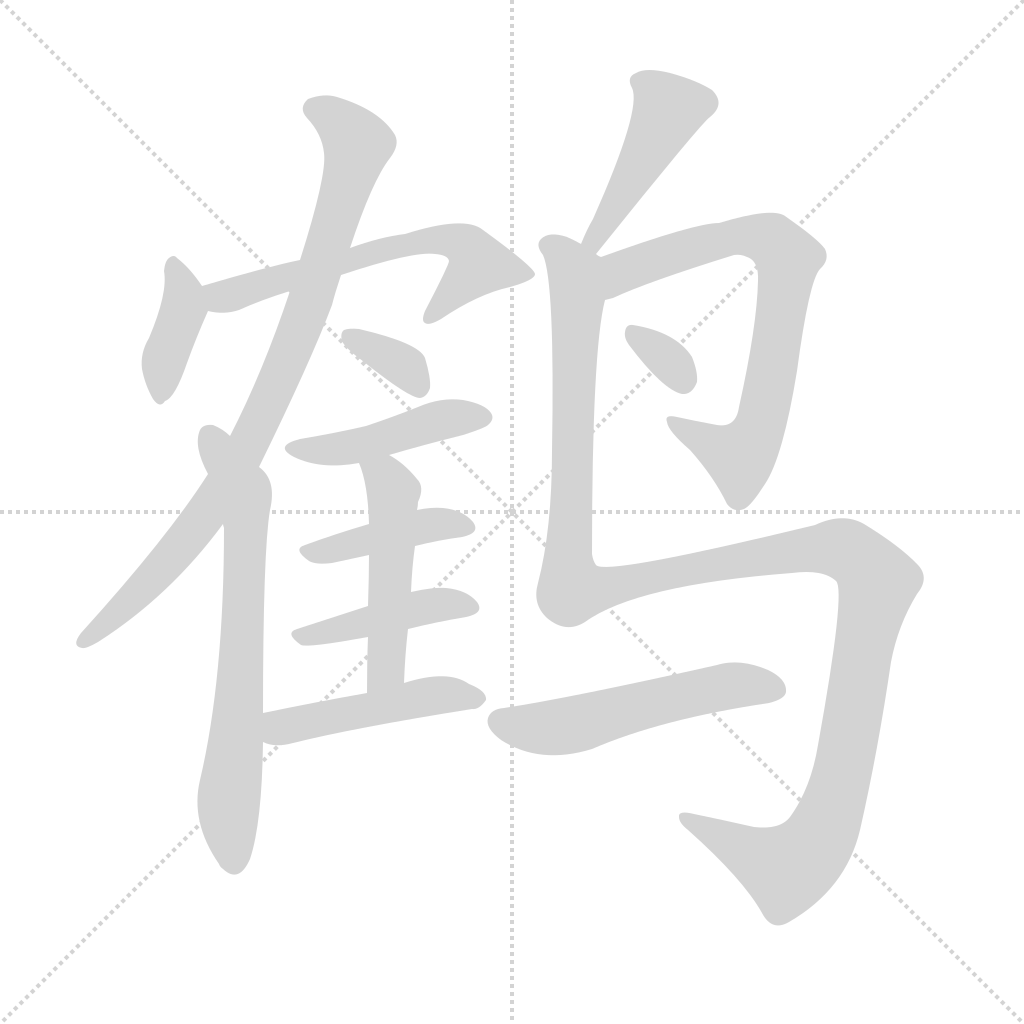
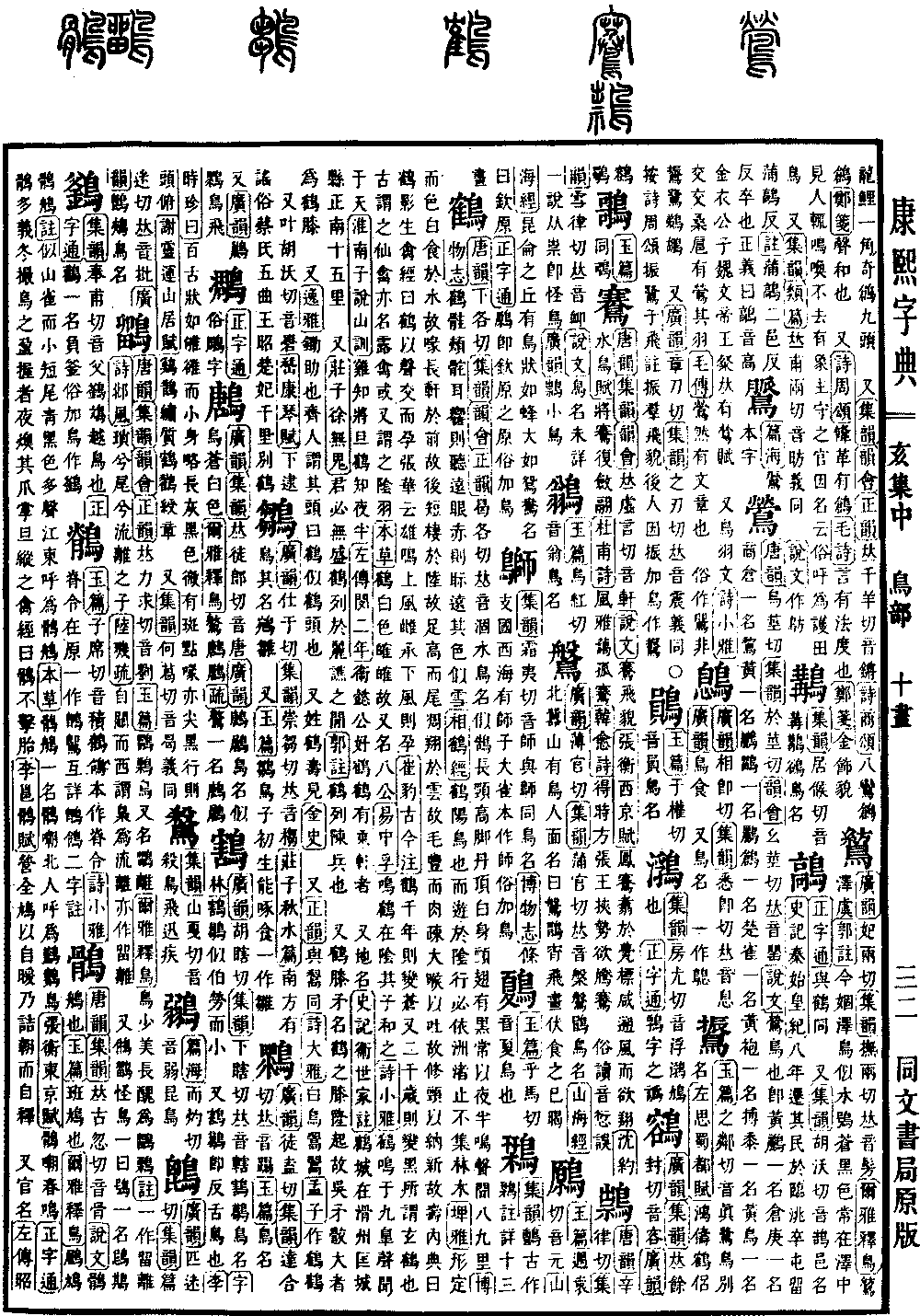
He
Kangxi Stroke Count: 21
Page 1496, Entry 01
Pronounced he
A type of water bird. It resembles a swan, with a long neck and high legs; the top of the head is red and the body is white, with black on the neck and wings. It often cries at midnight, and its sound can travel eight or nine li away.
Treatise on Curiosities (Bowuzhi): The crane has sensitive cheeks and ears, which is why it hears from afar, and its eyes are red, which is why it sees from afar. Its color is as white as snow.
Scripture on the Physiognomy of Cranes (Xianghejing): The crane is a bird of the yang essence, yet it dwells in yin environments. When flying, it invariably stays near sandbars in the water, and when resting, it does not gather in forests.
Encyclopedia of Animals and Plants (Piya): Its body is stable and its color is pure white. It forages at the water's edge, which is why its beak is long. Its front part is held high, which is why its rear is short. It dwells on dry land, which is why its legs are long and its tail is sparse. It flies among the clouds, which is why its feathers are dense and its muscles are lean. Its throat is broad to expel the old, and its neck is long to inhale the new, which is why it is long-lived. Buddhist scriptures state: The shadow of a crane can give birth to a young crane.
Classic of Birds (Qin jing): Cranes conceive through sound. Zhang Hua stated: If the male crane calls from upwind and the female responds from downwind, conception occurs.
Cui Bao, Records of Ancient and Modern Matters (Gujin zhu): If a crane lives one thousand years, it turns gray; if it lives two thousand years, it turns black. This is what is known as the dark crane (xuan he). In ancient times, it was called the celestial bird, also known as the dew bird, and sometimes the yin feathered one.
Materia Medica (Bencao): The crane is white, which is why it is also called the Eight Lords (ba gong).
Book of Changes (Yijing), section Central Sincerity (Zhongfu): The crane calls in the shade, and its young respond.
Book of Odes (Shijing), Lesser Odes (Xiaoya): The crane calls in the deep marsh, and its sound reaches the heavens.
Huainanzi, Discourses on Mountains (Shuoshun): The rooster knows when dawn is approaching; the crane knows the midnight hour.
Zuo Tradition (Zuo zhuan), Second Year of Duke Min: Duke Yi of Wei loved cranes, to the extent that cranes rode in the carriages of high officials.
It is also a place name. Records of the Grand Historian (Shiji), Commentary on the House of Wei: Crane City (He cheng) is located fifteen li directly south of Kuangcheng County in Huazhou.
Also, in Zhuangzi, section Xu Wugui: Do not deploy a grand military formation among the gate towers. Guo's commentary states: Crane formation (he lie) refers to the arrangement of troops.
There is also the crane knee (he xi), which is the name of a type of spear. The joints of the spear are prominent, so in the Wu region, large spear shafts are called crane knees.
Also, in Lost Encyclopedia (Yiya): A hoe (chu) serves as an aid. People in the Qi region call its head a crane, because it resembles the head of a crane.
It is also a surname. Heshou appears in History of Jin (Jinshi).
In addition, it is the same as the character (huo). Book of Odes (Shijing), Greater Odes (Daya): White birds that are pure and lustrous. Mencius writes it as (he he).
Also rhyming as huo. Ji Kang, Rhapsody on the Zither (Qinfu): Descending to folk ballads, the five pieces of Cai Yong. The sorrow of Wang Zhaojun and the Consort of Chu, as well as the parting sentiments of the Thousand Mile Parting Crane.