Hai Collection, Lower Volume
Radical: Bird (niǎo)
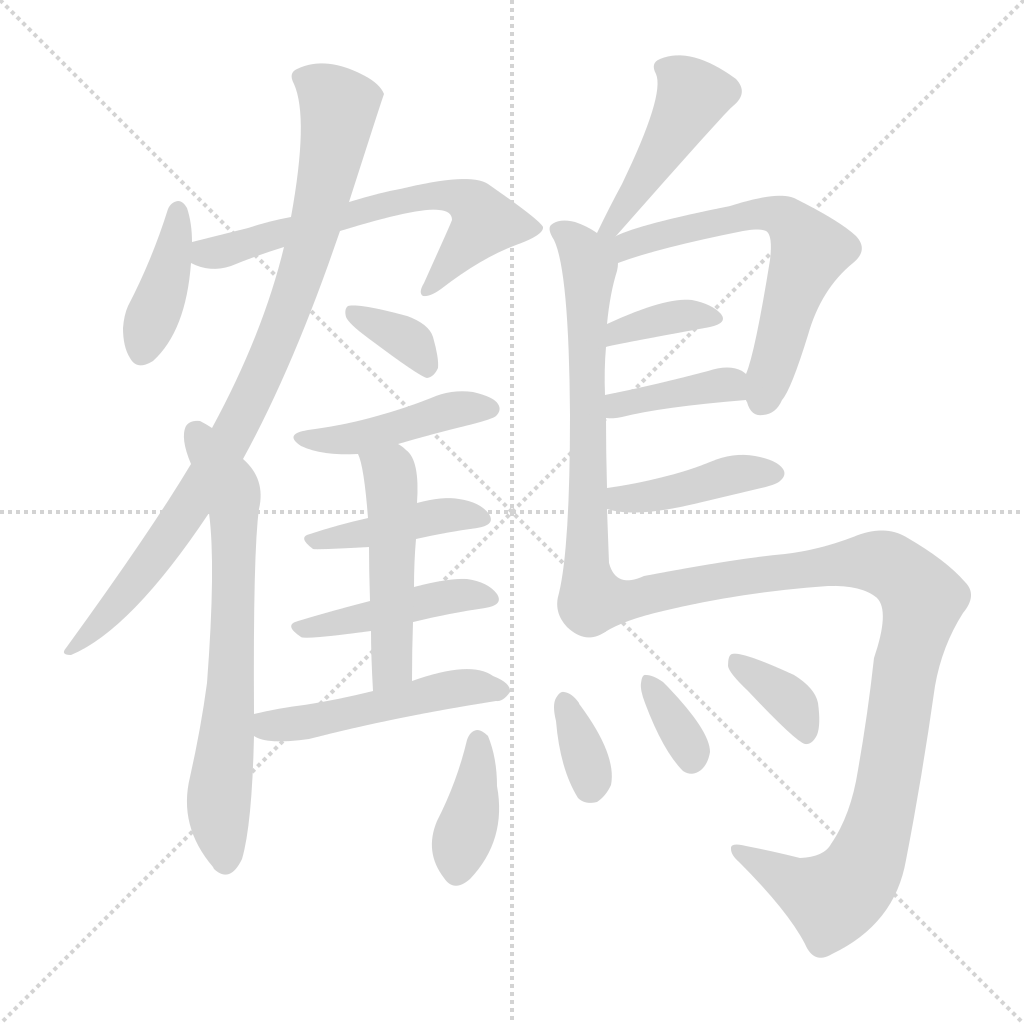
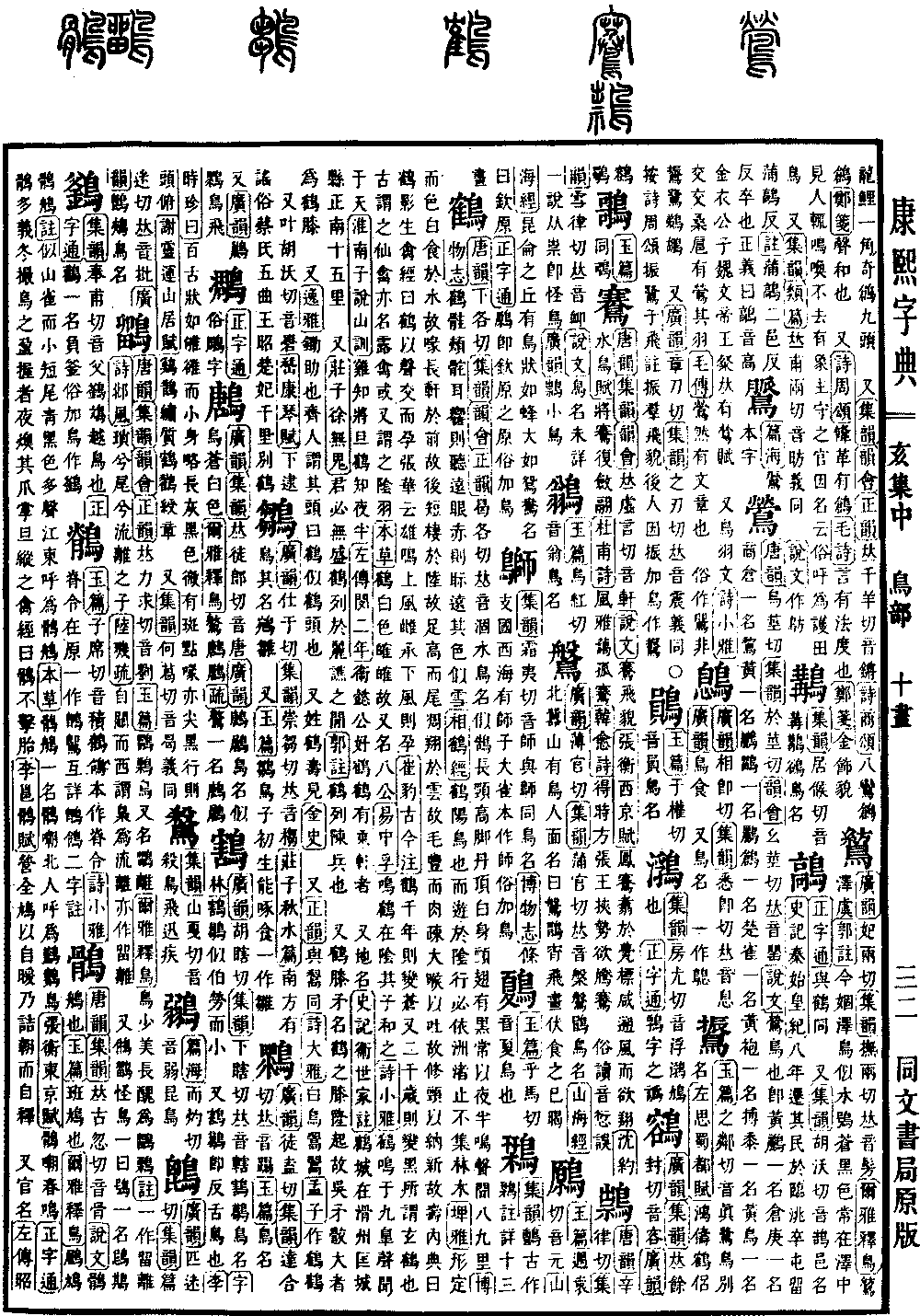
He (鹤)
Kangxi Strokes: 21
Page 1496, Entry 20
Pronounced he. According to the Tang Rhyme (Tangyun), the collection of rhymes (Jiyun), the compilation of rhymes (Yunhui), and the orthographic rhymes (Zhengyun), it is pronounced he, sounding the same as the word for dried up (he). It is the name of a type of water bird. Its appearance resembles a swan, with a long neck and long legs; its head is red, its body is white, and its neck and wings have black markings. It often calls out in the middle of the night, and its voice can carry for eight or nine miles.
Records of Inquiry into Natural Objects (Bowuzhi) states: The cheek area of a crane is sensitive, allowing it to hear from a distance; its eyes are red, allowing it to see from a distance; its feathers are as white as snow.
Classic of Cranes (Xianghejing) states: The crane is a bird belonging to the yang principle, yet it dwells in cool, shady places. When flying, it must follow sandbars in the water; when resting, it does not gather in forests.
Amplified Records (Piya) states: Its body is stable and its feathers are pure white; it forages at the water's edge, hence its beak is long. Its front part is held high, hence its back appears short. It dwells on land, hence its legs are high and its tail is sparse. It flies among the clouds, hence its feathers are full and its muscles are loose. Its throat is thick to expel stale breath, and its neck is long to inhale fresh breath, which is why it lives a long time.
Buddhist scriptures state: The shadow of a crane can produce a small crane. Classic of Birds (Qin jing) states: Cranes conceive through sound. Zhang Hua states: When a male crane calls from upwind, the female crane receives it downwind, and she becomes pregnant.
Cui Bao’s Records of Past and Present (Gujin Zhu) states: When a crane lives for one thousand years, it turns gray; after living for another two thousand years, it turns black; this is what is known as a dark crane (xuan he). In antiquity, it was called the immortal bird (xian qin), also known as the dew bird (lu qin), and sometimes called dark plumage (yinyu).
Materia Medica (Bencao) states: The crane is white, which is why it is also called the eight lords (ba gong).
Book of Changes (Yijing), Zhongfu hexagram, states: The crane calls in the shade, and its young respond to it.
Book of Odes (Shijing), Minor Odes (Xiaoya), states: The crane calls in the deep marshes, its voice reaching the heavens.
Huainanzi, Discourse on Mountains (Shuoshanzhun), states: The rooster knows when dawn is approaching; the crane knows the middle of the night.
Zuo Commentary (Zuozhuan), second year of Duke Min, states: Duke Yi of Wei was fond of cranes; the cranes he raised were allowed to ride in the carriages of senior officials.
It is also a place name. Records of the Grand Historian (Shiji), Commentary on the House of Wei, states: Crane City (Hecheng) is located fifteen miles directly south of Kuangcheng County in Huazhou.
Also, Zhuangzi, Xu Wugui, states: You must never array a grand army between magnificent city towers. Guo’s commentary states: "Crane array" (he lie) refers to the arrangement of an army.
Also, "crane knee" (hexi) is the name of a type of spear. The joints of a crane’s knee are raised, so in the Wu region, the large head of a spear is called a crane knee.
Also, Easy Elegance (Yiya) states: A hoe is an auxiliary tool. People in the Qi region call its head a "crane" because it resembles the head of a crane.
It is also a surname. A person named Heshou is mentioned in the History of Jin (Jinshi).
Also, the Orthographic Rhymes (Zhengyun) state: It is the same as the character for white (huo). Book of Odes (Shijing), Greater Odes (Daya), states: The feathers of the white bird are pure white. Mencius (Mengzi) writes it as he he.
Also, following the rhyme, it is pronounced huo, sounding the same as the word for rock (huo). Ji Kang’s Rhapsody on the Zither (Qinfu) mentions: Descending to folk songs, Cai Yong's Five Pieces of Cai, Wang Zhaojun's Zhaojun’s Resentment, the Concubine of Chu’s Lament of the Concubine of Chu, and the Parting Crane Melody (Biehecao).