You Collection, Middle Volume
Radical: Shell (bèi)
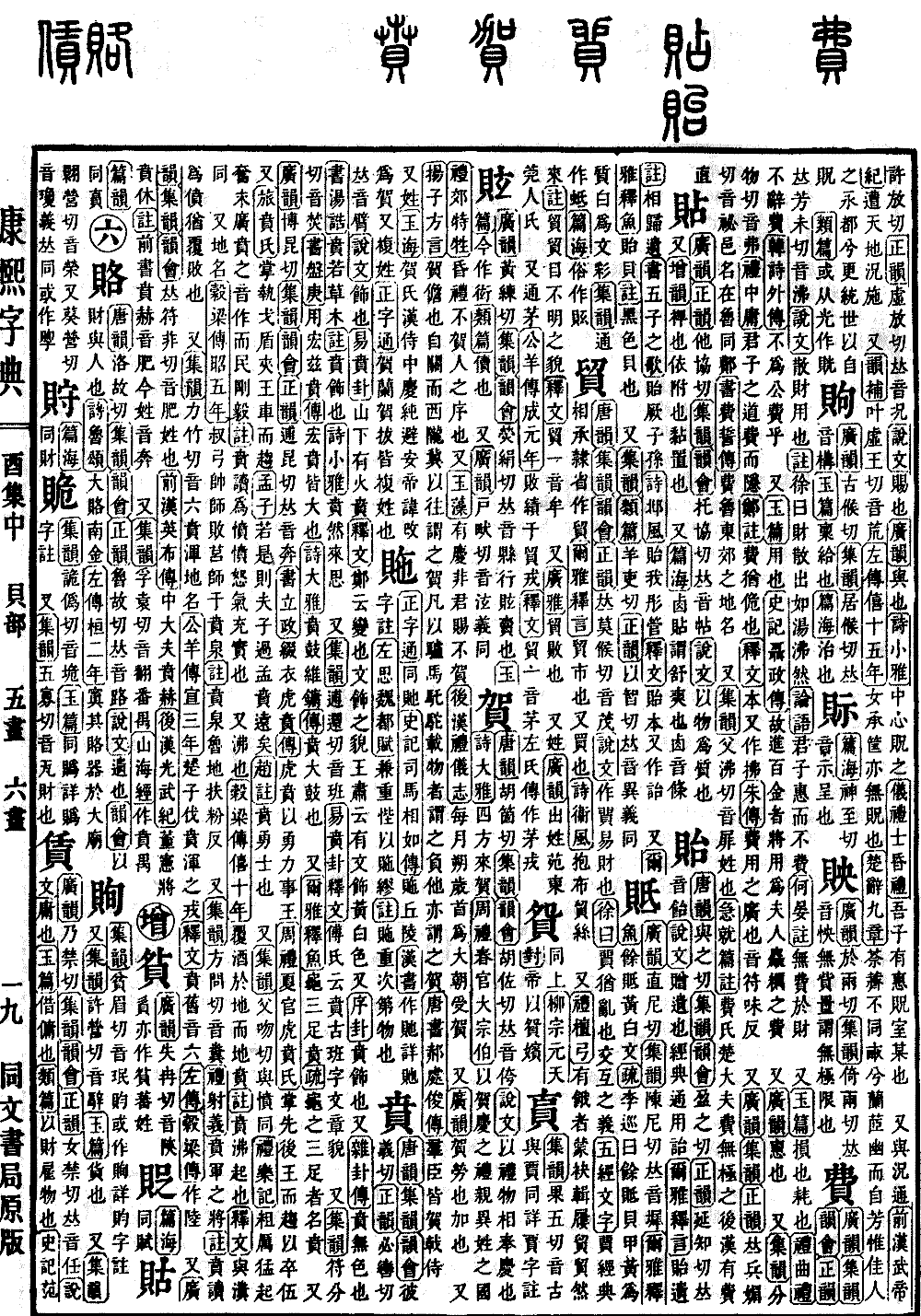
賀
Kangxi stroke count: 12
Page 1207, Entry 12
Tang Rhyme (Tangyun): Pronounced huò (falling tone)
Collected Rhymes (Jiyun) and Rhyme Compendium (Yunhui): Pronounced huò (falling tone)
Explanation in the Analytical Dictionary of Characters (Shuowen): To use gifts to mutually offer congratulations.
Book of Odes (Shijing), Greater Odes (Daya): People from the four quarters all come to offer congratulations.
Rites of Zhou (Zhouli), Spring Officials, Grand Overseer (Da Zongbo): Use the rites of congratulation to draw close the feudal states of different surnames.
Book of Rites (Liji), Suburban Sacrificial Rituals (Jiaotesheng): At weddings, there is no mutual congratulation, for this is the order of human relations.
Also, Book of Rites (Liji), Jade Tablet (Yuzao): If there is a joyous or celebratory event, one does not offer congratulations unless it is a reward bestowed by the ruler.
Book of the Later Han (Hou Hanshu), Records of Rites and Ceremonies: On the first day of every month and at the start of the year, a grand court audience is held to receive congratulations.
Also, Extensive Rhymes (Guangyun): He means to console or to increase.
Also, Yang Xiong (Yangzi), Regional Dialects (Fangyan): He means to carry a burden. From west of Hangu Pass, throughout Longshan and Jizhou, this is called he. Whenever donkeys, horses, or camels are used to carry goods, it is called futuo, which is also referred to as he.
Book of Tang (Tangshu), Biography of Hao Chujun: The assembled officials all held halberds to stand guard and offer congratulations.
Also a surname.
Sea of Jade (Yuhai): The He clan. During the Han dynasty, the attendant Qing Chun changed his surname to He to avoid the taboo of Emperor An's personal name.
Also a double-character surname.
Correct Meaning Thoroughly Comprehended (Zhengzitong): Helan and Heba are both double-character surnames.