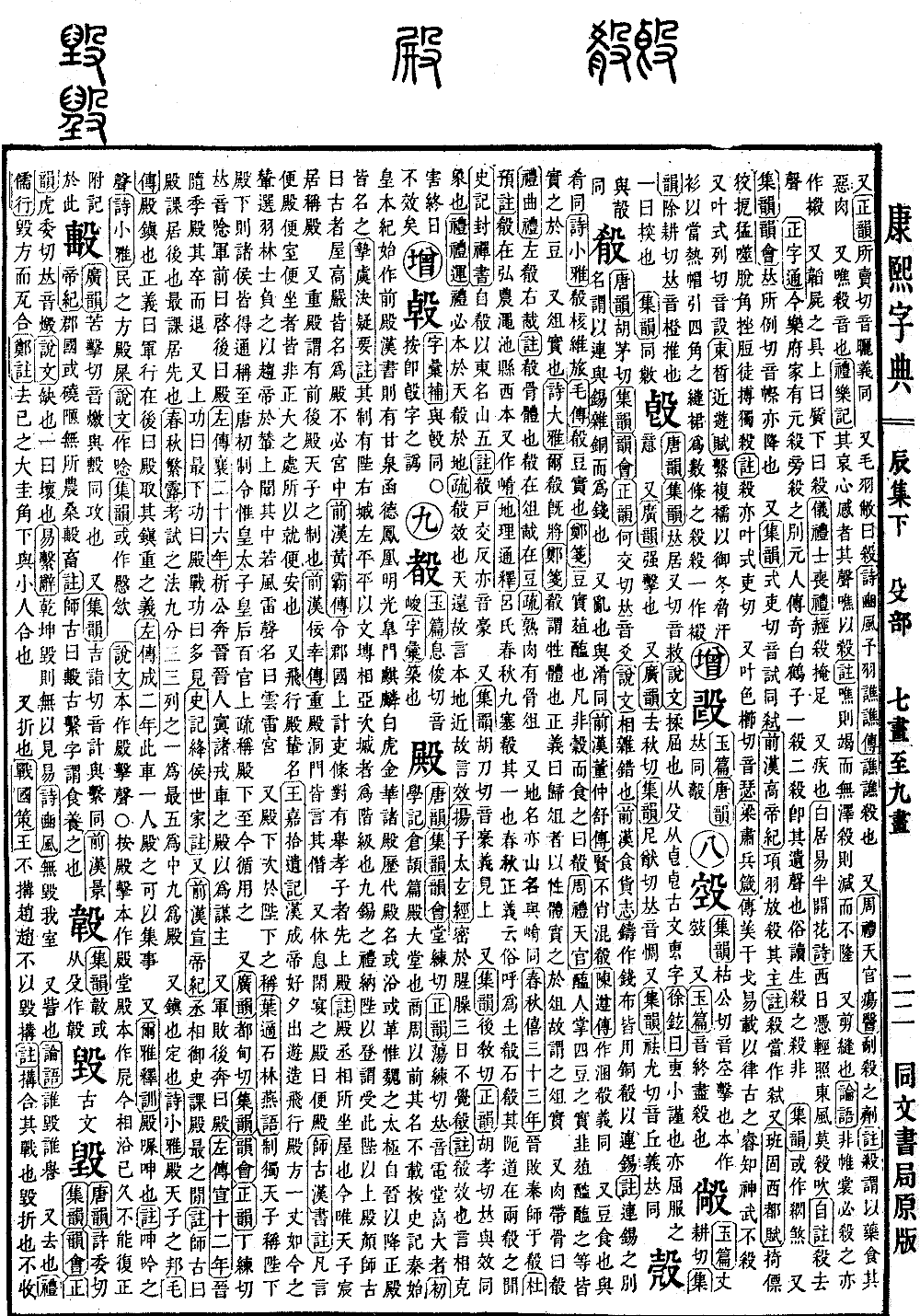
Chen Collection, Lower Volume
Radical: Weapon (shū)
Kangxi Strokes: 13
Page 586, Entry 03
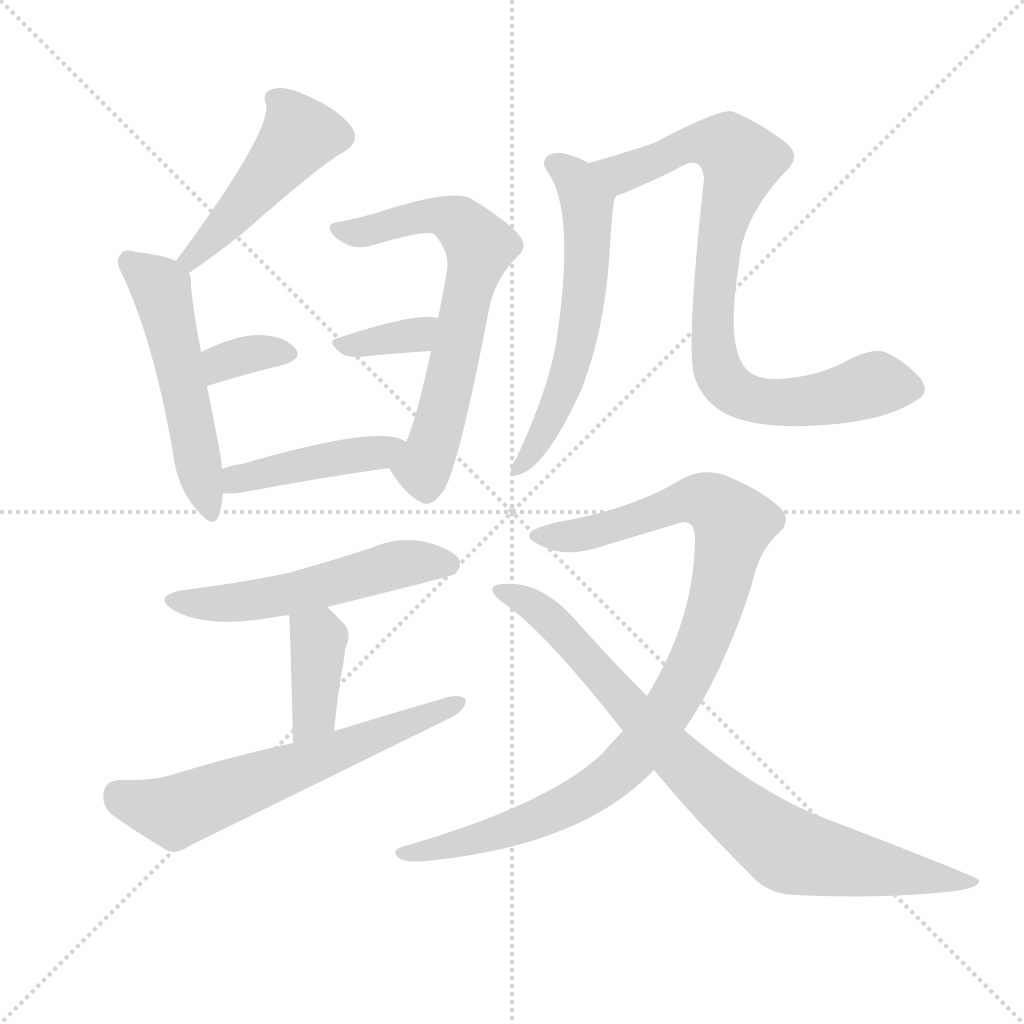
Ancient form. Pronounced hui (rising tone).
According to the Analytical Dictionary of Characters (Shuowen Jiezi), it means to lack. Another definition is to spoil.
Book of Changes (Yijing), Appended Statements: If Heaven and Earth are destroyed, there is no way to manifest the changes.
Book of Odes (Shijing), Odes of Bin (Binfeng): Do not destroy my house.
Also means to slander.
Analects (Lunyu): Who is slandered, and who is praised?
Also means to remove.
Book of Rites (Liji), The Conduct of a Scholar (Ruxing): To remove square corners to fit with curved ones.
Zheng Commentary: To remove one's own great principles and standards, descending to align with small-minded men.
Also means to break.
Strategies of the Warring States (Zhanguo Ce): If the King does not ally with Zhao, Zhao cannot fight with broken troops.
Commentary: Gou means to engage in battle. Hui means to break. If he does not support Zhao, Zhao cannot fight Qin alone with broken, defeated troops.
Also a method for predicting years: Years of metal are abundant, years of water are destroyed, years of wood are famished, years of fire are drought-stricken. See Records of the Grand Historian (Shiji), Biographies of the Money-makers (Huozhi Zhuan).
Also, prayers offered to remove misfortune are called hui.
Rites of Zhou (Zhouli), Earth Offices, Herdsmen: For all external sacrifices, use a variegated dog for hui rituals.
Commentary: This refers to auxiliary sacrifices, rituals to avert calamity, and the removal of disasters.
Also, mourning and emaciation.
Book of Rites (Liji), Summary of the Rites (Quli): Regarding the rites of observing mourning, emaciation should not show the bones.
Correct Meaning: Emaciation refers to being thin and weak; the form refers to bones being exposed. During mourning, one is allowed to be thin, but not to the extent that bones are visible.
Also, at fifty one does not necessarily become emaciated, and at sixty one does not become emaciated.
Classic of Filial Piety (Xiaojing), Chapter on Mourning for Parents: Emaciation must not destroy one's nature.
Also, when a child loses their milk teeth, it is called hui.
White Tiger Hall Discussions (Baihu Tong): Boys lose teeth at eight, girls at seven.
Also pronounced hui (falling tone). The meaning is the same.
Also pronounced hu (falling tone).
Forest of Changes (Yilin): The fraud is exposed, the cooking stove is entirely destroyed. The troops rest and the soldiers depart, arrows arrive like rain.
Also pronounced duo (falling tone).
Yangzi Taixuan: Reducing the illness so it does not become dangerous; the flowing ripples of reduction cause the roots to be destroyed.
Dictionary of Rhymes (Yunhui): Master Mao says: For all instances of "success and failure" (cheng-hui), hui is in the rising tone; examples like Zhuangzi’s "its success and its destruction" belong to this category. In cases of intentional damage or ruin (hui), it is in the falling tone; examples like Mencius’s "destroying his ancestral temple" belong to this category. For slander and praise, hui is in the rising tone and yu is in the falling tone; examples like Mencius’s "unexpected praise and sought-after slander" belong to this category. For cases where one envies a person and slanders them, or flatters a person and praises them, then hui is in the falling tone and yu is in the even tone; examples like the Analects’ "who is slandered, and who is praised" belong to this category. However, in the Analects, the character yu has a recorded pronunciation, while the character hui does not. In the classics, histories, and philosophical texts, the hui of "success and destruction" and the hui of "ruin" both lack specific pronunciation notes. For now, I follow general usage. Scholars and editors must be aware of this.