Chen Collection, Lower Volume
Radical: Weapon (shū)
Kangxi Strokes: 13
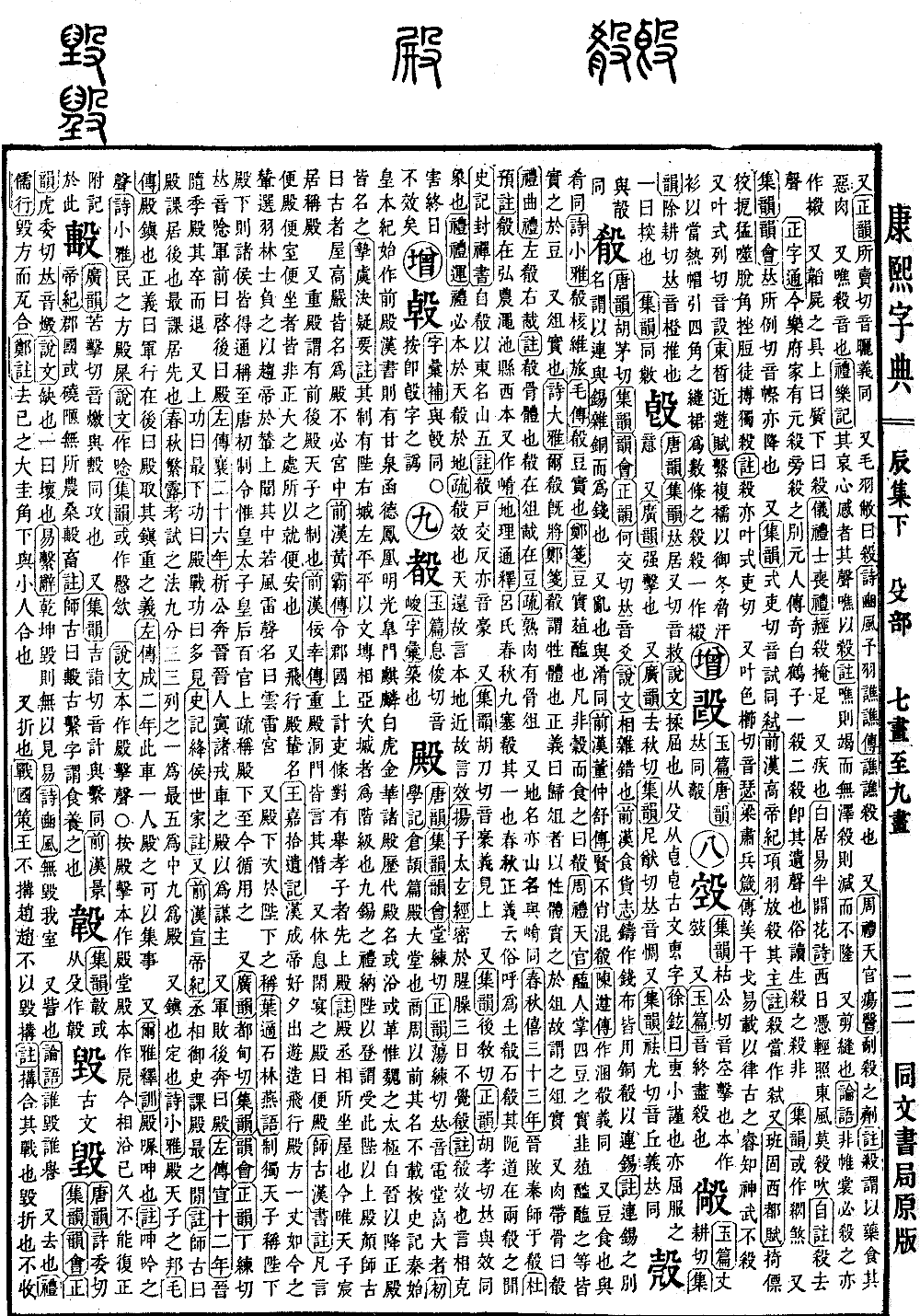
Page 586, Entry 12
Ancient character. Tang Dynasty Rhymes (Tangyun) states: pronounced hui (rising tone). Collected Rhymes (Jiyun), Rhyme Gathering (Yunhui), and Orthodox Rhymes (Zhengyun) state: pronounced hui (rising tone).
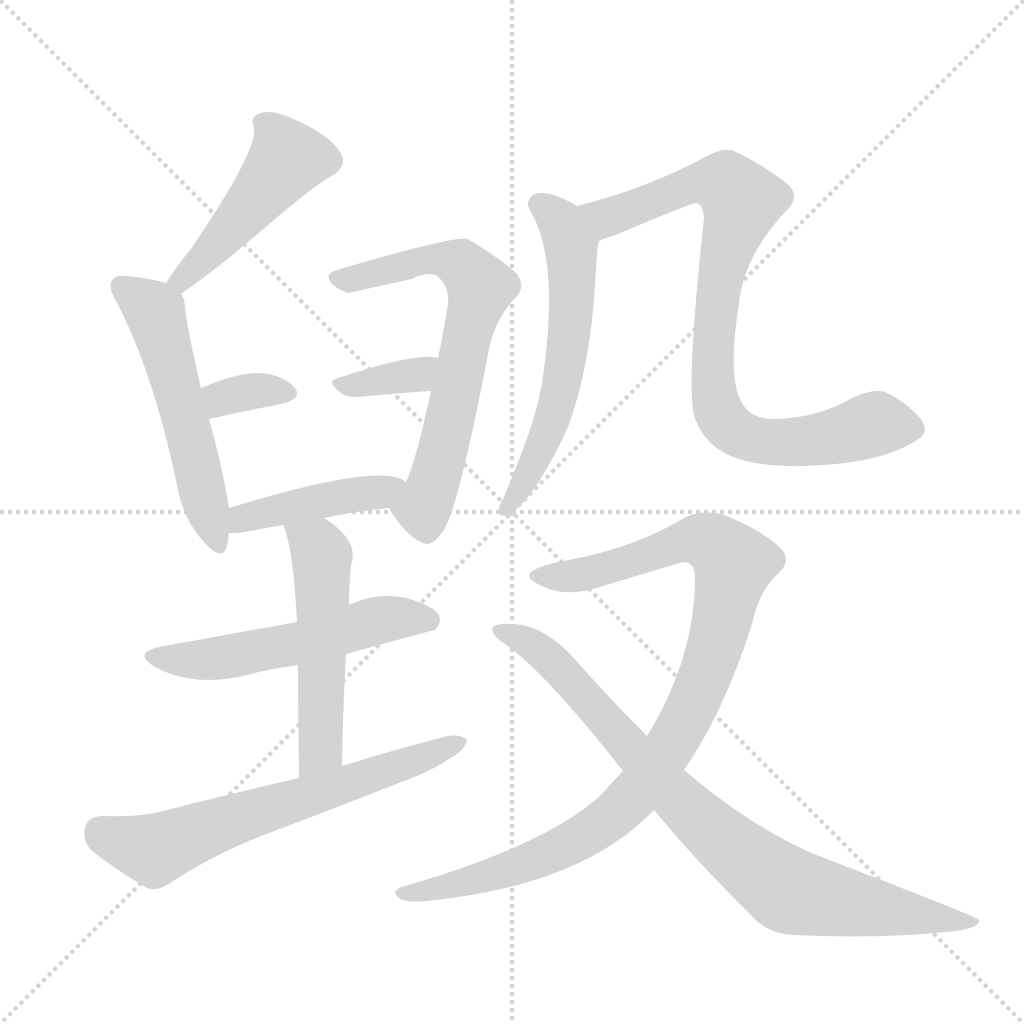
Explaining Writing (Shuowen) states: to lack. Another meaning is to destroy. Book of Changes (Yijing), Commentary on the Appended Phrases states: If heaven and earth are destroyed, then there is no way to manifest the changes. Book of Odes (Shijing), Bin Customs states: Do not destroy my house.
Also, to slander. Analects (Lunyu) states: Whom to slander, whom to praise.
Also, to remove. Book of Rites (Liji), Conduct of the Scholar states: Remove the square corners to join with the tiles. Zheng Commentary states: Remove one's own great principles and sharp edges to fit in with small people.
Also, to break. Strategies of the Warring States (Zhanguoce) states: The king does not unite with Zhao. Zhao does not use broken weapons to unite. Commentary states: Gou means to join in battle. Hui means to break. If one does not include Zhao, Zhao cannot fight Qin alone with broken weapons.
Also, a method for predicting the harvest year: metal represents a harvest, water represents destruction, wood represents famine, and fire represents drought. Seen in Records of the Grand Historian (Shiji), Biographies of the Money Makers.
Also, to pray to remove disasters is called hui. Rites of Zhou (Zhouli), Earth Officials, The Herdsman states: For all external sacrifices and destruction rituals, use the multicolored dog. Commentary states: This refers to auxiliary sacrifices and rituals for removing disasters and calamities.
Also, mourning and emaciation. Book of Rites (Liji), Summary of the Rites states: In the rituals of mourning, do not let emaciation become visible. Correct Meaning states: Hui-ji means to be thin and exhausted; the form refers to the bones showing. In mourning, one is allowed to be thin, but not to the extent that the bones are exposed.
Also, at fifty one does not cause harm to oneself, at sixty one does not cause harm to oneself. Classic of Filial Piety (Xiaojing), Chapter on Mourning Parents states: Do not let mourning destroy one's nature.
Also, when children lose their baby teeth it is called hui. White Tiger Hall Discussions (Baihutong) states: Boys lose teeth at eight, girls lose teeth at seven.
Also, Guangyun, Jiyun, and Yunhui state: pronounced hui (falling tone). The meaning is the same.
Also, rhyming with hu (falling tone). Forest of Changes (Yilin) states: Bin tricks Pangzi, the stove is completely destroyed. Soldiers rest and troops depart, arrows fall like rain.
Also, rhyming with duo (falling tone). Yangzi's Great Mystery (Taixuanjing) states: Reduce the illness so it does not reach a dangerous point; the flowing and rippling reduction causes the roots to be destroyed.
Rhyme Gathering (Yunhui) contains a note by Mr. Mao: For the destruction of success and failure, use the rising tone, as in the Zhuangzi phrase regarding success and destruction. For the destruction that comes from self-ruin or collapsing, use the falling tone, as in the Mencius phrase regarding destroying ancestral temples. For praise and blame regarding reputation, use the rising tone for blame and falling tone for praise, as in the Mencius phrase regarding unexpected praise and requested blame. For slandering someone out of jealousy or praising someone out of flattery, use the falling tone for slander and level tone for praise, as in the Analects phrase regarding whom to slander and whom to praise. However, in the Analects, the character for praise has a pronunciation, while the character for slander does not. In the classics, histories, and masters, the character for destruction in success and failure and the character for destruction in collapse generally do not have distinct pronunciations. We follow general usage. Scholars and proofreaders must not fail to understand this.