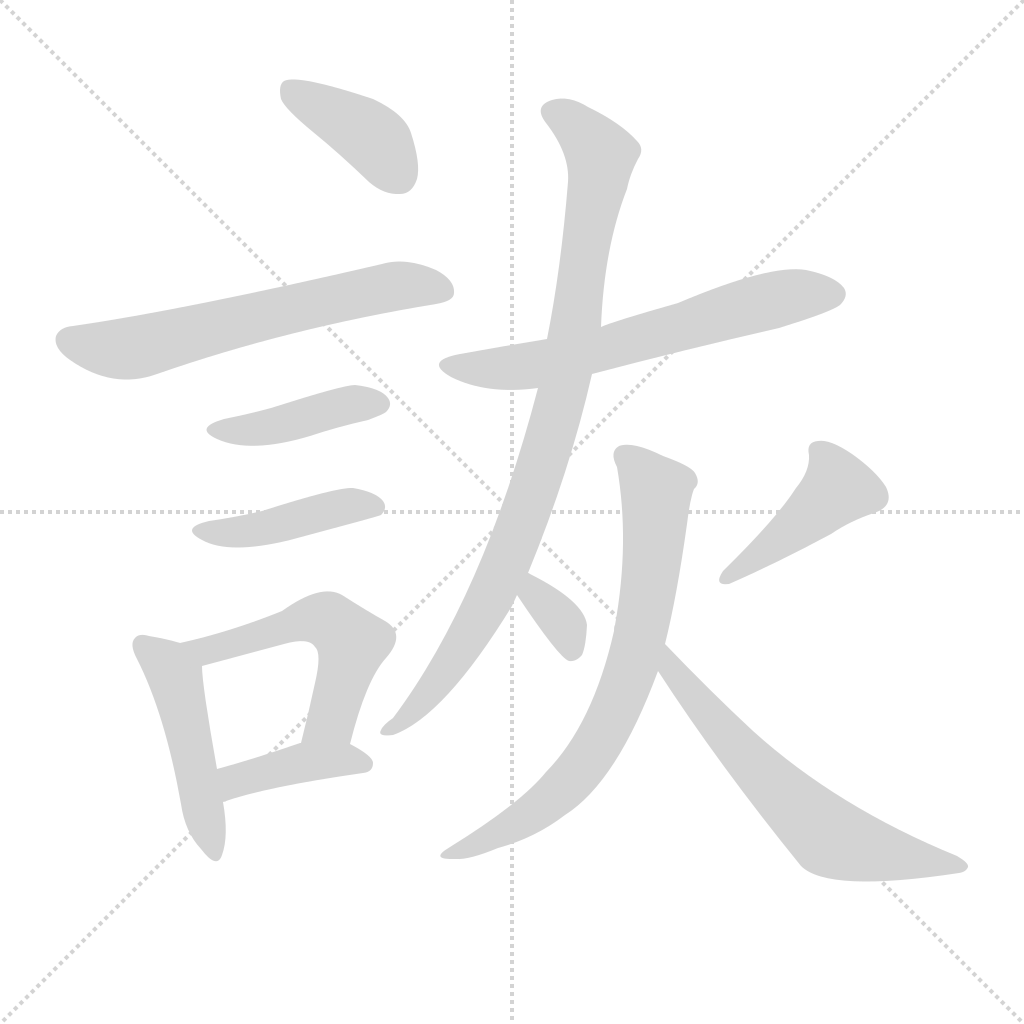
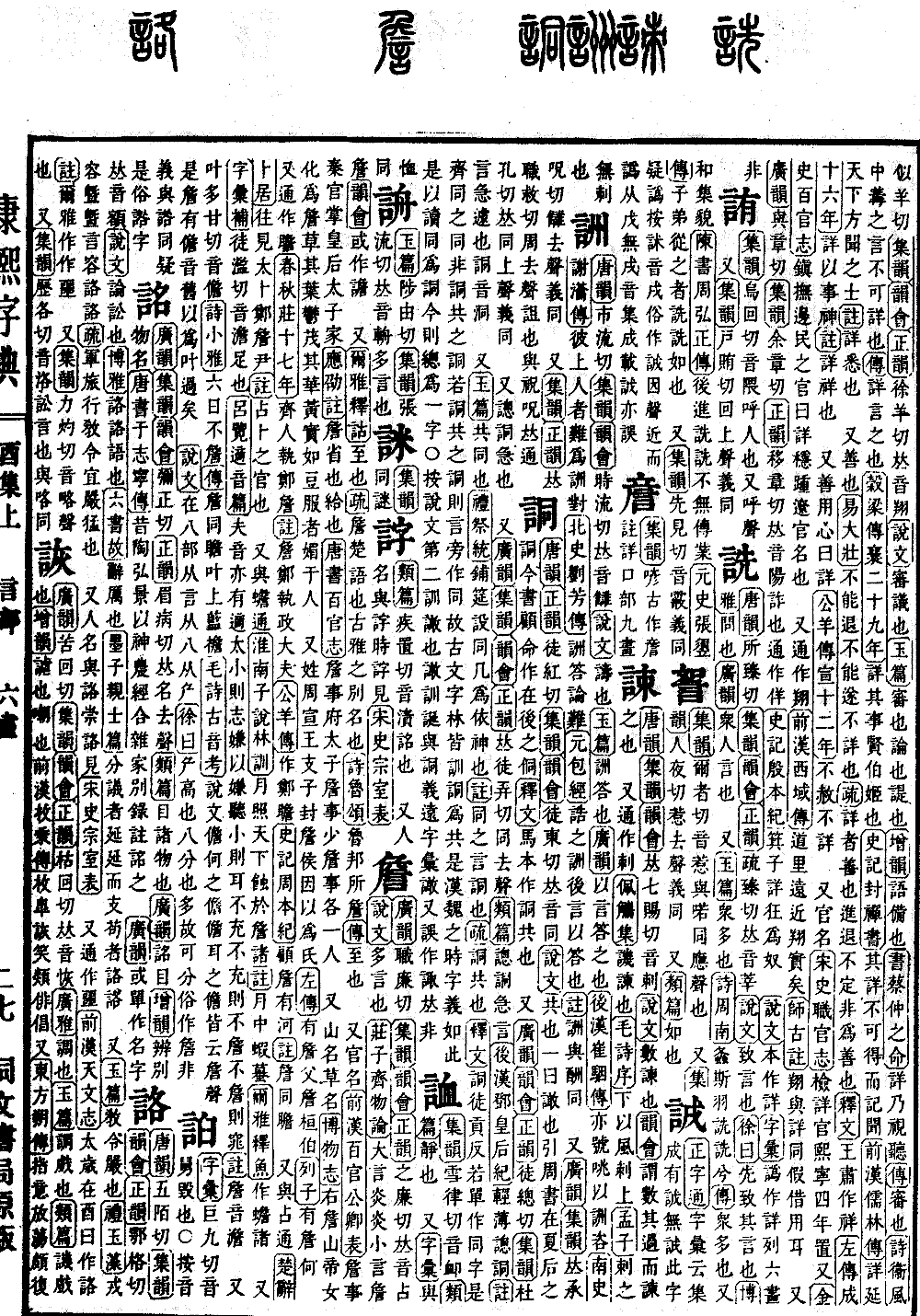
You Collection, Upper Volume
Radical: Speech (yán)
13 strokes
Page 1159, Entry 17
Pronounced hui.
According to the Extensive Dictionary of Sounds and Meanings (Guangyun), the Collection of Sounds and Rhymes (Jiyun), the Rhyme Collection (Yunhui), and the Correct Rhymes (Zhengyun), it is pronounced hui.
According to the Broad Museum of Antiquities (Guangya), it means to tease.
According to the Jade Chapters (Yupian), it means to play or joke.
According to the Categorized Chapters (Leipian), it means to ridicule or joke.
According to the Augmented Rhymes (Zengyun), it means to play or mock.
In the Biography of Mei Cheng in the History of the Former Han (Qianhan Shu), it is stated: Mei Gao used witty humor much like a jester.
In the Biography of Dongfang Shuo, it is stated: His intent was unrestrained, often engaging in witty humor.
In the Biography of Ma Zhong in the Records of Shu (Shu Zhi), it is stated: He joked and laughed heartily, never showing his anger on his face.
It is also commonly written in the variant form kui (kuī). In the Eastern Capital Rhapsody (Dongjing Fu) by Zhang Heng, it is stated: You Yu, as a lone minister from the Western Rong, mocked Duke Mu within the palace. The commentary notes that kui means the same as to mock, and is the same as hui.