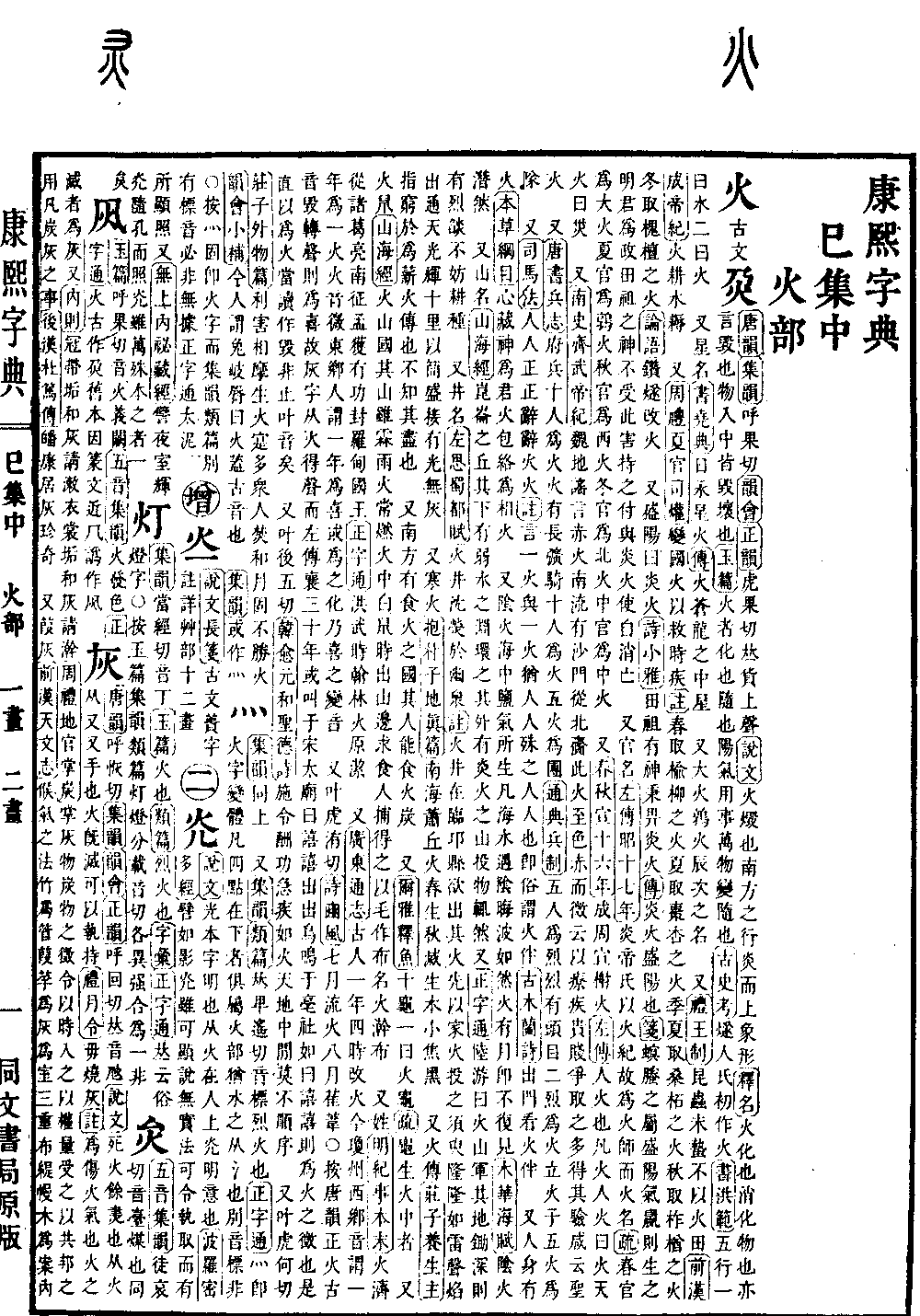
Si Collection, Middle Volume
Radical: Fire (huǒ)
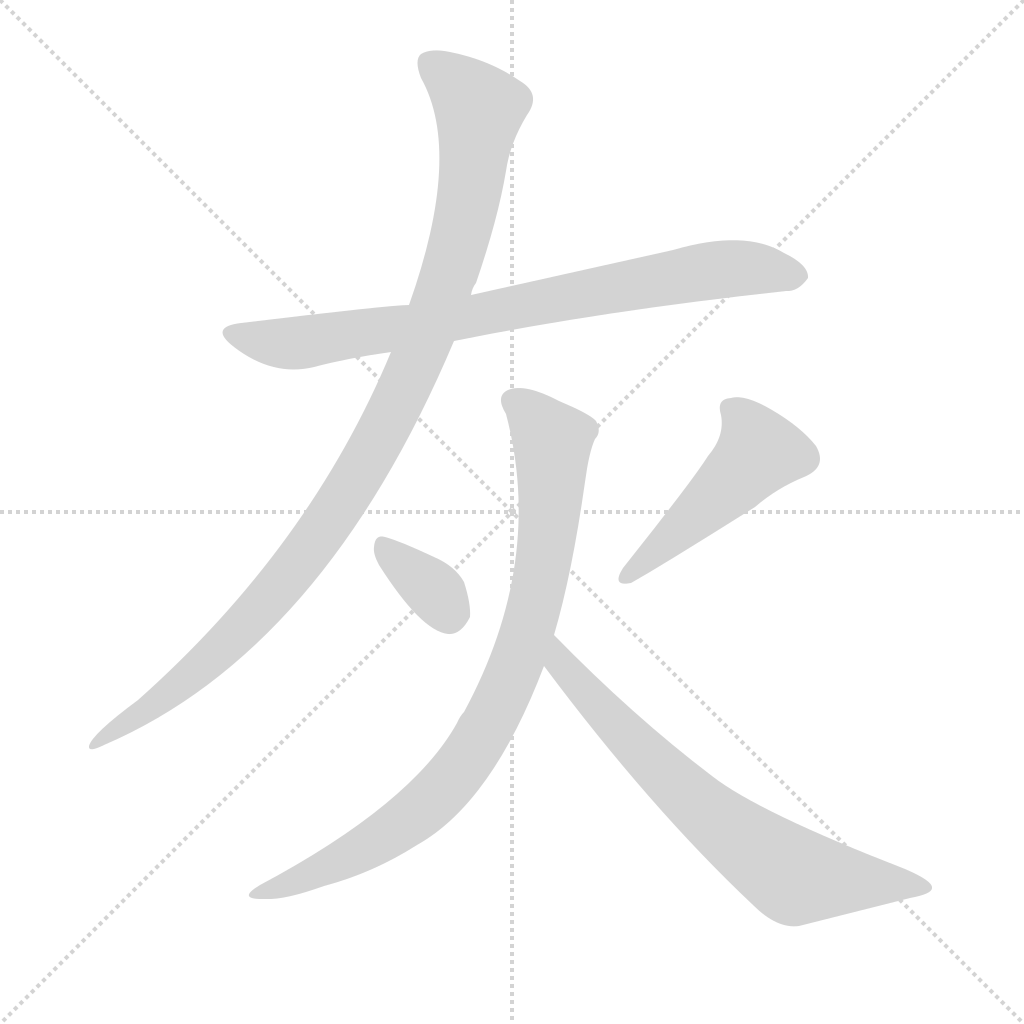
灰
Kangxi strokes: 6
Page 665, Entry 09
Pronounced hui.
Shuowen Jiezi (Shuowen): The remaining embers of a dead fire. Composed of fire and hand. The hand indicates it can be picked up. Once the fire is extinguished, it can be grasped.
Book of Rites (Liji), Monthly Ordinances (Yueling): Do not burn ashes. Annotation: This is to avoid damaging the fire spirit. What remains after a fire is extinguished is called ash.
Also, Inner Teachings (Neize): When headbands or belts are dirty, use ash and water to clean them. When garments are dirty, use ash and water to wash them.
Rites of Zhou (Zhouli), Earth Offices (Diguan): Managing the collection orders for ash and charcoal, receiving them on time, using scales and measuring tools to collect them for state use. This covers all matters regarding charcoal and ash.
Book of the Later Han (Hou Hanshu), Biography of Du Du: Causing the ashes and treasures of Kangju to become abundant.
Also refers to reed ash. Book of the Former Han (Qian Hanshu), Treatise on Astronomy: The method for observing qi (vital breath) involves using bamboo to make tubes filled with the inner membrane of reeds burned into ash. Construct a triple-layered room, hang orange-red curtains, and use wooden platforms that are lower on the inside and higher on the outside. Place the pitch pipes on these. When the solar term arrives, the ash will scatter.
Also refers to kalpa ash. Biographies of Eminent Monks (Gaoseng Zhuan): When Emperor Wu of Han excavated Kunming Pond, he found black ash. He asked Dongfang Shuo, who replied: You may ask the monks from the Western Regions. Later, when Zhu Falan arrived, he was asked, and he said: This is ash remaining from the fire that destroys the world at the end of a kalpa.
Also refers to natural ash. Miscellaneous Morsels from Youyang (Youyang Zazu): Whenever carving glazed glass, one must first boil it in natural ash to soften it. Zangqi says: The ash is produced in the South Sea, looks like yellow earth, and can wash clothes. If jade or stone is covered with this ash, it will rot until it becomes like mud.
Also refers to non-ash wood. Record of the World Extensively Surveyed (Taiping Huanyuji): Commonly called tingzi, when burned it becomes charcoal but does not turn into ash.
Also rhymes with hou. Yang Fang, Hehuan Poem: While living we are things joined as one, in death we are ash in the same coffin. The Qin family member spoke to the extreme; my feelings cannot compare.
Also rhymes with hu. Chen Lin, Rhapsody on the Willow (Liu Fu): There is a lonely little willow tree, standing tall and distinct all on its own, placed beside the stove with withered wood, about to be buried in earth and ash.
Shuowen Jiezi states the original character was written as the radical for fire combined with the character for hand.