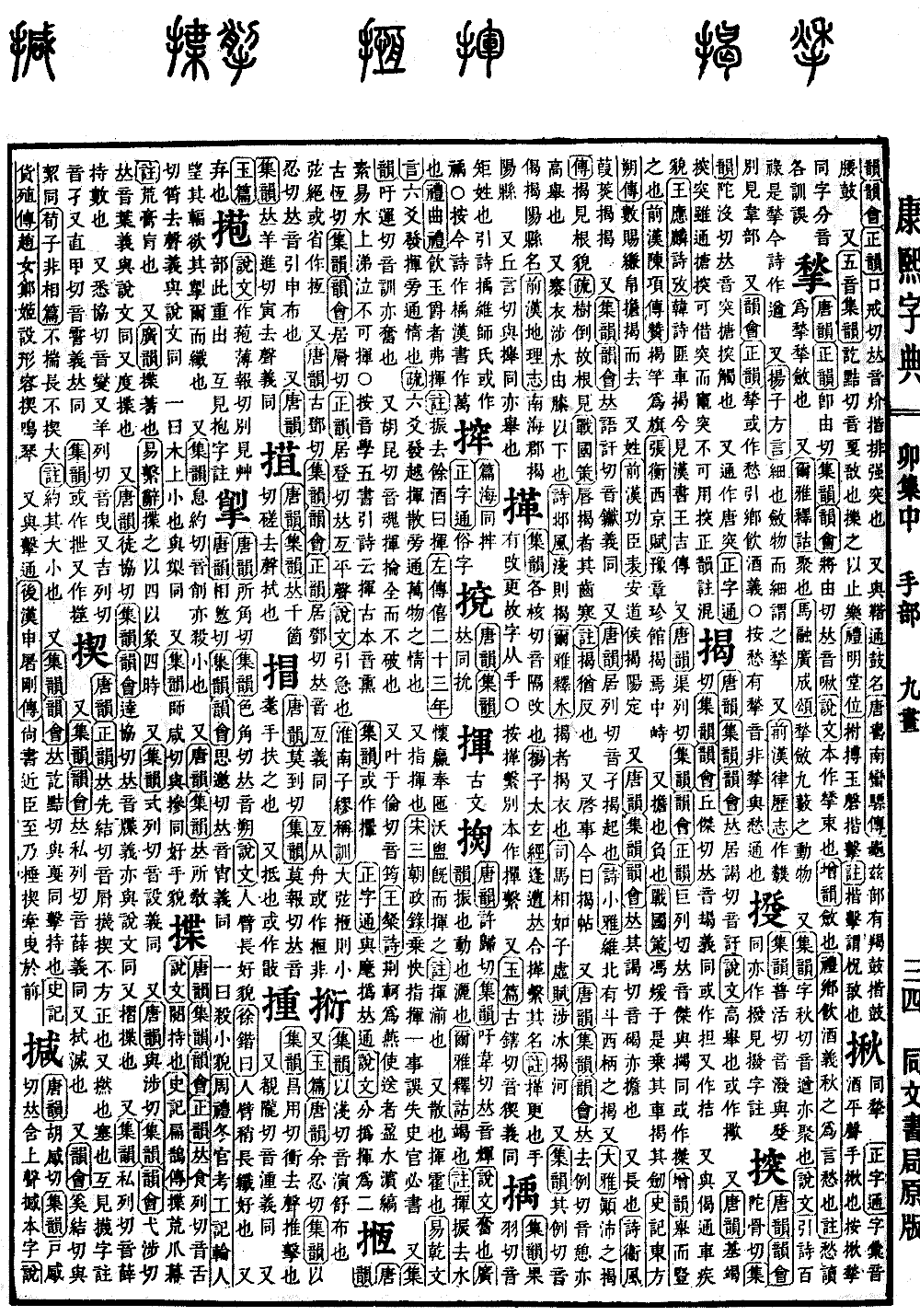
Mao Collection, Middle Volume
Radical: Hand (shǒu)
Kangxi stroke count: 13
Page 444, Entry 10
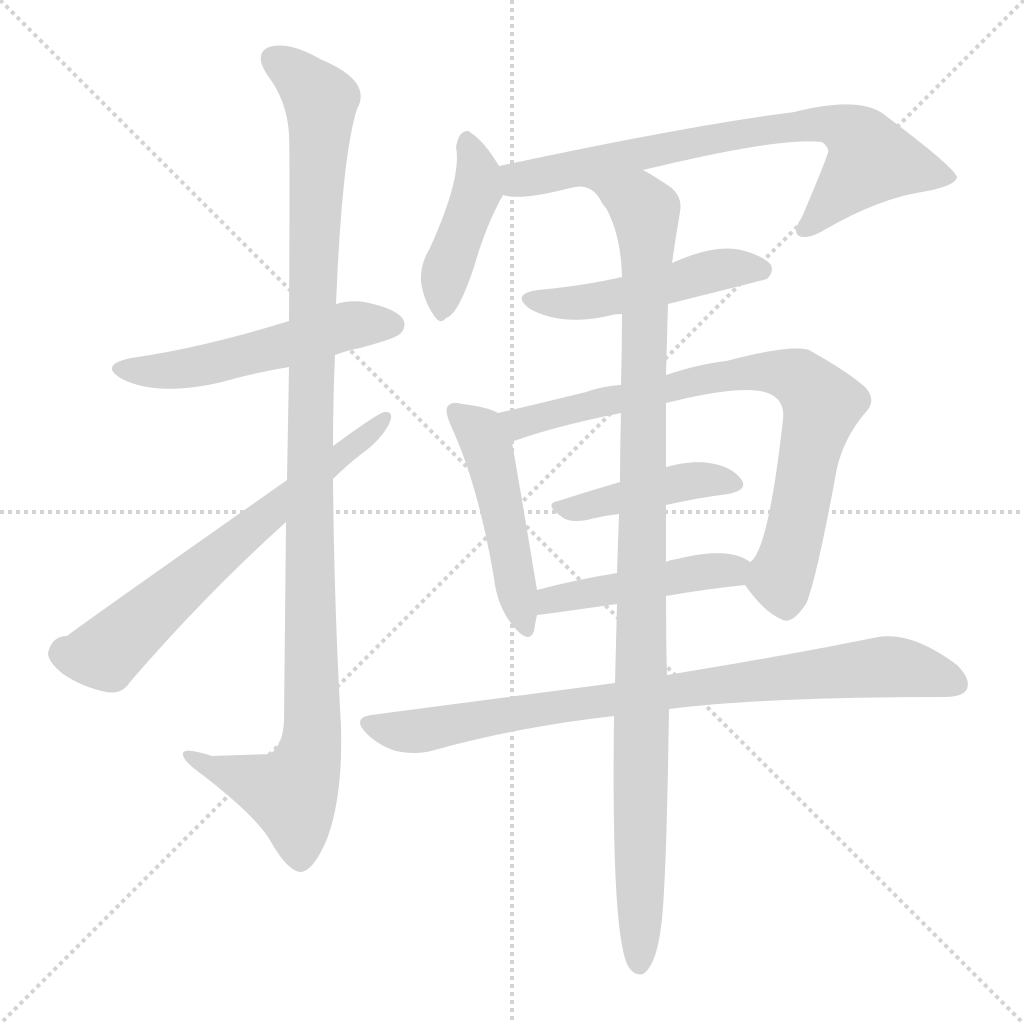
Pronounced hui.
Explanatory dictionary (Shuowen Jiezi): To rouse or to lift.
Broad Rhymes (Guangyun): To vibrate, to shake, or to sprinkle.
Approaching Elegance (Erya), Explanation of Ancient Words: To exhaust. Commentary: To shake off, referring to the removal of moisture.
Book of Rites (Liji), Songs of Propriety (Quli): One who uses a jade cup to drink wine should not wave the cup. Commentary: Shaking a cup to discard remaining liquid is called hui.
Zuo Tradition (Zuo Zhuan), Year 23 of Duke Xi: Huaiying held the basin to assist with washing; after finishing, she waved her hand to signal. Commentary: Hui refers to sprinkling.
Also carries the meaning of dispersing or squandering.
Book of Changes (Yijing), Qian Hexagram, Commentary on the Words: The six lines disperse and reveal, broadly penetrating the principles of all things. Subcommentary: The six lines radiate and scatter, broadly penetrating the state of all things.
Also refers to commanding. Records of the Three Reigns of the Song Dynasty: If one commands and handles a matter incorrectly out of temporary gratification, the historians will surely record it.
Pronounced xun. Also means to rouse.
Pronounced hun. Hui-lun refers to being complete and undamaged.
Pronounced yun. Poem by Wang Can: Jing Ke went on a mission for the State of Yan, and those who saw him off crowded the water's edge. Wearing white at the Yi River, tears could not be wiped away. According to the Five Books of Phonology (Yinxue Wushu), citing the Book of Odes (Shijing): The ancient pronunciation of hui was originally read as xun.
Collected Rhymes (Jiyun): Sometimes written in a variant form.
General Clarification of Characters (Zhengzitong): Interchangeable with hui and hui.
Explanatory dictionary (Shuowen Jiezi): Differentiates hui and hui as two separate characters.