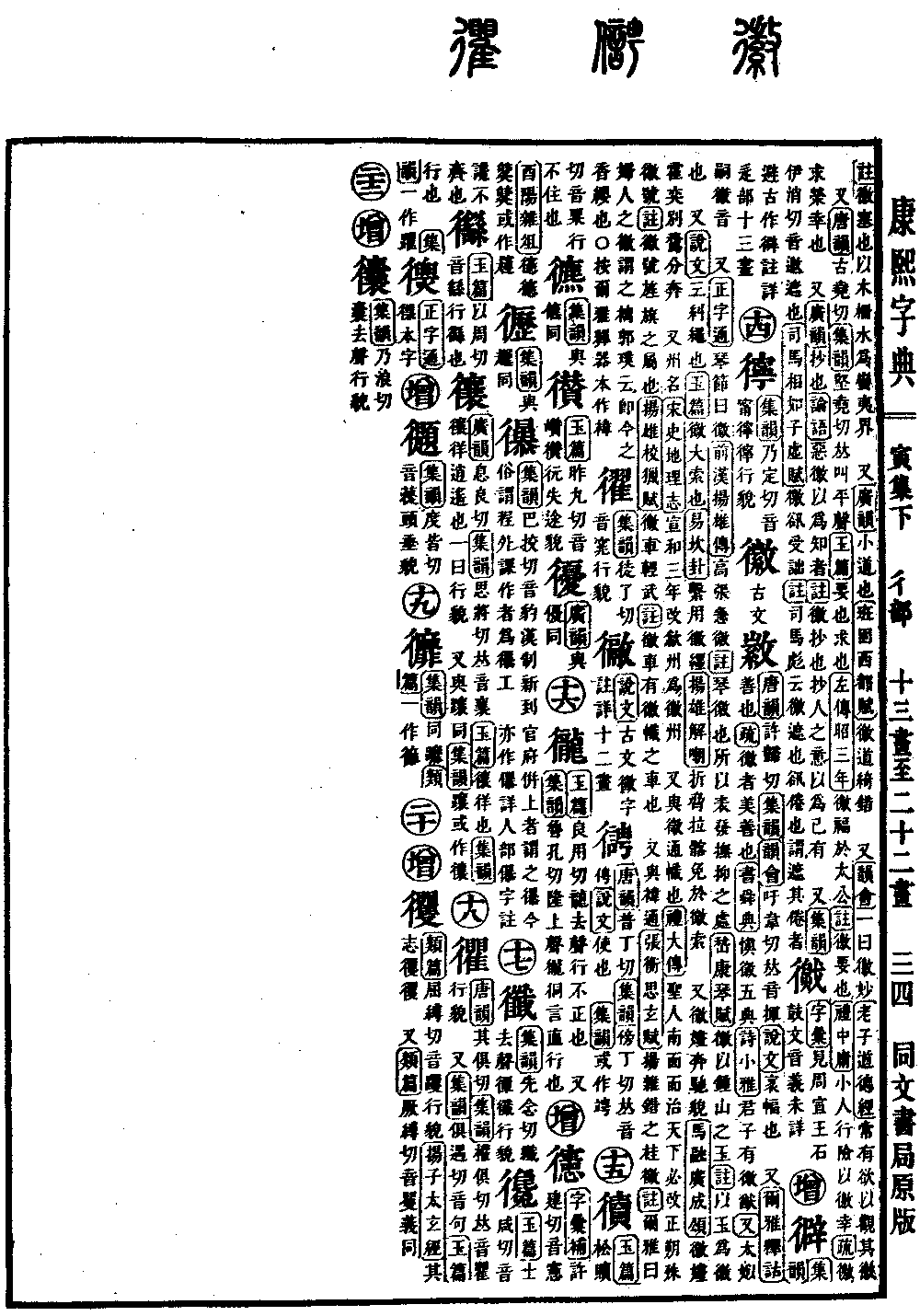
Yin Collection, Lower Volume
Radical: Step (chì)
Kangxi stroke count: 17
Page 372, Entry 04
Ancient text. Tang Rhymes (Tangyun): pronounced hui. Collected Rhymes (Jiyun), Rhyme Meetings (Yunhui): pronounced hui. According to the Explaining Graphs and Analyzing Characters (Shuowen Jiezi), it refers to silk leg wrappings. Also, in the Approaching Elegance: Explaining Glosses (Erya: Shiguhu), it means good. The sub-commentary states that hui means beauty and goodness. In the Book of Documents (Shangshu): Canon of Shun (Shundian), it says: Practice with caution the five constant virtues (wudian). In the Book of Odes (Shijing): Minor Odes of the Kingdom (Xiaoya), it says: The noble man has good plans (hui you). Also, Tai Si inherited a good reputation (hui yin). According to the Correct Meaning Through Characters (Zhengzitong), the markings on a zither are called hui. In the History of the Former Han (Qianhan Shu): Biography of Yang Xiong, it says: Stretch the strings high and tighten the markings (hui). The commentary explains: These are the zither markings used to indicate positions for pressing and releasing the strings. In Ji Kang's Rhapsody on the Zither (Qinfu), it says: Markings (hui) made of Zhongshan jade. The commentary notes: This refers to using jade for the markings. Also, according to the Explaining Graphs and Analyzing Characters (Shuowen Jiezi), it refers to a triple-twisted rope. The Jade Chapter (Yupian) defines hui as a large rope. In the Book of Changes (Yijing): Kan Hexagram, it says: Bound with ropes and cords (hui mo). In Yang Xiong's Disputing Ridicule (Jiechao), it says: Broken ribs and snapped hips, escaped from ropes and fetters (hui suo). Also, huihua describes the appearance of galloping quickly. In Ma Rong's Rhapsody on the Vast Park (Guangcheng Song), it says: Rushing rapidly (huihua) and brilliant, scattering and running in different directions. Also, the name of a prefecture. In the History of Song (Songshi): Treatise on Geography, it states that in the third year of Xuanhe, She Prefecture was renamed Hui Prefecture. Also interchangeable with hui, meaning a flag or banner. In the Book of Rites (Liji): Greater Tradition (Dazhuan), it says: When the sage rules the world from the south, he must correct the calendar and distinguish the banners and titles (huihao). The commentary notes: Huihao refers to banners and the like. In Yang Xiong's Rhapsody on the Imperial Hunt (Yulie Fu), it says: Banner-decorated carriages (huiche) and light armor. The commentary notes: Huiche refers to carriages decorated with banners. Also interchangeable with hui (garment). In Zhang Heng's Rhapsody on Contemplation (Si Fu), it says: Spreading the embroidered and varied robes (guihui). The commentary notes: The Approaching Elegance (Erya) says that the hui of a woman is called a li. Guo Pu says: This is what is now called a fragrance sachet (xiangying). Note: In the Approaching Elegance: Explaining Implements (Erya: Shiqi), this is originally written as hui.
Textual research: In the Rhapsody on the Imperial Hunt (Yulie Fu) by Yang Xiong, the text has been corrected to reflect the original book, changing it from Rhapsody on the School Hunt (Jiaolie Fu).