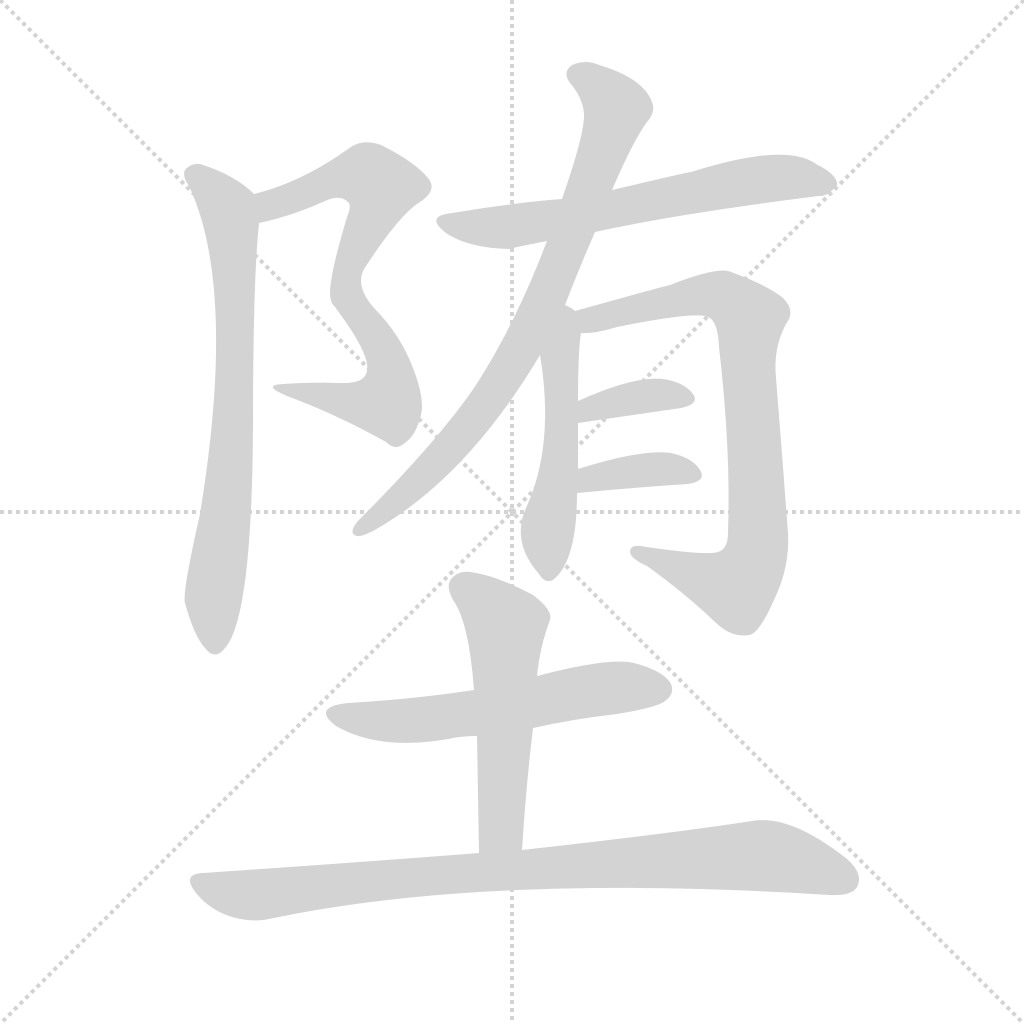
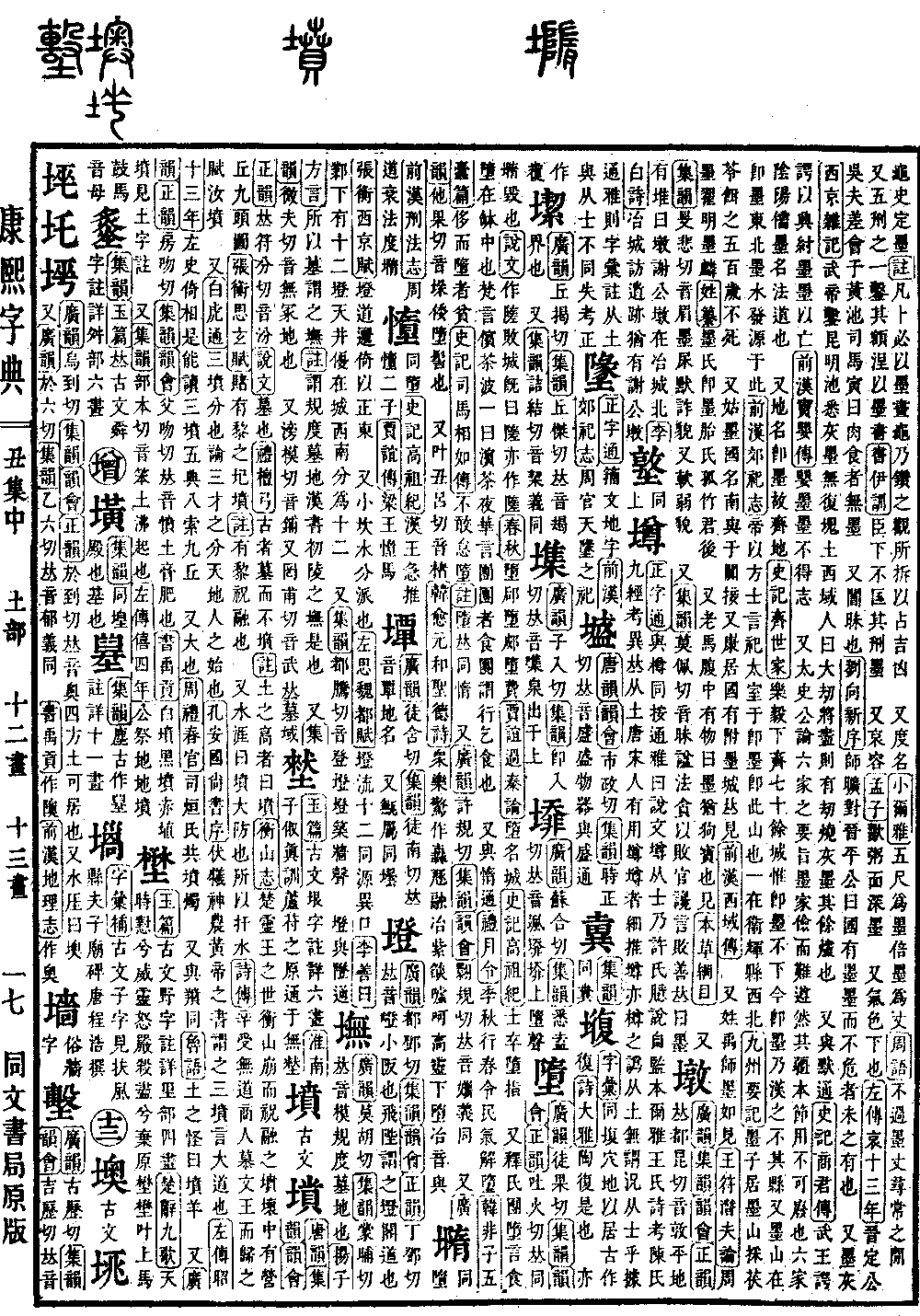
Chou Collection, Middle Volume. Radical: Earth (tǔ). 15 strokes. Page 239, Entry 15.
Pronounced duo. To destroy. According to the Analytical Dictionary of Characters (Shuowen Jiezi), it is written as a variant form (hui). To destroy a city wall is referred to as hui. Also written as a variant form (hui). In the Spring and Autumn Annals (Chunqiu), it is used in the context of destroying Hou and destroying Cheng and destroying Fei. In the Faults of Qin (Guo Qin Lun) by Jia Yi, it is used for destroying famous cities. In the Records of the Grand Historian (Shiji), Biography of Emperor Gaozu, it is used to describe soldiers losing their fingers.
Also, in Buddhist terminology, tuan-duo refers to food falling into an alms bowl. In Sanskrit, it is bin-cha-bo, or alternatively bin-cha-ye. In Chinese, it is called tuan, meaning food balls, referring to the act of begging for food.
It is also used interchangeably with the word for lazy (duo). In the Book of Rites (Liji), Monthly Ordinances, it says if one follows the seasonal commands of spring during the final month of autumn, the people’s energy will be dissipated and lazy. In the Han Feizi, Five Vermin chapter, it says the extravagant and lazy will be poor. In the Records of the Grand Historian (Shiji), Biography of Sima Xiangru, it says one must not be slothful or lazy. The commentary notes that this duo is the same as the word for lazy.
Pronounced hui. The meaning is the same.
Pronounced duo. Wo-duo refers to a hair bun style.
Rhymes with chu. In the Poem on the Sacred Virtues of the Yuanhe Era by Han Yu, it says the multitude of musical sounds startles and arises, roaring and crashing, melting and smelting. The purple flames breathe out and sigh, and the high spirits descend and fall. (Note: Ye is pronounced with the sound of the previous character.)
The character is originally written with the radical for mound (fu) and is not to be written as the character derived from sui.