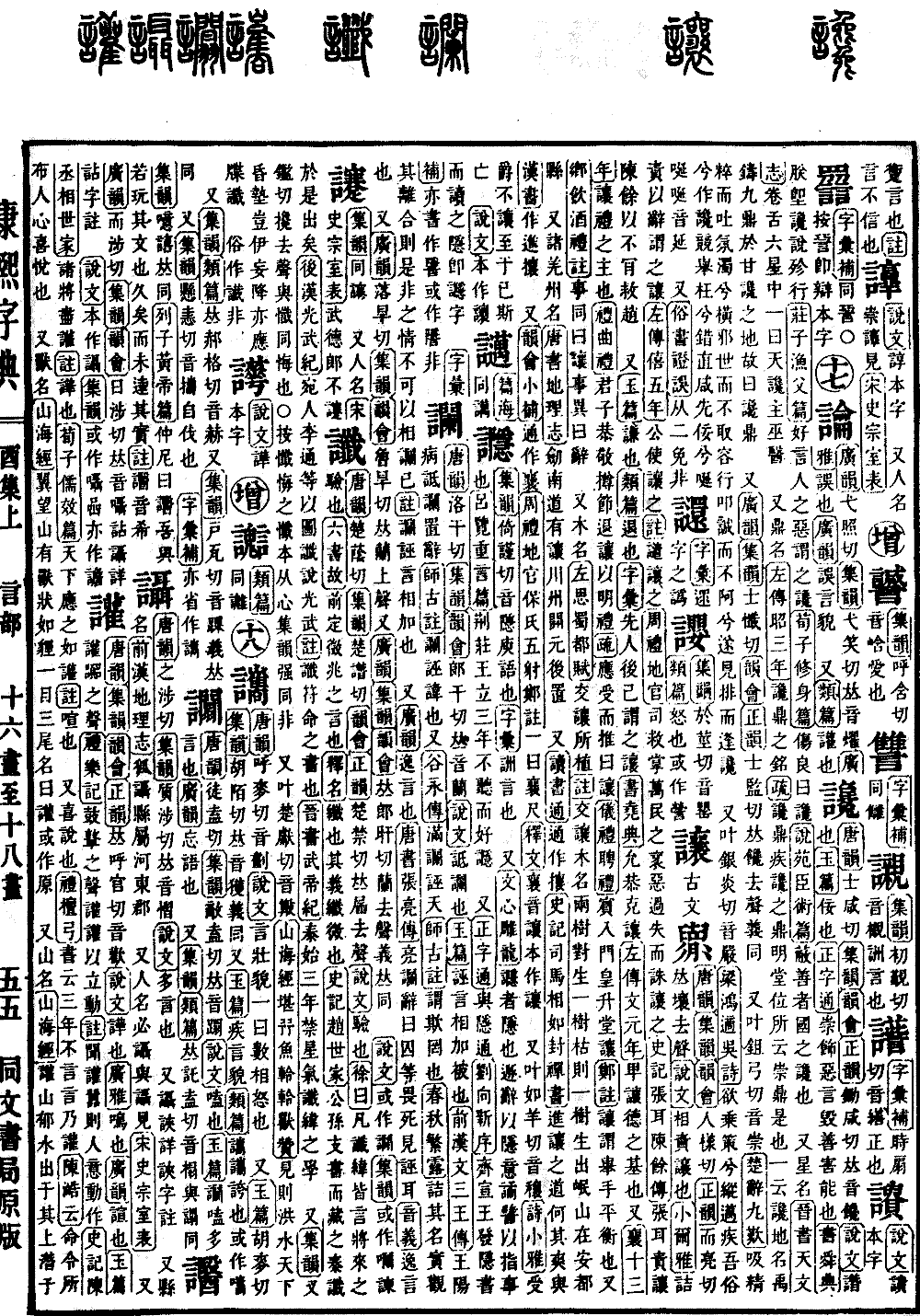
You Collection, Upper Volume
Radical: Speech (yán)
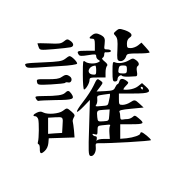
Huan
Kangxi strokes: 25
Page 1187, Entry 25
Tang Rhyme (Tangyun), Collected Rhymes (Jiyun), Dictionary of Rhymes (Yunhui), Corrected Rhymes (Zhengyun): Pronounced huan.
Explanation from the Origin of Chinese Characters (Shuowen): To clamor.
Expanded Glossary (Guangya): To cry out.
Expanded Rhymes (Guangyun): Noisy.
Jade Chapter (Yupian): A clamorous sound.
Book of Rites (Liji), Record of Music (Yueji): The sound of war drums is clamorous and stirring. Note: Upon hearing clamorous sounds, the human heart becomes restless.
Records of the Grand Historian (Shiji), Biographies of the Prime Ministers: The generals all clamored. Note: To make an uproar.
Xunzi, On the Efficacy of Confucianism: The world responded to it as if in clamor. Note: To shout noisily.
Also denotes joy.
Book of Rites (Liji), Tangong: The Book of Documents (Shangshu) says: For three years, he did not speak; when he finally spoke, it brought joy to the people.
Hao Yun: When government decrees are issued, the hearts of the people are joyful.
Also the name of a beast.
Classic of Mountains and Seas (Shanhaijing): On Yiwang Mountain there is a wild beast; its shape is like a raccoon, with one eye and three tails, named huan. Sometimes written in a variant form (yuán).
Also the name of a mountain.
Classic of Mountains and Seas (Shanhaijing): Huan Mountain, where the Yu River originates and flows underground beneath the mountain.
Also the name of a state.
Classic of Mountains and Seas (Shanhaijing): The people of the Huan Tou State have human faces, bird beaks, and wings. Sometimes called Huan Zhu State.
Also a place name.
Spring and Autumn Annals (Chunqiu), Third Year of Duke Huan: The Marquis of Qi escorted the Lady Jiang to the place called Huan. Note: Huan is a place name in the State of Lu. To the west of Sheqiu County in Jibei Commandery, there is the Xia Huan Pavilion.
Also a surname. See Universal Genealogy of Surnames (Wanxing Tongpu).
Also Expanded Rhymes (Guangyun): Pronounced xuan. To cry out in alarm. One theory suggests it describes a clamorous appearance.
Yang Xiong’s Dialect (Fangyan): To rebuke. In the northern Yan region, when people rebuke one another, it is called huan.
Collected Rhymes (Jiyun): Identical to kou. Commonly written as xuan or xuan.
Also Collected Rhymes (Jiyun): Pronounced guan. Identical to huan (joy).
Also Collected Rhymes (Jiyun): Pronounced huan (departing tone). Identical to huan (to call out). Sometimes written in a variant form (guān).
Also a rhyming entry pronounced shan (level tone).
Yan Yanzhi, Lamentation Text: The countryside is submerged in mist, and the people are in sad clamor. The coming fragrance can be described, but the departing carriage cannot be retrieved.