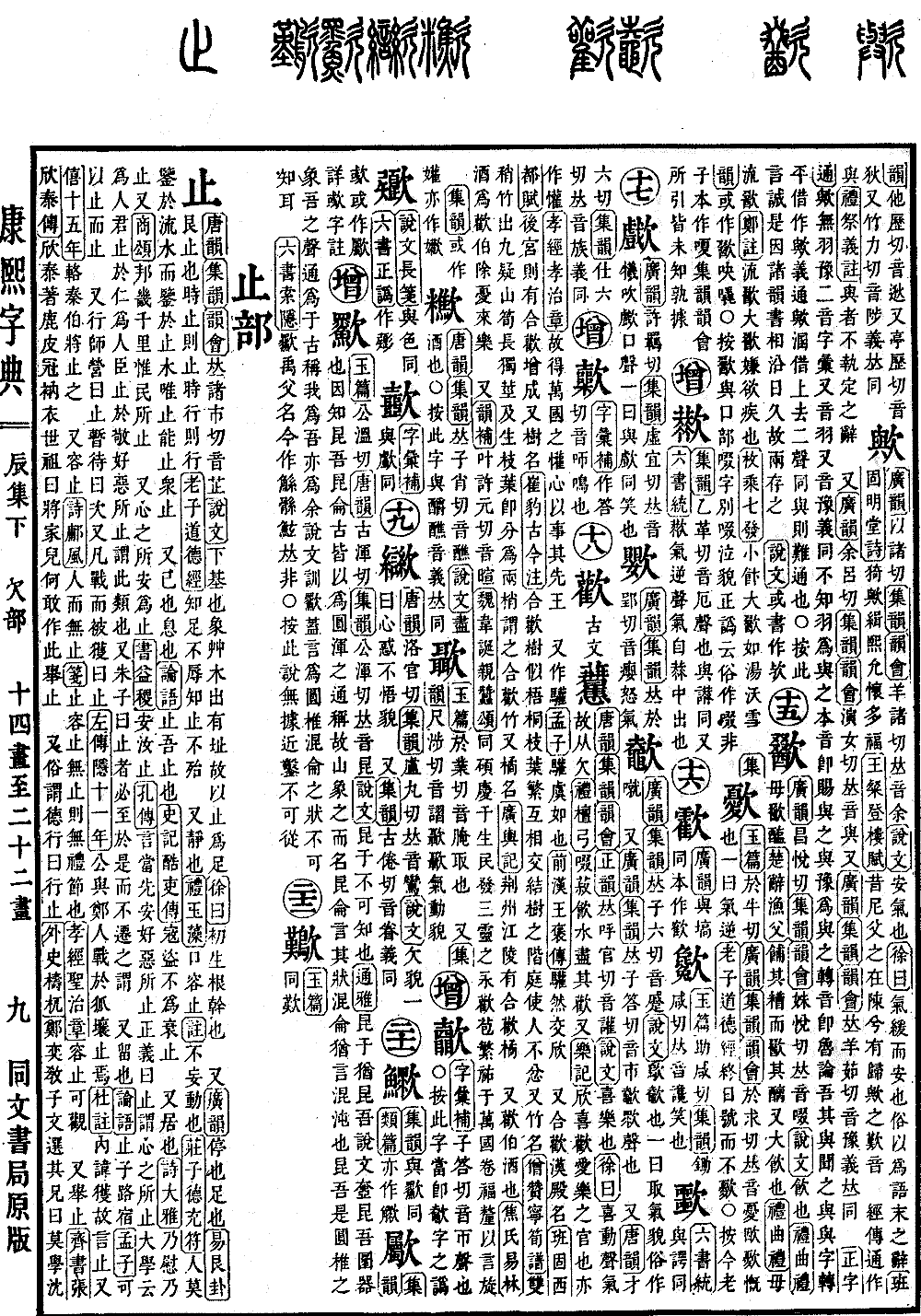
Chen Collection, Lower Volume
Radical: Lack (qiàn)
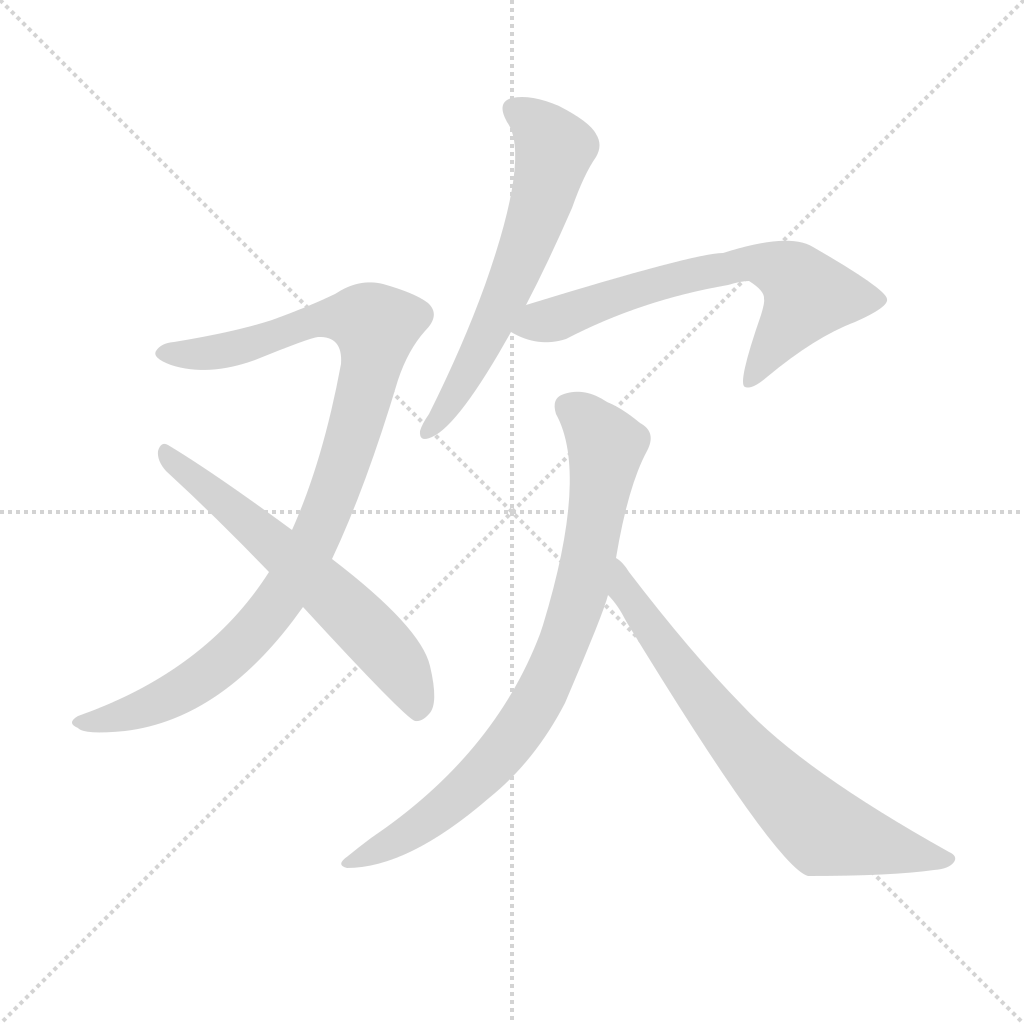
Character: Huan
Kangxi Stroke Count: 22
Page 573, Entry 01
Ancient phonological records in Tang Rhyme (Tangyun), Collection of Rhymes (Jiyun), Rhyme Compilation (Yunhui), and Orthodox Rhymes (Zhengyun) state the pronunciation is huan. In the Explaining Graphs and Analyzing Characters (Shuowen Jiezi), it is defined as joy and happiness. Xu Kai states that because joy causes the breath to vibrate, the character is categorized under the Radical: Lack (qiàn). The Book of Rites (Liji), in the Tan Gong chapter, records: Eating bean porridge and drinking clear water, one can still fully enjoy happiness. Also, the Record of Music (Yueji) writes: Joy and love are the essential functions of music. It is also written in the variant form huan. The Classic of Filial Piety (Xiaojing), in the chapter on Filial Governance, records: Thus, one can obtain the joyous hearts of the ten thousand states to offer sacrifices to their former kings. It is also written as huan. The Mencius (Mengzi) describes: The appearance of happiness and harmony. The Book of the Former Han (Qian Hanshu), in the Biography of Wang Bao, records: Joyfully and happily together. There is also the term Hehuan (Harmonious Joy), which is the name of a palace in the Han dynasty. Ban Gu, in his Western Capital Rhapsody (Xidu Fu), writes: The inner palace contains the Hehuan and Zengcheng palaces. It is also the name of a tree. Cui Bao, in the Notes on Past and Present (Gujin Zhu), records: The Hehuan tree resembles the phoenix tree; its branches and leaves are lush and intertwined. Planting this tree before the courtyard steps can help people dispel anger. It is also the name of a type of bamboo. Seng Zanning, in the Bamboo Shoot Manual (Sun Pu), records: Double-tip bamboo is produced in the Jiuyi Mountains; the bamboo shoot grows as a single stem. When branches and leaves sprout, it splits into two tips, known as Hehuan bamboo. It is also the name of a type of orange. The Record of the Broad Earth (Guangyu Ji) records: Jiangling in Jingzhou produces the Hehuan orange. There is also the term Huanbo (Lord of Joy), which refers to wine. Jiao Shi's Forest of Changes (Jiaoshi Yilin) writes: Wine is the Lord of Joy; it can dispel sorrows and bring happiness. The Rhyme Supplement (Yunbu) notes an alternative pronunciation as xuan. Wei Dan of the Wei dynasty, in the Ode to the Personal Sericulture (Qincan Song), writes: Sharing the celebration of a bountiful year with the common people, inciting the long-lasting joy of the three spirits: heaven, earth, and humanity. Spreading prosperous blessings to all nations, gathering fortune and auspiciousness to return. The Collection of Rhymes (Jiyun) records: It may be written as huan, or as nv-huan.