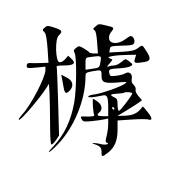
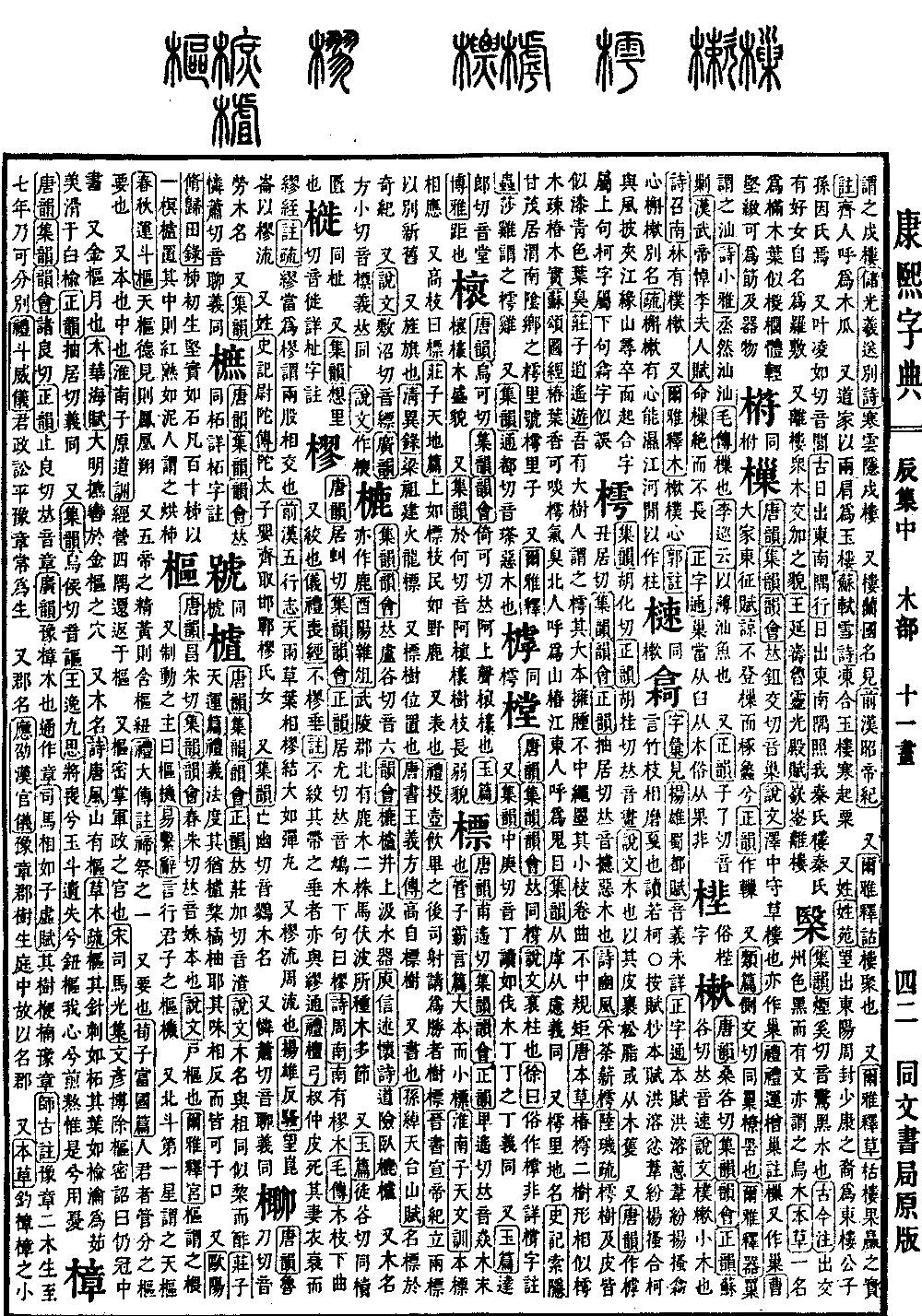
Chen Collection, Middle Volume, Radical: Tree (mù)
Chū; Kangxi Stroke Count: 15; Page: 550, Entry 08
Jiyun: Hu hua qie. Zhengyun: Hu gua qie, pronounced hua.
Shuowen: A tree. Its bark is used to wrap pine resin. Sometimes written with the radical "guò" instead of "lǜ".
Also, Tangyun: written as 槱. Chou ju qie. Jiyun, Yunhui, Zhengyun: Chou ju qie, pronounced shū. A bad tree.
Book of Odes (Shijing), Bin Feng: "Gathering tǔ and chū firewood." Lu Ji's commentary: Chū trees and their bark resemble lacquer, are greenish, and their leaves are foul-smelling.
Zhuangzi (Xiaoyao You): "I have a large tree, people call it chū. Its trunk is gnarled and useless for carpentry. Its small branches are twisted and useless for geometry."
Tang Bencao: The chūn and chū trees are similar in shape, but the chū wood is sparse, while the chūn wood is dense. Su Song's Tu Jing: Chūn leaves are fragrant and edible. Chū has a foul smell; northerners call it mountain chūn, and Jiangdong people call it ghost eyes.
Jiyun: Written with "hū" and "lǜ", the meaning is the same.
Also, Chūlǐ, a place name. Shiji (Suoyin): Gan Mao lived in Chūlǐ, Yinxiang, south of the Wei River, and was known as Prince Chūlǐ.
Also, Er Ya (Shichong): A grasshopper is called a chū ji.
Also, Jiyun: Tōng dū qie, pronounced tū. A bad tree.