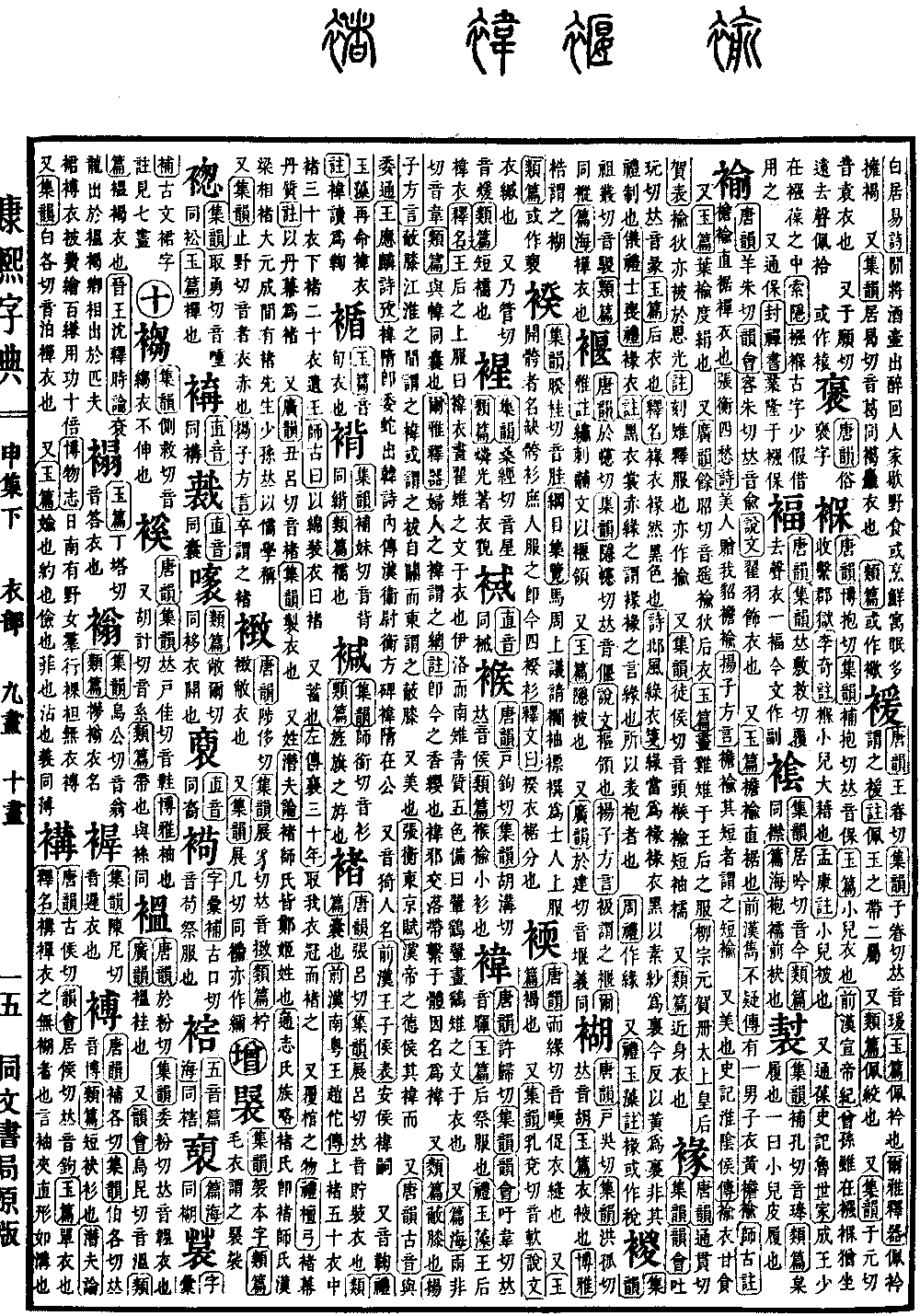
Shen Collection, Lower Volume
Radical: Clothing (yī)
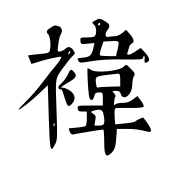
Character: Hui
Kangxi Stroke Count: 15
Page 1121, Entry 17
Pronounced hui.
In the Dictionary of Jade (Yupian), it refers to the sacrificial robes of a queen. In the Book of Rites (Liji), it states that the queen wears the hui robe.
In the Explanation of Names (Shiming), it states that the queen's superior ceremonial robes are called hui robes, which are robes painted with the patterns of a pheasant. In the regions south of the Yi and Luo rivers, a pheasant with a greenish base and five colors is called hui; the yao-hui is a robe painted with the pattern of a hawk-pheasant.
Also pronounced wei, as found in the Sea of Characters (Pianhai). In the Classified Dictionary (Leipian), it is the same as wei, meaning a bag.
In the Erya (Approaching Elegance), the hui of a woman is called a li. The commentary explains that this refers to what is now known as a perfume sachet. The hui is a strap that crosses diagonally and hangs down from the body, hence the name hui.
In the Classified Dictionary (Leipian), it refers to a knee cover. In Yang Xiong's Regional Dialects (Fangyan), in the regions between the Yangtze and Huai rivers, it is called a hui or a fu, while east of the Hangu Pass, it is called a knee cover.
It also denotes beauty. In Zhang Heng's Eastern Capital Rhapsody (Dongjing Fu), he writes: The virtues of the Han emperor, how beautiful they are.
According to ancient pronunciations from the Tang Dynasty, it is interchangeable with wei. In Wang Yinglin's Examination of the Book of Odes (Shi Kao), it states that hui-sui is equivalent to wei-yi, originating from the Han School's Commentary on the Book of Odes (Hanshi Neizhuan). In the Han Dynasty Inscription of Weiwei Heng Fang, it appears as hui-sui zai gong.
Also pronounced yi. It is a personal name. In the Tables of Princes and Marquises of the Former Han (Qianhan Wangzihoubiao), it records that the Marquis of An, Hui, succeeded to the title.
Also pronounced ju. In the Book of Rites (Liji), it mentions the robes worn by those holding two commissions, with a commentary noting that here, hui is read as ju.