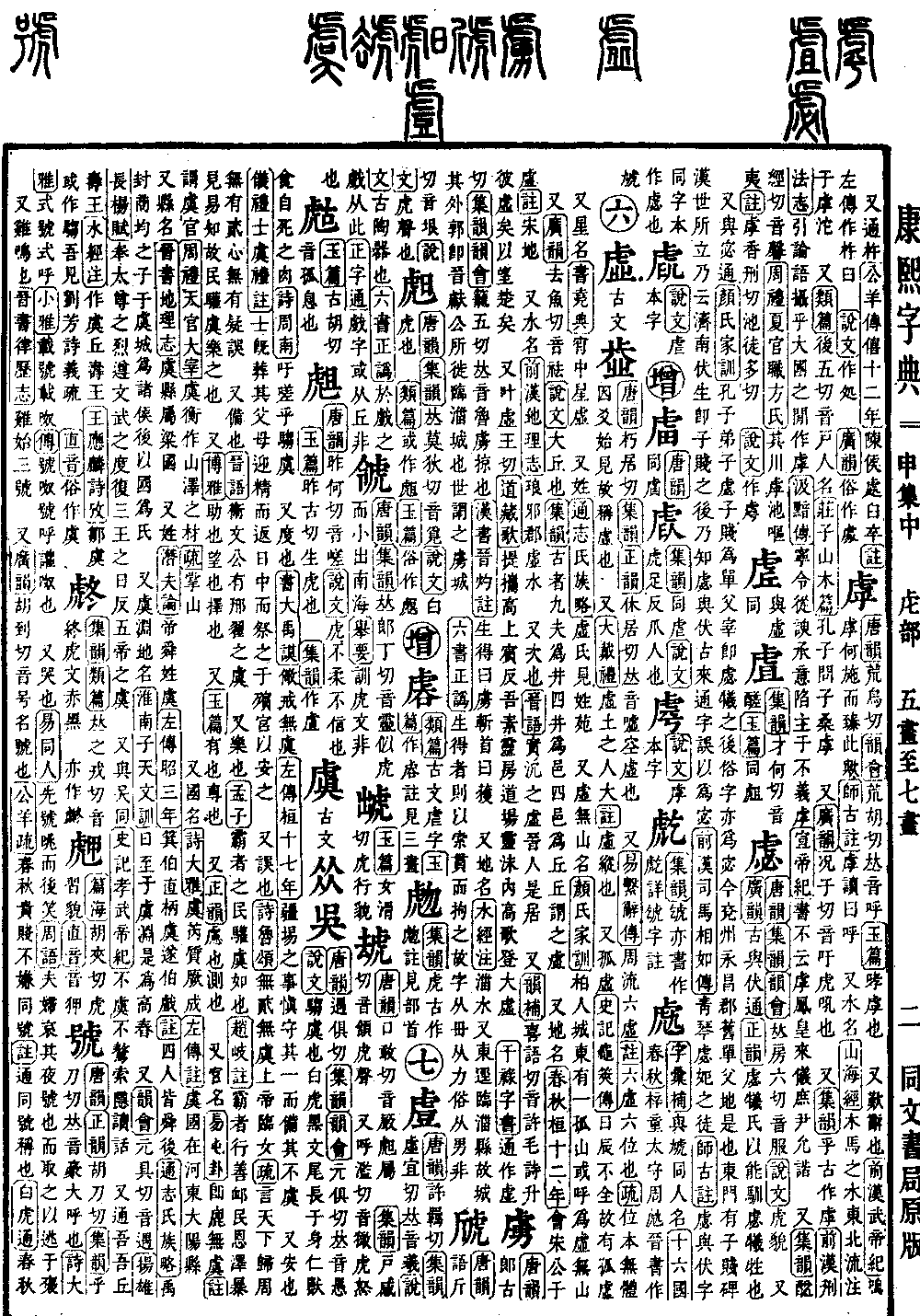
Shen Collection, Middle Volume
Radical: Tiger (hū)
Kangxi strokes: 11
Page 1074, Entry 01
Pronounced hu.
Yu Pian (Book of Miscellaneous Characters) defines it as a roar or bellow. It is also used as an exclamation.
Book of Han (Hanshu), Annals of Emperor Wu: Alas, what could be done to attain this?
Annotation by Yan Shigu: The character is pronounced hu.
It is also the name of a river. Classic of Mountains and Seas (Shanhaijing): The Muma River flows northeast and enters the Hutuo River.
Also noted in Classified Chapters (Leipian) as pronounced hu (falling tone), used in personal names. Zhuangzi, Shanmu Chapter: Confucius asked Zisang Hu.
Also noted in Expanded Dictionary of Sounds (Guangyun) as pronounced xu, referring to the roar of a tiger.
Also, in Collected Rhymes (Jiyun), the character hu (generic particle) was written as the variant form hū in ancient times. Book of Han (Hanshu), Record of Laws: Quotes the Analects (Lunyu), where the particle hu in the phrase squeezed between great states is written as hū.
Biography of Ji An: Does this not mean to flatter and cater to the ruler's will, thereby causing the ruler to fall into unrighteousness?
Annals of Emperor Xuan: Does the Book of Documents (Shangshu) not say: The phoenix arrives in ceremony, and all officials are in harmony?
Also noted in Collected Rhymes (Jiyun) as pronounced xing. Zhou Rites (Zhouli), Summer Official: Its river is the Hutuoyi. Annotation: Hu is pronounced xiang. Chi is pronounced tuoduo.
Shuowen Jiezi (Explaining Simple and Compounding Characters) records the variant form.