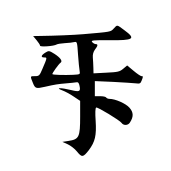
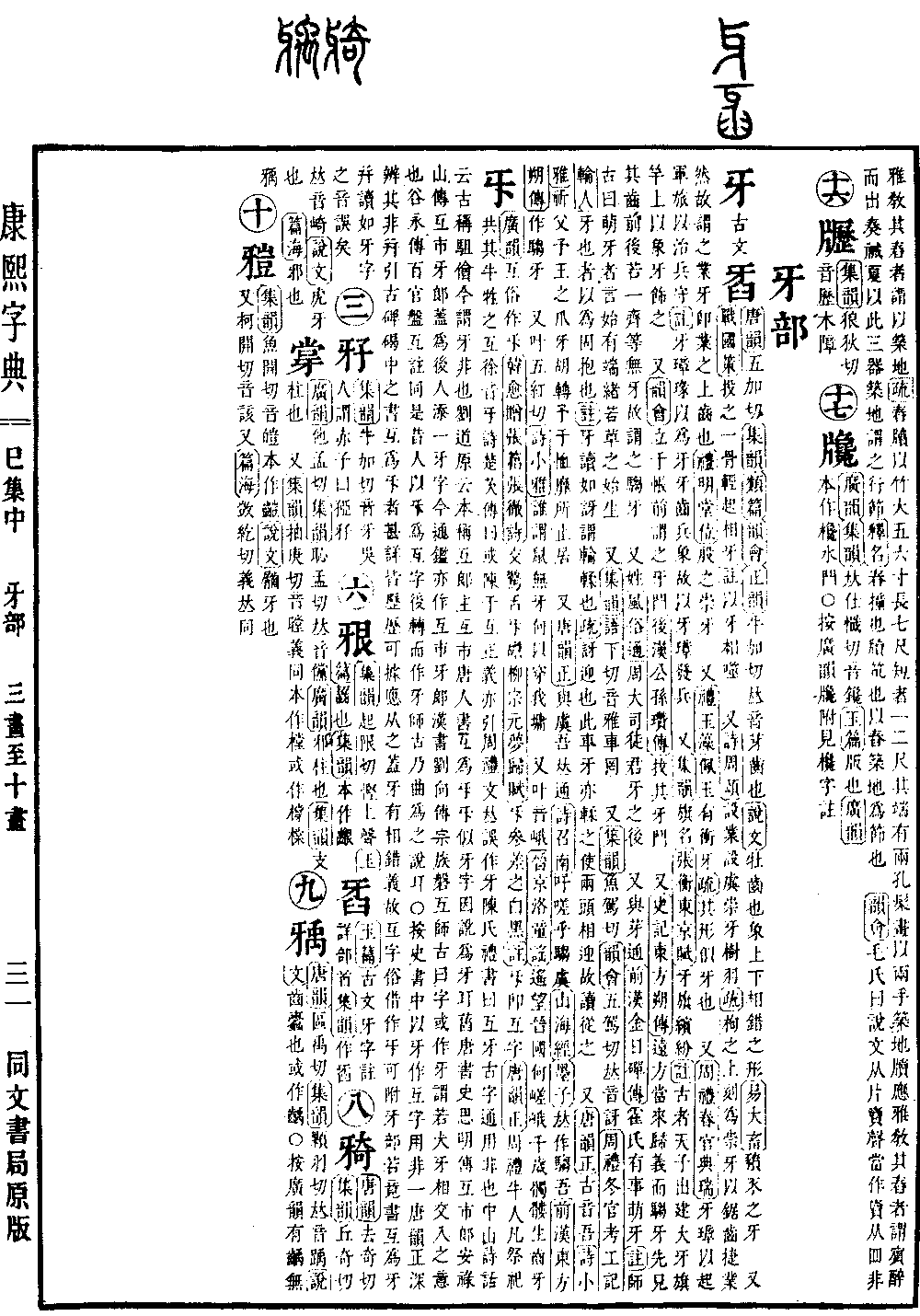
In the "Guangyun" (Guangyun), the character "互" (hù) is written in its common form as "㸦" (hù). Han Yu's "Poem Presented to Zhang Ji and Zhang Che" (Zeng Zhangji Zhangche Shi) contains the line "交惊舌㸦舚" (jiāo jīng shé hù lín). Liu Zongyuan's "Ode to Returning in a Dream" (Menggui Fu) has "㸦参差之白黑" (hù cēncī zhī bái hēi). The commentary states that "㸦" is the character "互".
"Tang Yun Zheng" (Tang Yun Zheng) records that in the "Niuren" (Niuren) chapter of the "Rites of Zhou" (Zhou Li), it is stated that "互" (hù) refers to cattle provided for sacrifices. Xu Miao's pronunciation is "㸦" (hù). The transmitted text of the "Book of Odes" (Shijing), in the "Chu Ci" (Chu Ci) chapter, says that some were displayed in "互" (hù). Kong Yingda's "Zhengyi" (Zhengyi) also quotes the text from the "Rites of Zhou" but mistakenly writes it as "牙" (yá). Chen Xiangdao's "Lishu" (Lishu) states that "互" (hù) and "牙" (yá) were interchangeable in ancient script, which is incorrect. Liu Yuanyuan's "Zhongshan Shihua" (Zhongshan Shihua) states that in ancient times it was called "驵侩" (zǎng kuài) and now it is called "牙" (yá), which is also incorrect. Liu Yuanyuan says it was originally called "互郎" (hù láng), in charge of mutual markets. Tang dynasty people wrote "互" (hù) as "㸦" (hù), and the shape of "㸦" (hù) resembled "牙" (yá), thus it was erroneously changed to "牙" (yá).
The "Old Book of Tang" (Jiu Tangshu), in the biography of Shi Siming, writes "互市郎" (hùshì láng), and in the biography of An Lushan, it writes "互市牙郎" (hùshì yáláng). It is likely that later generations added the character "牙" (yá). The "Comprehensive Mirror to Aid in Government" (Zizhi Tongjian) also writes "互市牙郎" (hùshì yáláng).
In the "Book of Han" (Hanshu), in the biography of Liu Xiang, there is "宗族磐互" (zōngzú pánhù). Yan Shigu says that the character was sometimes written as "牙" (yá), meaning interwoven like dog teeth. In the same book, in the biography of Gu Yong, there is "百官盘互" (bǎi guān pánhù), with the same annotation. This indicates that in the past, people used "㸦" (hù) as the character "互" (hù), which later evolved into "牙" (yá), and Yan Shigu's explanation is forced.
Note: The use of "牙" (yá) as "互" (hù) in historical records occurs in more than one place. "Tang Yun Zheng" deeply analyzes its error and cites examples from ancient steles where "互" (hù) is written as "㸦" (hù) in a very detailed and clear, well-supported manner. It should be followed. It is likely that "牙" (yá) has the meaning of mutual interlocking, so the common form of "互" (hù) was borrowed as "㸦" (hù) and can be placed under the "牙" (yá) radical. If "互" (hù) is directly written as "牙" (yá) and pronounced with the sound of "牙" (yá), then it is wrong.