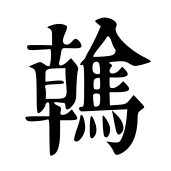
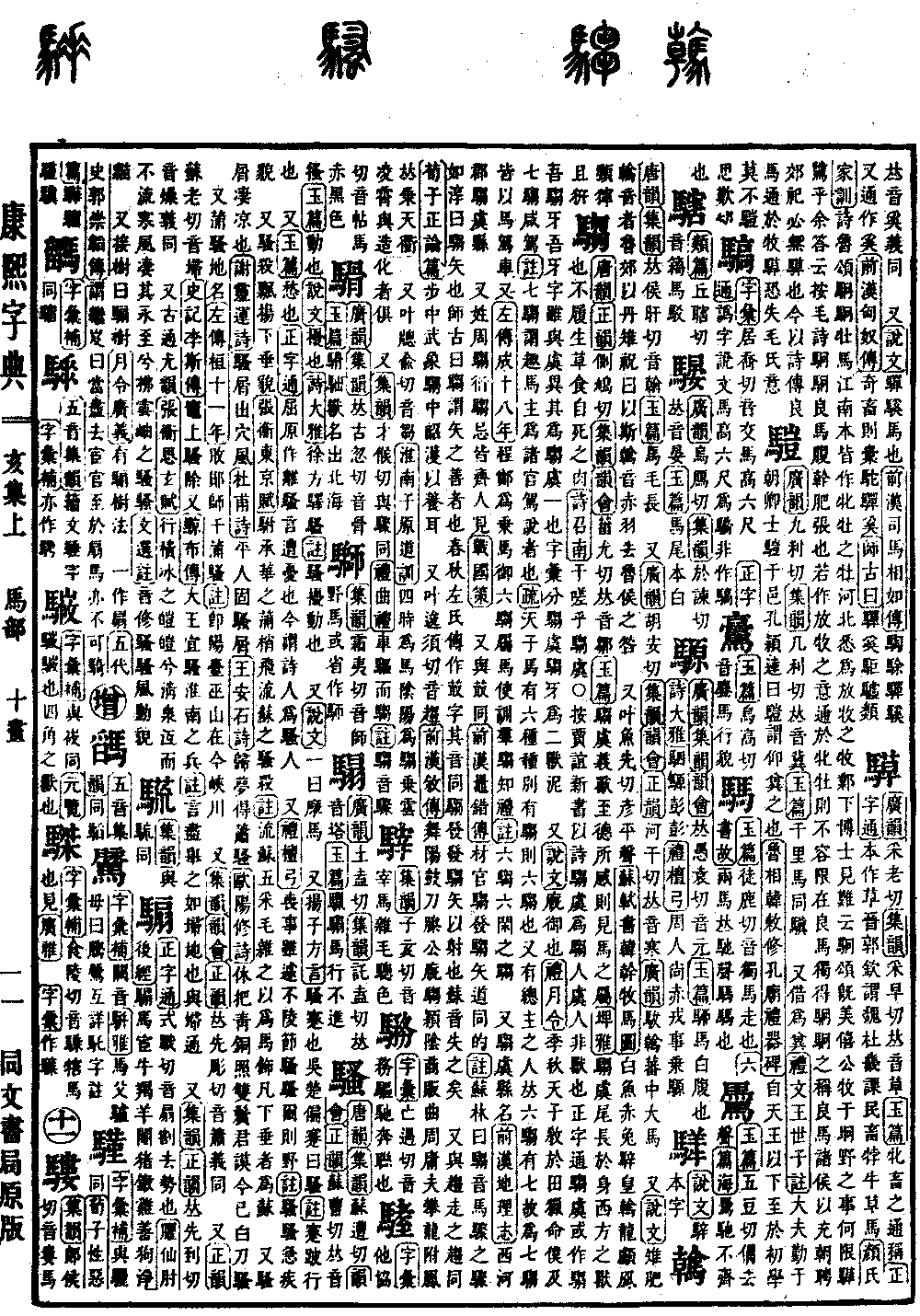
Zi Collection, Page Position: Upper, Radical: Horse (mǎ), Page 498, Entry 02
According to the "Tang Yun" and "Ji Yun," this character is pronounced "hàn" (rising tone), from the rhyme group "hóu gàn." The "Yu Pian" explains it as the long hair of a horse.
According to the "Guang Yun," it is pronounced "hán" (level tone), from the rhyme group "hú ān." The "Ji Yun," "Yun Hui," and "Zheng Yun" read it as "hán" (level tone), from the rhyme group "hé gàn." The "Guang Yun" records that "䮂䮧" refers to large horses from foreign regions.
The "Shuowen Jiezi" states: A pheasant that is plump and has a loud cry. During the suburban sacrifices in the state of Lu, a red pheasant was offered with the prayer: "With this loud cry and red feathers, may the calamities of the Duke of Lu be removed."
It also has a harmonic sound pronounced "yàn" (level tone), from the rhyme group "yú xiān." The poem "On Han Gan's Painting of Horses Being Tended" by Su Shi writes: "White fish, red rabbits, and yellow-maned horses, with dragon-like heads and phoenix-like necks, fierce and..." The "Shuowen Jiezi" states: "䮧" refers to the long hair of a horse. "鶾" refers to a pheasant that is plump and has a loud cry.