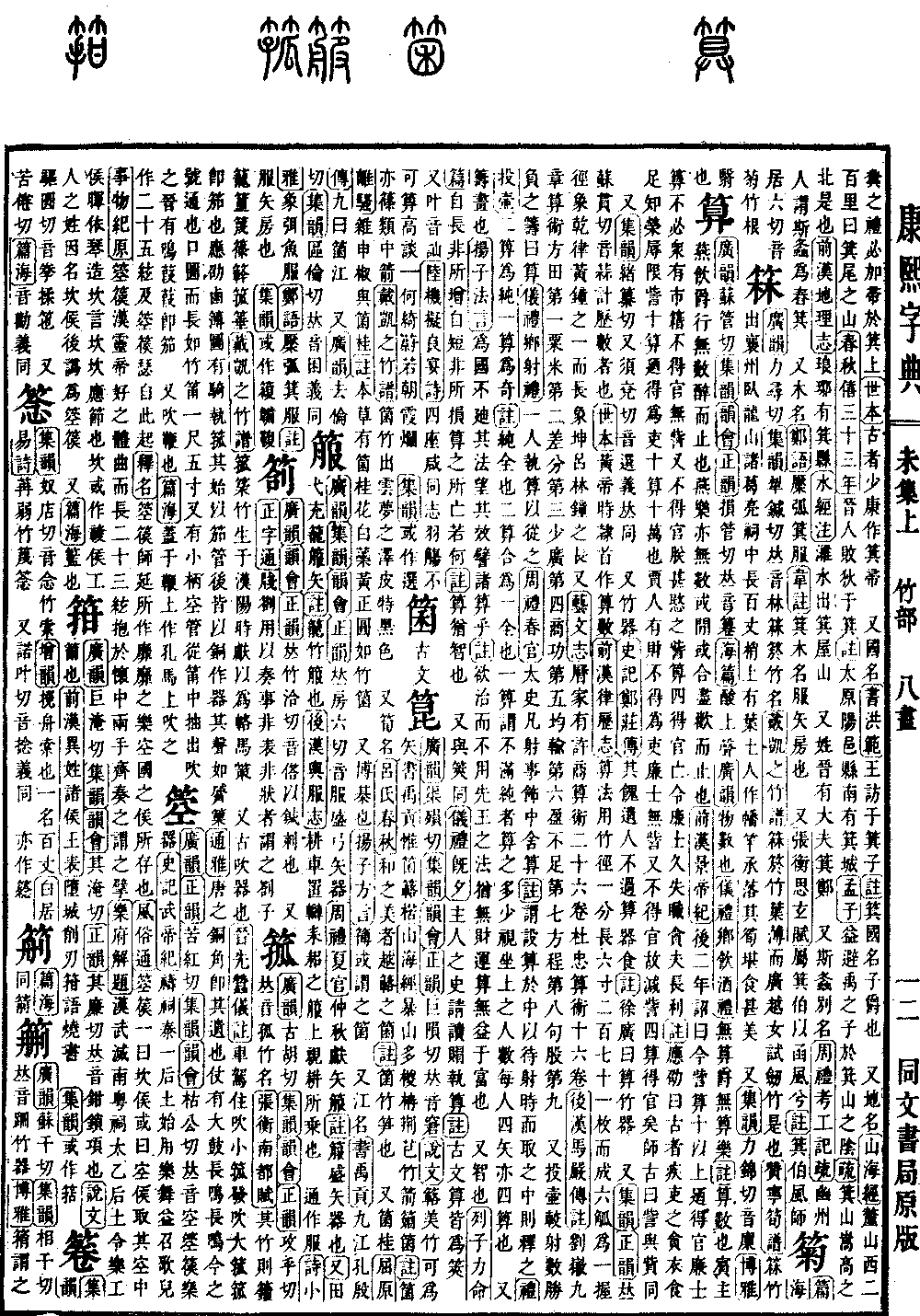
Wei Collection, Upper Volume
Radical: Bamboo (zhú)
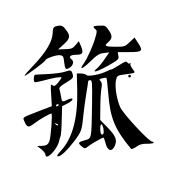
Gu
Kangxi stroke count: 14
Page 888, Entry 08
Pronounced gu
A type of bamboo.
In the Southern Capital Rhapsody (Nandu Fu) by Zhang Heng, the bamboos mentioned include longlong, mieshao, gangu, and gu.
According to the Bamboo Treatise (Zhu Pu) by Dai Kaizhi, the gu bamboo grows in the Hanyang region and was historically offered as tribute to be crafted into whips for the imperial carriages.
Also refers to an ancient wind instrument. According to the Jin Dynasty Rituals of the First Sericulturist (Jin Xiancan Yizhu), when the imperial carriage halted, small gu were played, and upon departure, large gu were played. Gu is the same as jia. According to the Illustrations of Imperial Escorts (Lubu Tu) by Ying Shao, cavalrymen held gu; initially made from jia reeds, they were later crafted from copper, producing a sound similar to the bili.
According to the Thorough Elegance (Tongya), the copper horn of the Tang Dynasty is the inherited form of this instrument. Ceremonial guards utilized great drums and long-calls. The long-call is equivalent to the modern trumpet; its mouthpiece is round and long, resembling a bamboo tube, measuring one foot and five inches in length. It also features a small handle with a hollow tube that can be withdrawn from the main cylinder to be played. The Jin Dynasty possessed an instrument known as mingjia, where jia refers to the reed.
Also refers to a blow-whip. According to the Sea of Documents (Pianhai), it likely consisted of a whip drilled with holes, played while mounted.