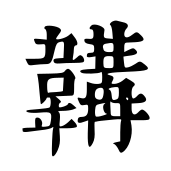
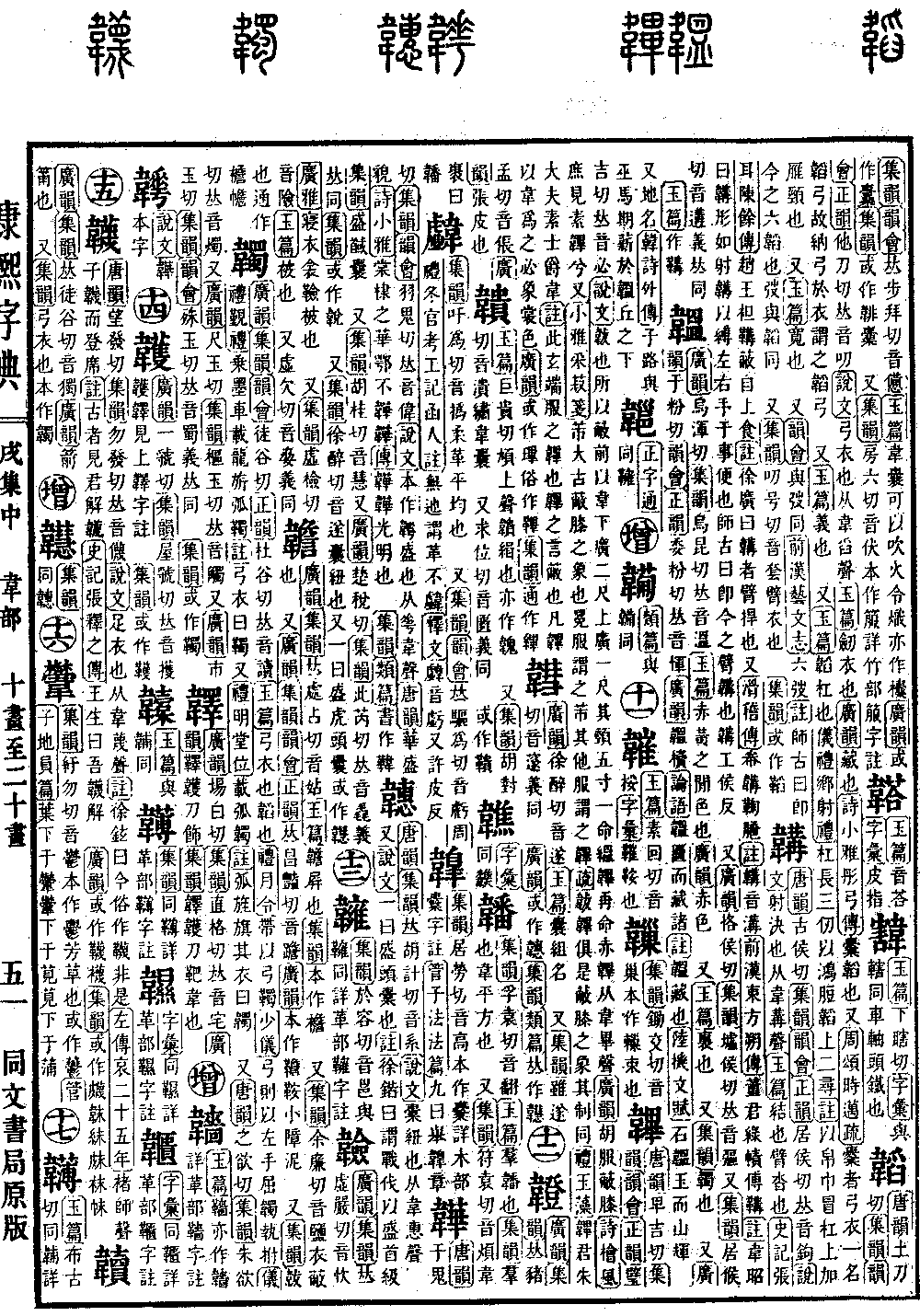
Xu Collection, Middle Volume
Radical: Tanned Leather (wéi)
19 strokes
Page 1395, Entry 04
Pronounced gou.
According to the Tang Rhyme (Tangyun), the Collection of Rhymes (Jiyun), the Collection of Rhymes and Explanations (Yunhui), and the Correct Rhymes (Zhengyun), the pronunciation is the same as the character for hook.
According to the Analytical Dictionary of Characters (Shuowen), it is an archer's thumb ring. The character is formed with tanned leather as the radical and the sound provided by the component for interlocking.
According to the Jade Chapters (Yupian), it refers to a binding or a sleeve worn on the arm.
In the Records of the Grand Historian (Shiji), Biography of Zhang Er and Chen Yu: The King of Zhao bared his arms and wore arm guards while personally serving food. The commentary by Xu Guang states that the arm guard is a protective sleeve for the arm.
In the Biography of the Buffoons: Rolling up the sleeves, wearing arm guards, bowing and bending. The commentary states the pronunciation is the same as the word for ditch.
In the History of the Former Han (Qianhan), Biography of Dongfang Shuo: Mr. Dong wore a green turban and had arm guards on his hands. The commentary by Wei Zhao states that the shape of the arm guard resembles an archer's thumb ring, used to bind the left and right arms to facilitate work. Yan Shigu states that it is what is currently called an arm sleeve. The pronunciation is given as the equivalent of gou.
According to the Extensive Rhyme (Guangyun), it is pronounced kou. According to the Collection of Rhymes (Jiyun), it is also pronounced kou.
According to the Collection of Rhymes (Jiyun), it is also pronounced gou, with the same meaning.
According to the Jade Chapters (Yupian), it is written as a variant form (gou).
Textual Research: In the Biography of the Buffoons, the text appears as rolls and arm guards. Note: The right component of the character is a combination of the components for assist and canopy, which has been corrected here.