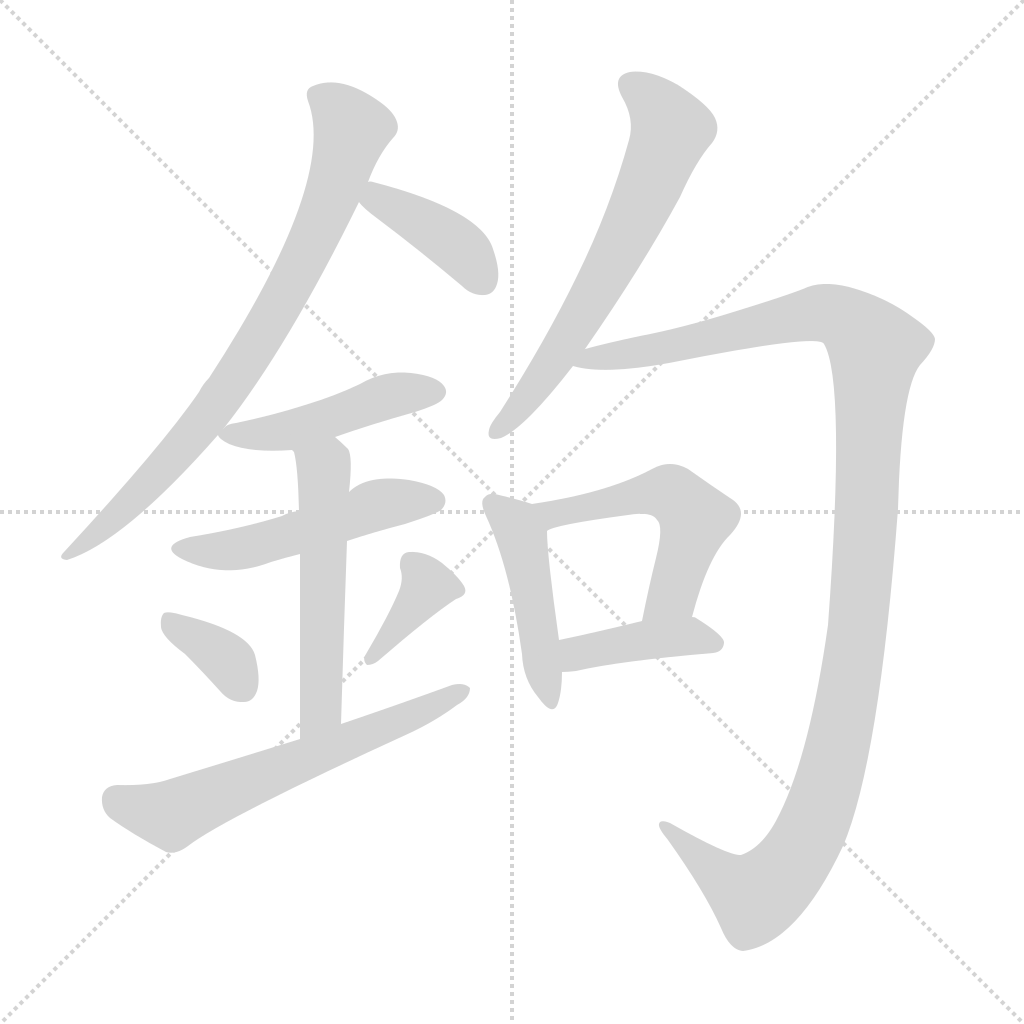
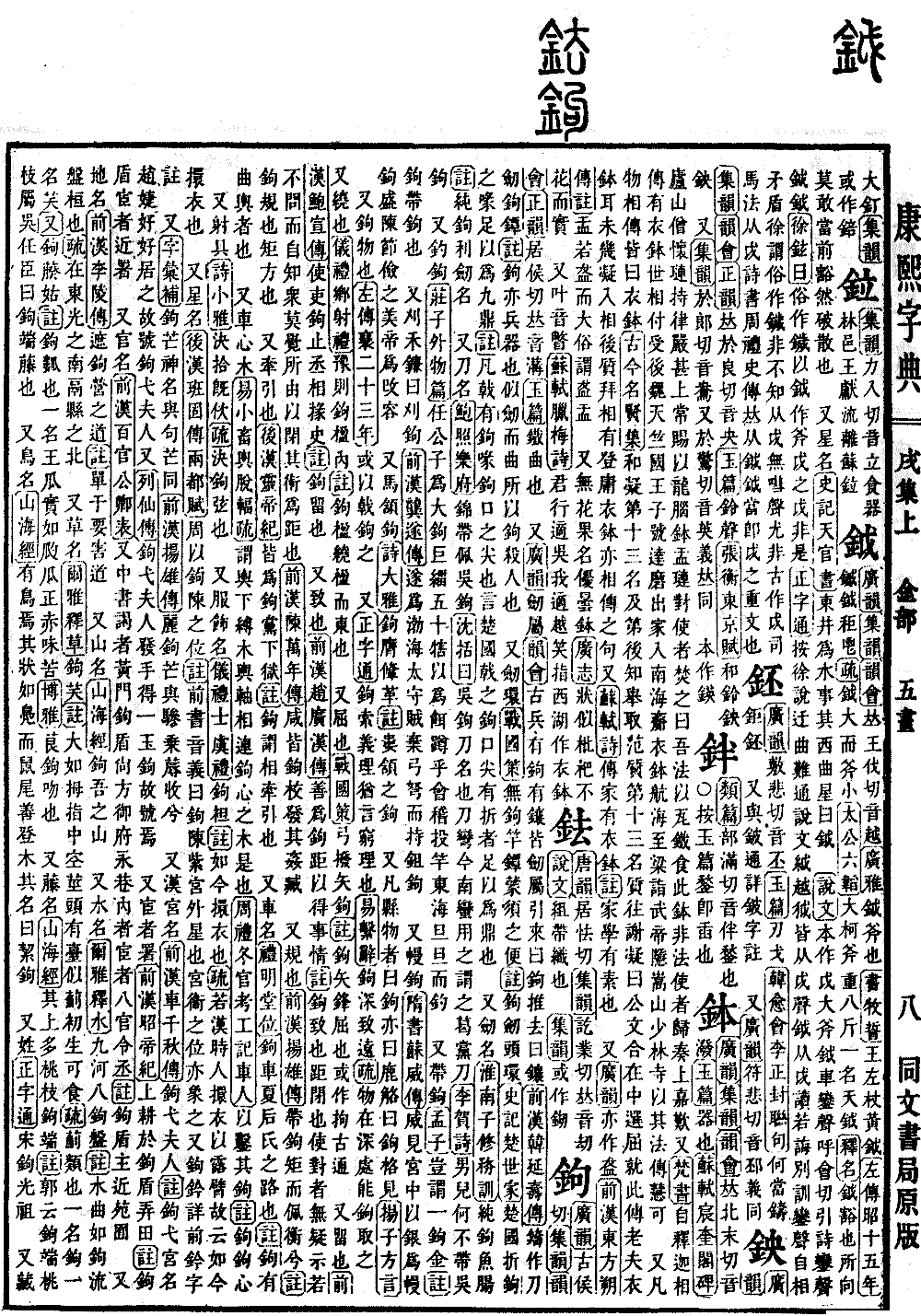
Xu Collection, Upper Volume. Radical: Metal (jīn). Character: 鉤; Kangxi stroke count: 13; Page 1302, Entry 08.
Pronounced gou.
In Yu Pian (Comprehensive Volume), it means an iron hook.
Also, in Guangyun (Broad Rhymes), a type of sword. In Yun Hui (Collection of Rhymes), ancient weapons include hooks and xiang (a type of polearm), both being sword-like. The one used to pull is called a hook, and the one used to push is called a xiang.
In the Biography of Han Yanshou in the History of the Former Han (Qian Hanshu), it mentions casting blades, swords, hooks, and sword guards. The commentary states that the hook is also a weapon, similar to a sword but curved, used for hooking and killing people.
Also, a sword ring. In Strategies of the Warring States (Zhanguoce), it mentions having no hook, pole, or guard, causing inconvenience for the wearer. The commentary notes the hook is the ring at the head of a sword.
In the Annals of Chu in the Records of the Grand Historian (Shiji), it mentions the beak-like hook of the State of Chu, which was sufficient to be cast into the Nine Tripods. The commentary notes that any halberd with a hooked beak refers to the tip of the hook-shaped edge. It says the hooks of the halberds of Chu, even those with broken tips, were enough to cast a tripod.
Also, a sword name. In Huainanzi, it mentions the Chun-Gou and Yu-Chang swords. The commentary notes Chun-Gou is the name of a sharp sword.
Also, a knife name. In a poem by Bao Zhao, it mentions wearing a Wu-Gou at the belt. Shen Kuo stated that the Wu-Gou is a type of knife. The blade is curved, and it is currently used by the southern barbarian tribes, known as the Gedang knife. Li He also references the Wu-Gou in his poetry.
Also, a fishing hook. In the External Things chapter of Zhuangzi, it records that the son of Ren made a large hook and thick rope, used fifty oxen as bait, sat at Kuaiji, cast the rod into the East Sea, and fished every day.
Also, a belt hook. In Mencius, it asks whether one is referring to a single hook of gold. The commentary notes that this hook refers to a belt hook.
Also, a sickle for harvesting grain is called an yi-gou. In the Biography of Gong Sui in the History of the Former Han (Qian Hanshu), it records that when Gong Sui was the Governor of Bohai, bandits abandoned their bows and crossbows to take up hoes and hooks.
Also, a curtain hook. In the Biography of Su Wei in the Book of Sui (Suishu), it records that Su Wei saw the palace using silver for curtain hooks and praised the virtue of frugality, which moved the Emperor.
Also, a horse-chest hook. In the Book of Odes (Shijing), it mentions hooks on the chest and leather straps. The commentary notes these are hooks under the horse's neck.
Also, anything used for hanging items is called a hook. Also called a deer-horn (lu-ge), or hook-rack (gou-ge). See the Erya (Approaching Elegance).
Also, to hook or pull things. In the Zuo Tradition (Zuozhuan), it records someone using a halberd to hook him.
Also, in Zhengzitong (Correction of Characters), it implies the meaning of searching or investigating, similar to exploring principles. In the Book of Changes (Yijing), it mentions hooking the deep to reach the far. The commentary notes that when things are in deep places, one can hook them out.
Also, to wind around. In the Book of Etiquette and Ceremonial (Yili), it refers to winding around a pillar. The commentary notes that hooking the pillar means walking around it toward the east.
Also, curved. In Strategies of the Warring States (Zhanguoce), it mentions bows being pulled and arrows being curved. The commentary notes that here, hook means the arrowhead is curved. Sometimes written in a variant form (ju). This was common in ancient times.
Also, to detain. In the History of the Former Han (Qian Hanshu), it mentions sending officials to detain the subordinates of the Chancellor. The commentary notes that here, hook means to detain.
Also, to recruit or solicit. In the Biography of Zhao Guanghan in the History of the Former Han (Qian Hanshu), it notes he was skilled at using the hook-ju method to obtain the truth of matters. The commentary explains that hook means to solicit, and ju means to close/seal. It makes the respondent have no doubts, acting as if the questioner knew the answer without asking, and others do not realize the source of the method. Using the closure of the method is called ju. In the Biography of Wan Nian, it mentions Chen Xian using the hook-jiao method to expose their treachery and corruption.
Also, to plan or measure. In the Biography of Yang Xiong in the History of the Former Han (Qian Hanshu), it mentions carrying a hook and square to be measured. The commentary notes that hook refers to a compass (circle) and ju refers to a square.
Also, to implicate. In the Annals of Emperor Ling in the History of the Later Han (Hou Hanshu), it refers to being imprisoned as part of a hook-dang (entangled faction). The commentary notes that hook here means to implicate one another.
Also, a type of carriage. In the Book of Rites (Liji), it mentions the hook-cart, the royal carriage of the Xia Dynasty. The commentary notes it is a carriage with a curved shaft.
Also, the wood at the center of a carriage. In the commentary on the Book of Changes (Yijing), it discusses the wood bound under the carriage to connect the axles, which is this central hook-wood. In the Book of Rites of Zhou (Zhouli), it mentions chiseling the hook. The commentary notes this refers to the hook-xin.
Also, an archery tool. In the Book of Odes (Shijing), it mentions the thumb ring being ready. The commentary notes the jue is the thumb ring used to pull the bowstring.
Also, a name for clothing. In the Book of Etiquette and Ceremonial (Yili), it refers to the gou-tan. The commentary compares it to rolling up sleeves today, as people in the Han Dynasty would roll up sleeves to expose their arms.
Also, a star name. In the Two Capitals Rhapsody by Ban Gu in the History of the Later Han (Hou Hanshu), it refers to the position of the hook. The commentary explains that the hook is an outer star of the Purple Forbidden Enclosure, representing the guards of the palace.
Also, gou-qian, described in the entry for the character qian.
Also, in Zi Huibu (Supplement to the Collection of Characters), gou-mang is a god's name, identical to Ju-mang. In the Biography of Yang Xiong in the History of the Former Han (Qian Hanshu), it mentions matching the riding carriage of Ru-shou with Gou-mang.
Also, a Han palace name. In the Biography of Che Qianqiu in the History of the Former Han (Qian Hanshu), it refers to Lady Gouyi. The commentary notes that Gouyi is the name of a palace where Lady Zhao liked to reside, hence the title. In Liexian Zhuan (Biographies of Immortals), it says Lady Gouyi stretched out her hand and obtained a jade hook, hence the name.
Also, an office for eunuchs. In the Annals of Emperor Zhao in the History of the Former Han (Qian Hanshu), it mentions the Emperor farming in the Gou-dun. The commentary notes Gou-dun is the office near the eunuchs.
Also, an official title. In the History of the Former Han (Qian Hanshu), it lists the eight official bureaus including the Gou-dun, which managed affairs near the imperial gardens.
Also, a place name. In the Biography of Li Ling in the History of the Former Han (Qian Hanshu), it refers to blocking the road at Gou-ying, a vital passage for the Xiongnu leader.
Also, a mountain name. Mentioned in the Classic of Mountains and Seas (Shanhaijing) as Gouwu Mountain.
Also, a water name. In the Erya (Approaching Elegance), it lists the nine rivers, the eighth being the Goupan. The commentary notes the water flows in curves like a hook, swirling and circling. It is located south of Dongguang and north of Ge County.
Also, a grass name. In the Erya (Approaching Elegance), it refers to the gou-fu. The commentary describes it as thumb-sized, hollow in the center, with a platform on the stem, similar to thistle, and edible when young. The commentary identifies it as a thistle-like plant. It also identifies it as the name for various types of melons, such as the snake gourd. In Boya, it is identified as a type of toxic plant.
Also, a vine name. The Classic of Mountains and Seas (Shanhaijing) mentions mountains having many peach-branch hook-ends. Guo Pu says the hook-end is a type of peach branch; Wu Renchen says it is a vine.
Also, a bird name. The Classic of Mountains and Seas (Shanhaijing) describes a bird shaped like a wild duck but with a rat's tail, skilled at climbing trees, named the xie-gou.
Also, a surname. In Zhengzitong (Correction of Characters), it mentions a Gou Guangzu from the Song Dynasty.
Also, the game of hiding the hook. In Fengtuji (Records of Local Customs), it describes people in the capital playing a game of hiding the hook after sunset, dividing into two teams to compete for victory. Li Shangyin wrote a poem mentioning passing the hook while the spring wine was warm.
Also, in Zheng Yun (Standard Rhymes), it is the same as the word for drawing lots. In Xunzi, it mentions casting lots and throwing hooks.
Also, jiao-gou, describing endless chatter. Ouyang Xiu has a poem mentioning speaking in endless talk.
Also, gou-zhou, the sound of a partridge calling. Lin Bu has a poem mentioning the cloud and water and the sound of the gou-zhou.
Also, in Jiyun (Collection of Rhymes), pronounced ju. Gouding, the name of a kingdom of the southwestern barbarians. In the History of the Former Han (Qian Hanshu), it records the naming of the King of Gouding.
Also, in Jiyun (Collection of Rhymes), pronounced gou. Gou-ti, a tool for attacking cities. In the Book of Odes (Shijing), it mentions using your hooking ladders. The commentary says the hook is a hooking ladder, a tool for pulling oneself up a city wall.
Also, in rhymes, it rhymes with the sound of "ju." In the poem "Sun Rising in the Southeast Corner," it mentions using cinnamon branches to make a hook for a basket.