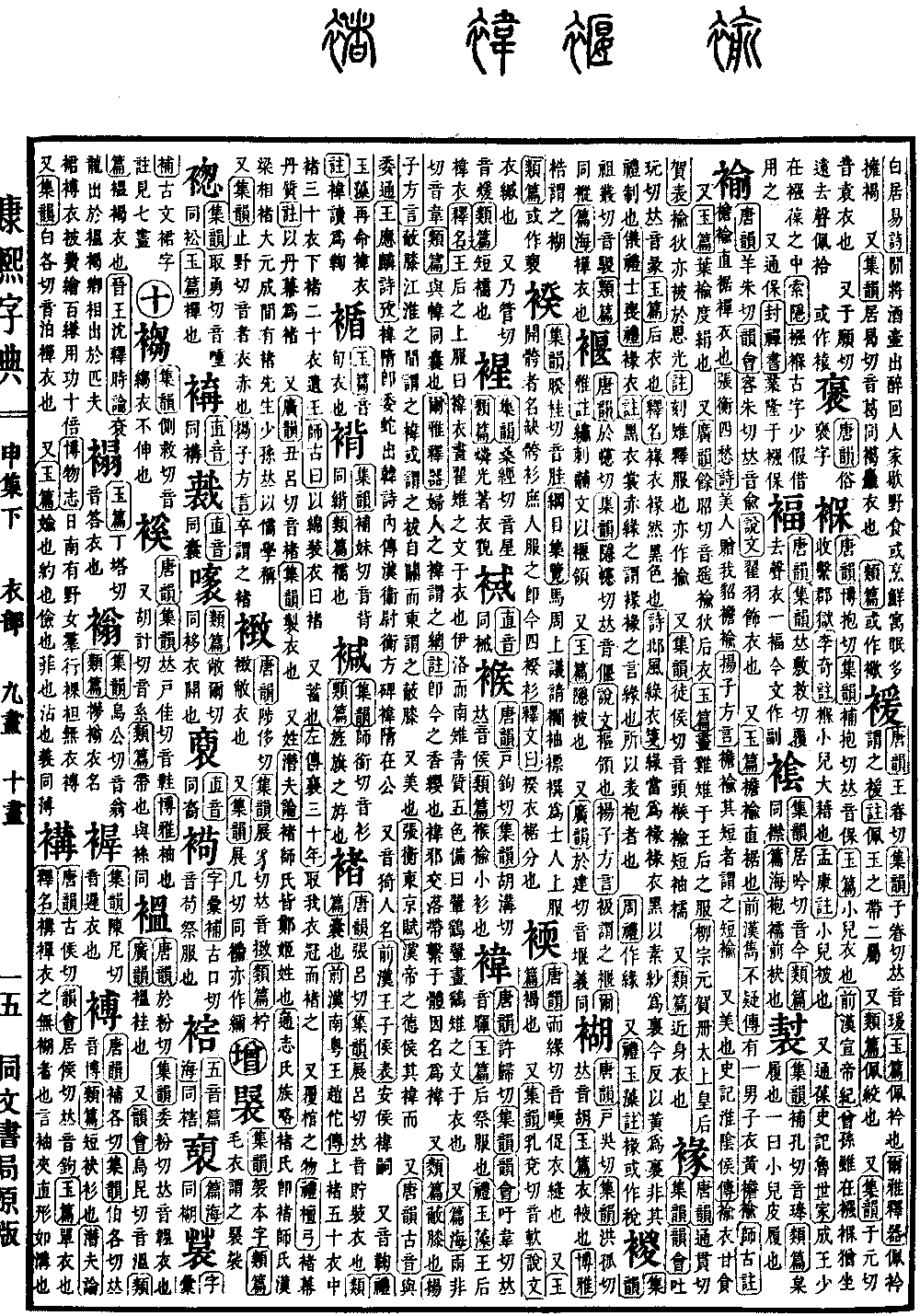
Shen Collection, Lower Volume
Radical: Clothing (yī)
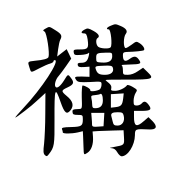
Entry: gou
Kangxi Strokes: 16
Page 1121, Entry 40
Pronounced gou.
In the Jade Pavilion (Yupian), it is defined as an unlined garment.
In the Explaining Names (Shiming), it states that a gou is an unlined garment without a lining. Its sleeves are straight in shape like a trench.
In the Records of Wu (Wuzhi), commentary by Pei Songzhi, it is noted that Lu Fan took off his outer garment, put on trousers and a tunic, and, holding a horse whip, arrived at the palace gate.
In the Book of Jin (Jinshu), Treatise on Rites, it is recorded that the Attendant in Ordinary, Che Yin, proposed that court officials should wear vermilion robes and gou-style head wraps when performing the bowing ceremony, to which the Crown Prince would respond with a return bow.
It also refers to arm coverings.
In the Book of the Later Han (Hou Hanshu), Annals of Empress Ma, it is mentioned that servants wore green arm coverings with pure white collars and cuffs.
The commentary explains that a gou is an arm garment, which is what is now called an arm sleeve. It is used to bind the left and right arms to make it convenient for working.
Furthermore, according to the Extended Rhymes (Zengyun), it refers to the pleats or wrinkles in clothing.