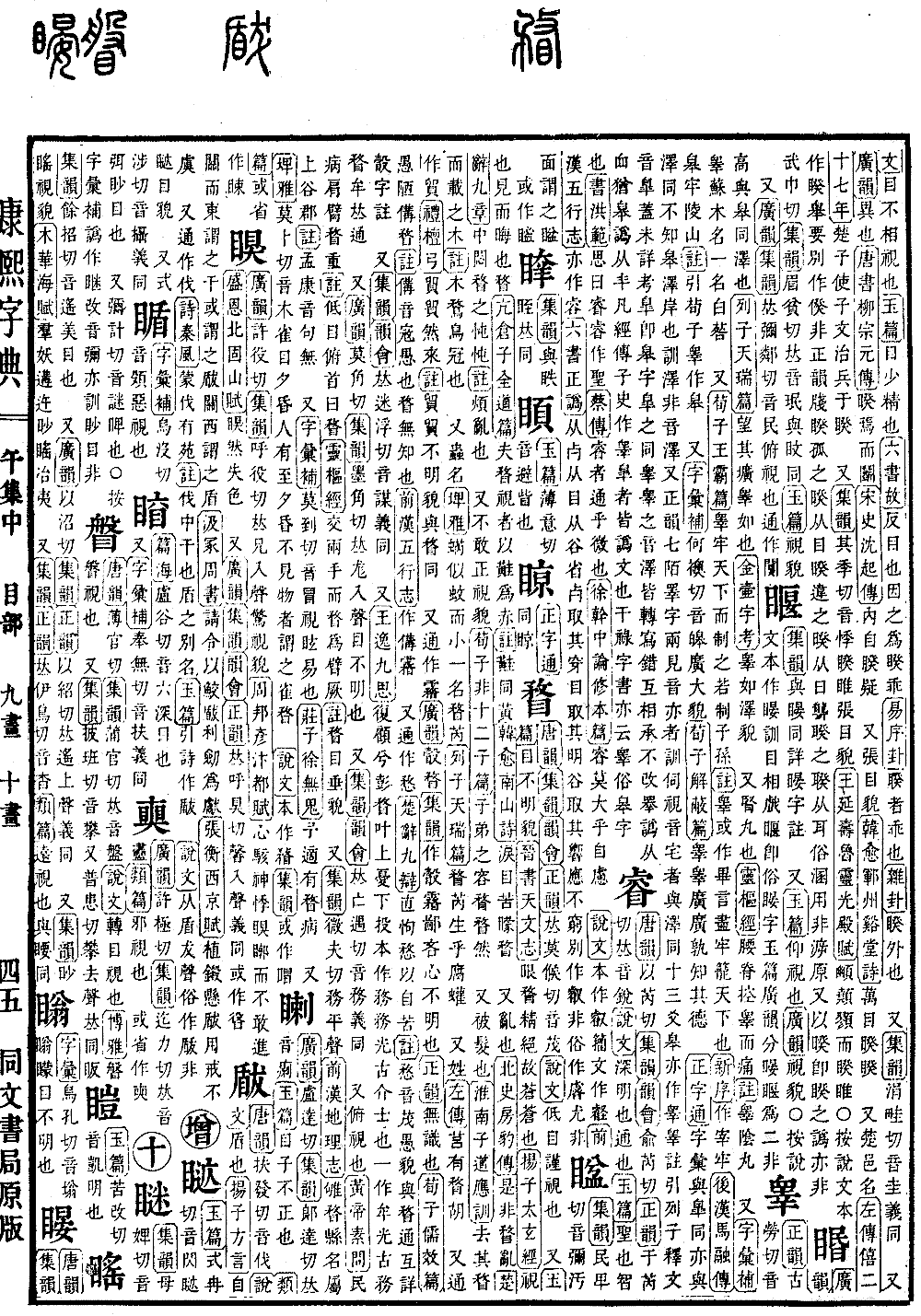
Wu Collection, Middle Volume
Radical: Eye (mù)
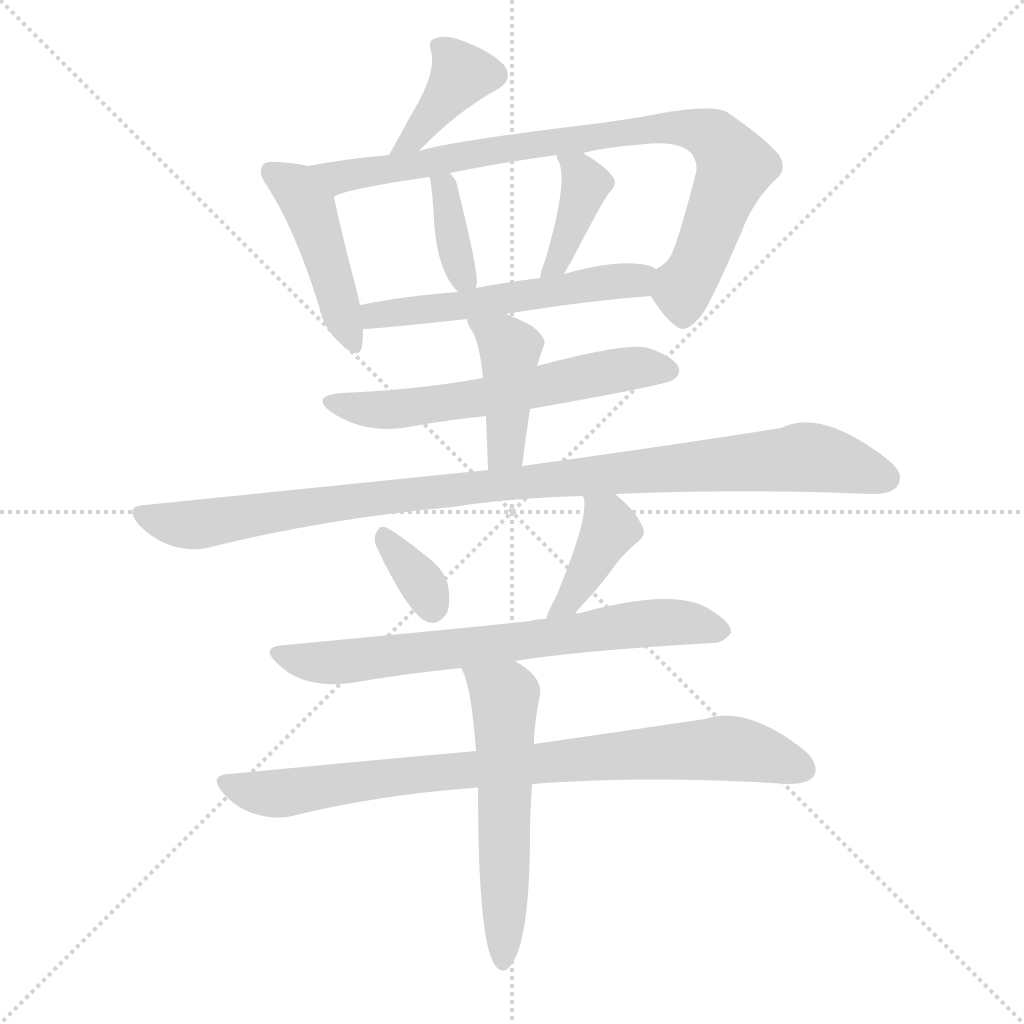
Character: gāo
Kangxi stroke count: 14
Page 813, Entry 03
Correct Rhymes (Zhengyun): Pronounced gāo. Same as gāo (marsh). In the Liezi (Liezi), Tianrui Chapter: Gazing at the wasteland, it appears vast. In the Golden Pot Character Examination (Jinhu zikao): Vast appearance. Also, the testicles. In the Spiritual Pivot (Lingshujing): The waist and spine are constrained by pain in the testicles. Commentary: The testicles are the scrotum. Also, in the Dictionary Supplement (Zihuibu): A tree name. Another name for white. Also, in the Xunzi (Xunzi), Wangba Chapter: To capture the world and control it as if controlling one's descendants. Commentary: May also be written as bì, meaning to fully contain the world. The New Preface (Xinxu) writes it as zǎi. In the Biography of Ma Rong (Ma Rong zhuan) in the History of the Later Han (Hou Hanshu): To capture the hills and mountains. Commentary: Citing the Xunzi, gāo is written as gāo. Also, in the Dictionary Supplement (Zihuibu): Pronounced hào. Appearance of vastness. In the Xunzi, Jiebi Chapter: Vast and wide, who can know its virtue? The Proper Character Comprehension (Zhengzitong) states that the character is the same as gāo and also the same as zé (marsh). It is a mistake to define it as marsh. In Correct Rhymes (Zhengyun), under the rhyme qī-mò, the character appears twice: one pronunciation as yì, meaning to observe; the other as zhái, the same as zé (marsh). In the rhyme shísān-yáo, gāo is also written as gāo. The commentary on gāo in the Liezi Interpretation (Liezi shiwen) pronounces it gāo, perhaps not having fully examined that gāo is the same as gāo. That gāo is the same as gāo, and that gāo is pronounced as zé, are all results of transmission errors and mutual corruption. The character gāo is an erroneous form derived from blood, just as gāo is an erroneous form derived from abundant. All instances in the classics, commentaries, and histories where gāo or gāo appear are erroneous scripts. The Ganlu Character Book also states: gāo is a common form of gāo.
yì
Ancient character form of the above.
Tang Rhyme (Tangyun): Pronounced yì. Collected Rhymes (Jiyun), Rhyme Meetings (Yunhui), and Correct Rhymes (Zhengyun): Pronounced yì.
Explanation of Characters (Shuowen): To observe or spy. To order officials to use their eyes to capture criminals.
Also, in the Dictionary (Zihui): To pull, to provide.
Also, in the Jade Chapter (Yupian): To be born, to be happy, to be good.
Also, in the Broad Rhyme (Guangyun): Appearance of pulling and drawing.
Also, a mountain name. In the Strategies of the Warring States (Zhanguoce): A mountain name, on the shady side of Mount Liangfu.
Also, in the Original Meanings of the Six Writings (Liushu benyi): Same as yì and yì.
Also, in the Broad Rhyme (Guangyun): Pronounced niè. Also means to observe or spy.
Also, in Correct Rhymes (Zhengyun): Pronounced zhái. Same as zé (marsh). In the Xunzi, Zhenglun Chapter: Side-loaded with fragrant herbs to nourish the nose. Commentary: Fragrant herbs. Or it is said that it should be zé, meaning marsh orchid.
Also, in Correct Rhymes (Zhengyun): The character zé is also written as yì.
Also, in Collected Rhymes (Jiyun): Pronounced dù. To ruin or spoil. Same as the characters for ruin or decay. Explanation of Characters (Shuowen): Originally written as. Composed of horizontal eye and. The original character for ruin is composed of the death radical.