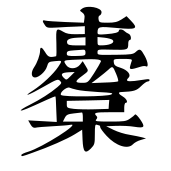
Chen Collection, Middle Volume
Radical: Tree (mù)
Kangxi Strokes: 19
Page 560, Entry 25
Pronounced gao
Shuowen Jiezi (Explanation of Simple and Compound Characters): A large case on a carriage.
Du Yu states: Gao means to encase; it is a cover for a bow, or a cover for armor. It also refers to a container for arrows.
Book of Rites (Liji), Tan Gong chapter: Do not carry cases or bow bags on a carriage used for announcement.
Zuo Zhuan (Zuo Commentary), First Year of Duke Zhao: Wu Ju requested to enter with his case lowered.
Commentary: This was to show he carried no bow.
Zuo Zhuan, Twenty-third Year of Duke Xi: On the right side was attached the arrow case and the bow bag.
Commentary: The case (gao) is for holding arrows, and the bow bag (jian) is for holding bows.
Also interchangeable with gao.
Zuo Zhuan, Tenth Year of Duke Zhuang: Prince Yan covered himself with a tiger skin and was the first to attack.
Sub-commentary: Wrapping weapons in tiger skin is called jian gao.
Pronounced gao
Book of Odes (Shijing), Minor Odes: The red bow is unstrung, and I take it and case it. I have distinguished guests, and in my heart I love them.
Textual Research: In the Book of Rites, Tan Gong chapter, the text mentions cases and curtains. Following the original text, this has been corrected to cases and bow bags.
Note: The passage regarding wrapping weapons in tiger skin is a sub-commentary, not a commentary, and has been corrected to reflect the original Zuo Zhuan sub-commentary.