Xu Collection, Upper Volume
Radical: Gate (mén)
Kangxi Strokes: 14
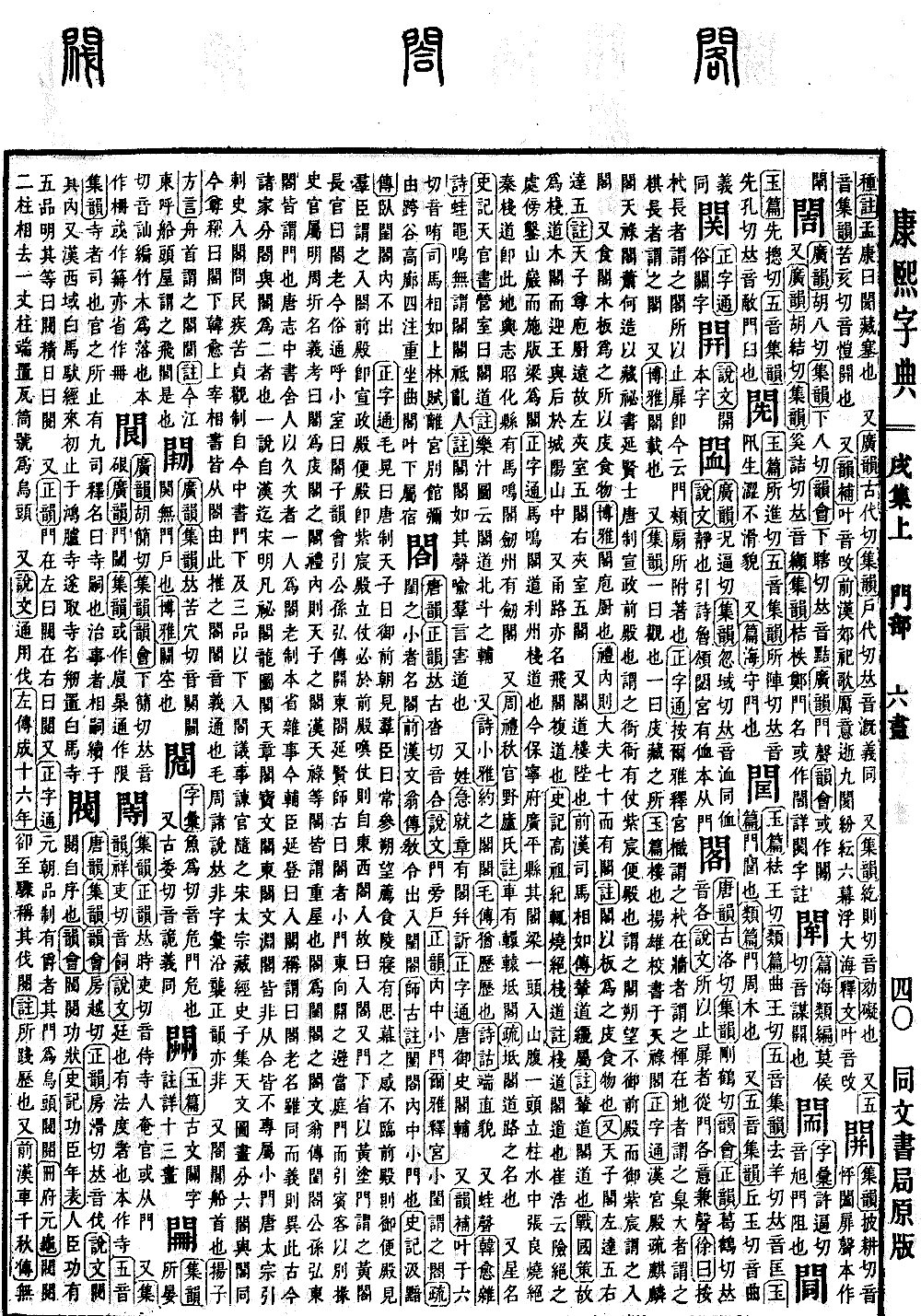
Page 1334, Entry 11
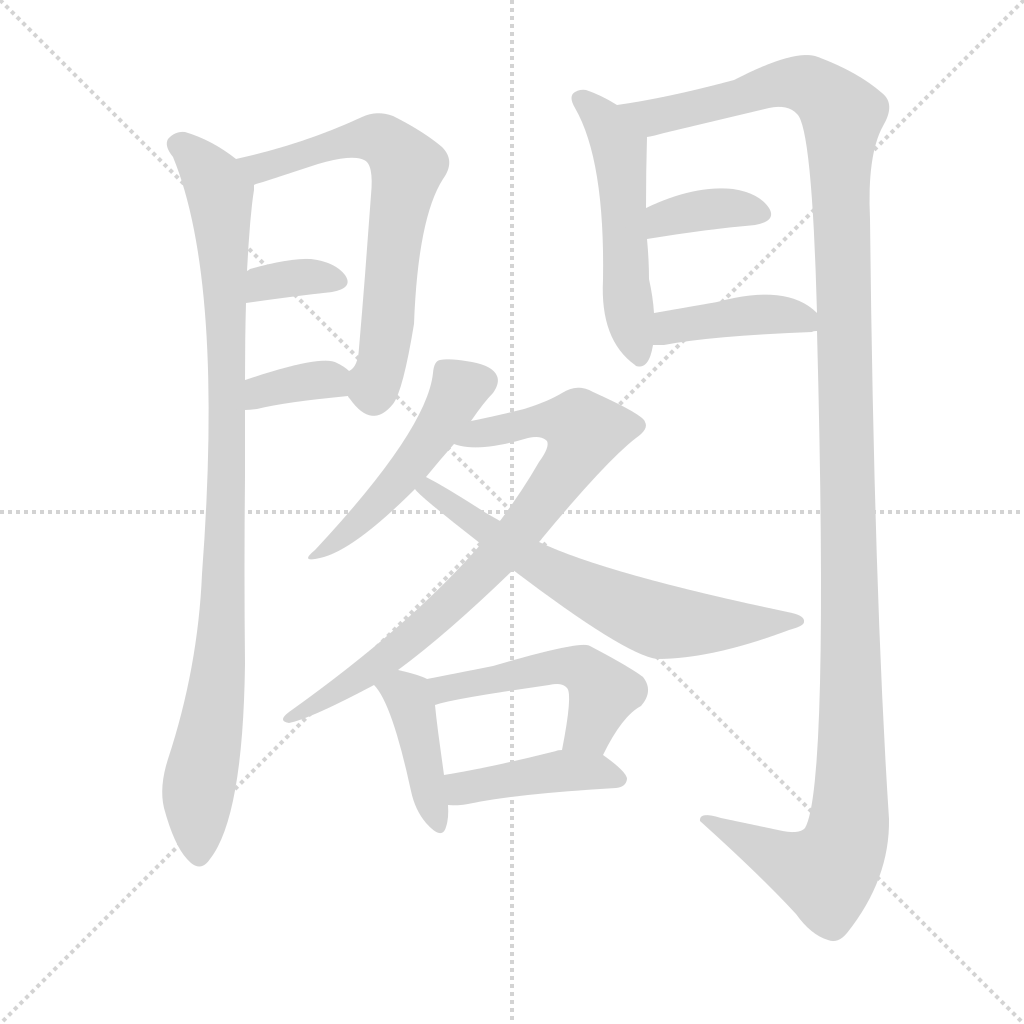
Pronounced ge.
According to the Explaining Graphs and Analyzing Characters (Shuowen Jiezi), it refers to an object used to fasten a door leaf. It is composed of the Gate radical and the character ge, which functions as both meaning and sound.
Xu Kai remarks: A long wooden stake is called a ge, used to stop a door leaf. It refers to what is now called a door cheek, the part to which the door leaf is attached.
In the Correct Meaning of Characters (Zhengzitong), it is noted that according to the Er Ya (an ancient dictionary), a wooden stake is called a yi, one on a wall is called a hui, one on the ground is called a nie, a large one is called a gong, and a long one is called a ge.
Also, according to the Guangya (a dictionary), ge means to support or carry.
According to the Jiyun (a rhyme dictionary), another interpretation refers to an observatory or viewing tower. Another interpretation refers to a storage space.
According to the Yupian (a jade chapter dictionary), it refers to a multi-story building. Yang Xiong collated books in the Tianlu Pavilion.
The Correct Meaning of Characters (Zhengzitong) states: Records of Han Palaces note that the Qilin Pavilion and Tianlu Pavilion were built by Xiao He to store secret texts and recruit virtuous scholars. In Tang dynasty state regulations, the Xuanzheng Hall was the front hall, called the ya, where ceremonial guards were stationed. The Zichen Hall was a side hall, called the ge. When the emperor did not hold court in the front hall on the first and fifteenth days of the month but went to the Zichen Hall, it was called entering the ge.
Also, it refers to a food cupboard made of wooden planks for storing provisions.
According to the Guangya, ge refers to a kitchen.
According to the Book of Rites (Liji), Inner Chapters (Neize), an official at age seventy is provided with a ge. The commentary notes that a ge is a place made of wooden planks for storing food.
Also: The emperor has ten such storage spaces, five on the left and five on the right. The commentary notes that since the emperor is exalted, the kitchen is kept at a distance; thus, there are five storage spaces in the left side-room and five in the right side-room.
Also, it refers to a raised walkway or gallery.
In the Former Han History (Qian Hanshu), Biography of Sima Xiangru, it is recorded that the carriage road connects consecutively. The commentary explains that the carriage road is the same as a raised walkway (ge dao).
In the Strategies of the Warring States (Zhanguoce), it describes building wooden plank roads (zhan ge) into the Chengyang mountains to welcome the King and Queen.
Also, a covered path, also called a flying gallery, refers to a double-roofed walkway.
In the Records of the Grand Historian (Shiji), Annals of Gaozu, the commentary on the burning and destruction of plank roads states that the plank road is a raised walkway. Cui Hao says that in steep terrain, roads were carved along cliffs and wooden planks were installed to create raised walkways.
The Correct Meaning of Characters (Zhengzitong) notes that the Maming Plank Road is a road in Lizhou. In present-day Guangping County of Baoning Prefecture, the beams for the raised walkway have one end inserted into the mountain face and the other end supported by pillars in the water. The Qin dynasty plank road burned by Zhang Liang is this one. The Records of Geography (Diyuzhi) records the Maming Plank Road in Zhaohua County and the Jian Ge in Jianzhou.
Also, according to the Rites of Zhou (Zhouli), Ministry of Autumn, commentary on the Official of Wild Huts (Yelushi), vehicles have specialized axle covers and raised pathways (di ge). The commentary explains that di ge is the name of a road.
Also, a star name. In the Records of the Grand Historian (Shiji), Book of Celestial Officials (Tianguanshu), it is written that six stars traverse the Milky Way and reach the Ying-Shi star mansion; this is called the Raised Walkway (Ge Dao). The commentary explains that the Ge Dao is an auxiliary star to the Big Dipper.
Also, in the Book of Odes (Shijing), Lesser Odes (Xiaoya), it is written "jue zhi ge ge." The Mao Commentary interprets this as being like distinct, clear lines. The Poetry Exegesis (Shigu) interprets this as a straight, upright appearance.
Also, the sound of frogs. In the Miscellaneous Poems of Han Yu, it is written that frogs croak meaninglessly, a ge ge sound that only disturbs people. The commentary notes that ge ge mimics the sound. This is a metaphor for various reckless speeches that endanger the proper path.
Also, a surname. In the Emergency Handbook (Jijiu Zhang), there is a name Ge Bingxin. The Correct Meaning of Characters (Zhengzitong) notes that in the Tang dynasty, there was an Imperial Censor named Ge Fu.
Also, according to the Rhyme Supplement (Yunbu), it rhymes with the sound you.
In Sima Xiangru's Shanglin Rhapsody (Shanglin Fu), it is written: "Remote palaces and separate lodges, spanning mountains and crossing valleys. Tall galleries pouring in four directions, multi-storied sitting areas and curved walkways." The rhyme matches the following lines.