Chen Collection, Middle Volume
Radical: Tree (mù)
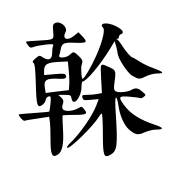
Gan
Kangxi strokes: 14
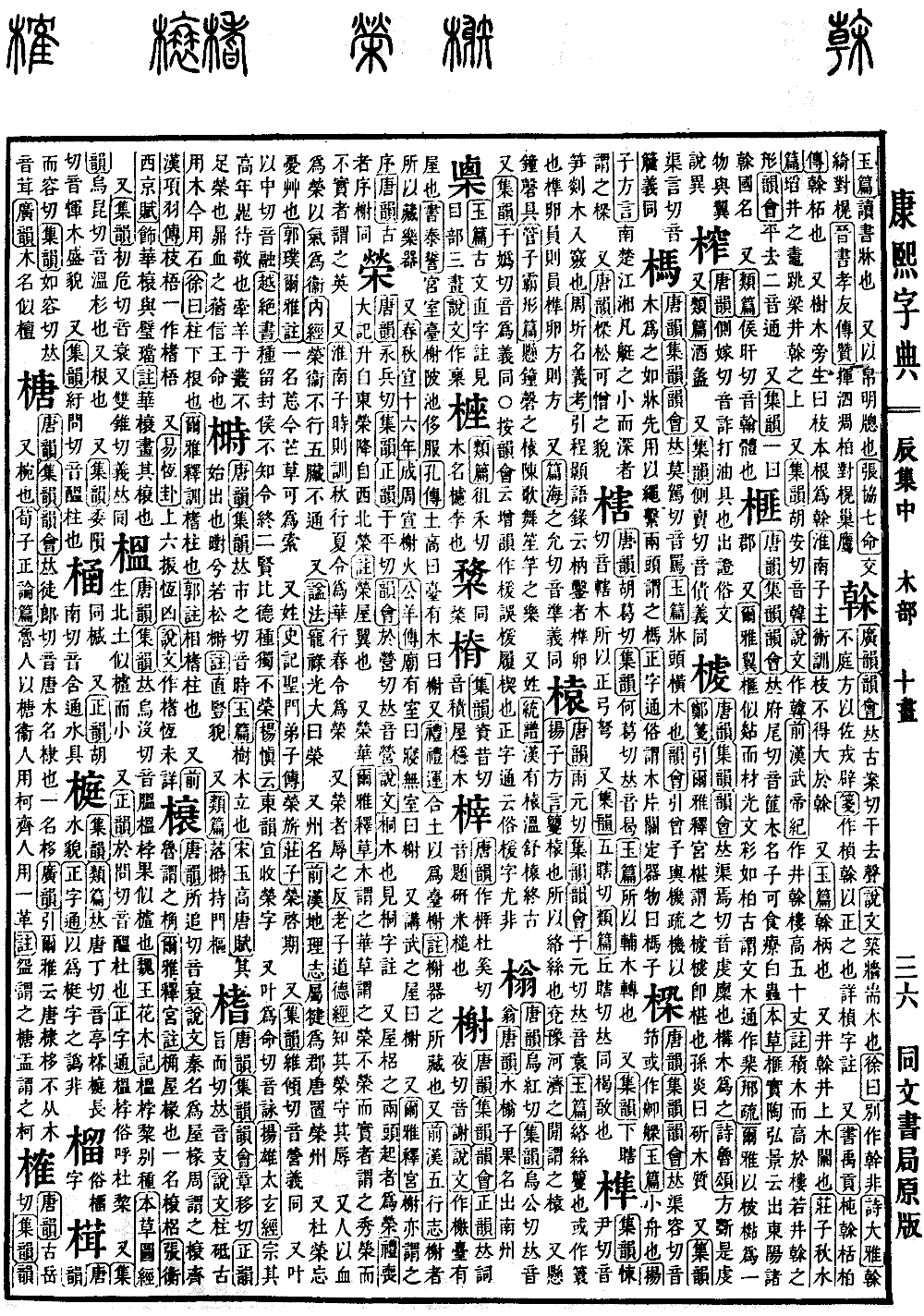
Page 544, Entry 01
According to the Comprehensive Rhymes (Guangyun) and the Collection of Rhymes (Yunhui), it is pronounced gan (falling tone), which is the falling tone version of the character gan.
According to the Explaining Graphs and Analyzing Characters (Shuowen Jiezi), it refers to the wooden pillars used at both ends of a wall during construction to provide support and stability.
Xu Xuan states that writing it as the variant form (gan) is incorrect.
The Book of Odes (Shijing) contains the line, "Supporting the unruly regions to assist your majesty."
Zheng Xuan, in his annotations, explains this as creating a framework to rectify the four corners of the realm. For detailed information, see the annotations for the character zhen.
Additionally, the Book of Documents (Shangshu) mentions "chun-gan and pine-cypress."
Kong Yingda comments that in this context, gan refers to the wild mulberry tree.
Furthermore, branches growing from a tree are called zhi, while the main trunk at the base is called gan.
The Huainanzi says: Branches cannot be thicker than the main trunk.
According to the Jade Chapters (Yupian), gan refers to the handle of a tool.
It also refers to the well-frame, the wooden barrier built around a well.
The Zhuangzi contains the passage, "The frog in the pit jumps along the edge of the well-frame."
According to the Collected Rhymes (Jiyun), it is also pronounced han (level tone).
The Explaining Graphs and Analyzing Characters (Shuowen Jiezi) identifies this as the variant form.
The History of the Former Han (Qian Hanshu) records the construction of a well-frame tower, fifty zhang in height.
The commentary explains this as a high tower built by stacking timber in a manner resembling a well barrier.
The Collection of Rhymes (Yunhui) notes that both the level and falling tone pronunciations are commonly used.
According to the Classified Chapters (Leipian), it is also pronounced han (falling tone). It refers to the essence or body of a thing.