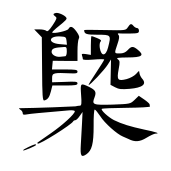
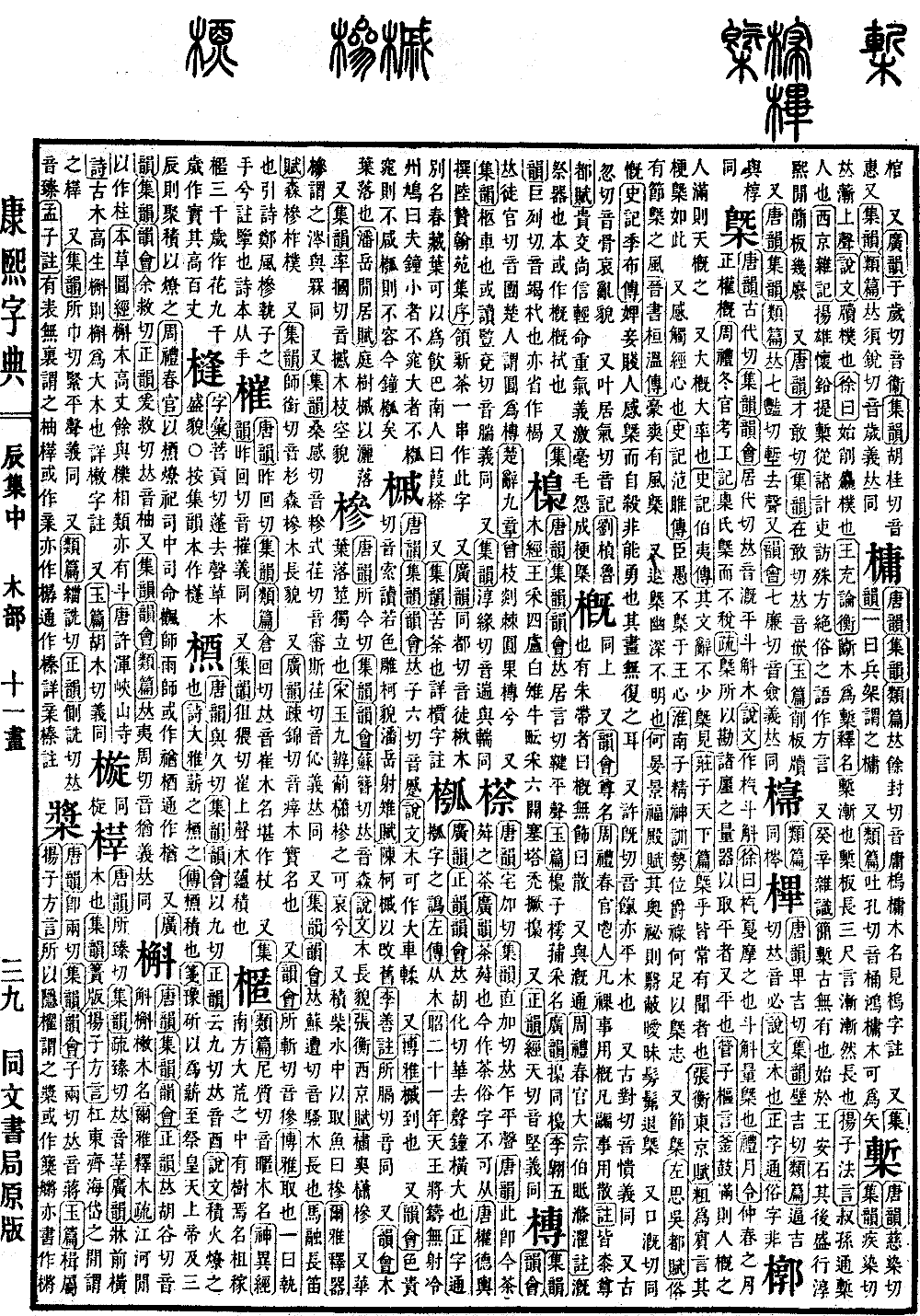
Chen Collection, Middle Volume. Radical: Tree (mù). Kangxi stroke count: 15. Page 547, Entry 06.
Tang Dynasty Rhymes (Tangyun) states: pronounced gai. Collected Rhymes (Jiyun) and Rhyme Compendium (Yunhui) state: pronounced gai. A wooden board used to level off grain in containers such as the dou and hu.
Explaining Graphs and Analyzing Characters (Shuowen) writes it as the form with the radical for wood, referring to the dou and hu. Xu states: it refers to the act of scraping and smoothing. The dou and hu are tools used to level off grain when measuring.
Book of Rites (Liji), Monthly Ordinances (Yueling): In the middle month of spring, standardize weights and leveling boards.
Rites of Zhou (Zhouli), Winter Offices, Record of Craftsmen (Kaogongji): The market supervisor uses leveling boards to verify measurements without levying taxes. The Commentary (Shu) says: the leveling board is a tool used to inspect various market measuring devices to ensure fairness.
It also carries the meaning of level. Guanzi, Pivot of Words (Shuyan): When the pot and drum containers are full, one will scrape them level; when human desires are full, Heaven will level them.
It also means generally or outline. Records of the Grand Historian (Shiji), Biography of Boyi: Their literary works are rarely seen in outline. Zhuangzi, Under Heaven Chapter: They are generally people who have heard of common teachings. Zhang Heng, Western Capital Rhapsody (Dongjing fu): Roughly narrating for the guests, this is what is generally meant.
It also implies feelings stirred in the heart. Records of the Grand Historian (Shiji), Biography of Fan Ju: Your servant is dull and cannot align with the feelings of your Majesty. Huainanzi, Treatise on the Spirit (Jingshen xun): How could power, status, titles, or stipends be enough to move one's spirit?
It also means integrity and spirit. Zuo Si, Rhapsody on the Capital of Wu (Wudu fu): Among the people, there is a tradition of integrity and spirit. Book of Jin (Jinshu), Biography of Huan Wen: Bold, heroic, and possessed of a dignified spirit.
It also refers to the phrase tui gai, meaning deep, obscure, and unclear. He Yan, Rhapsody on the Jingfu Hall (Jingfu dian fu): That which is deep and obscure is hidden and dim, appearing dark and indistinct.
Also pronounced kai. Same as the character for sigh or indignation. Records of the Grand Historian (Shiji), Biography of Ji Bu: If a maid or a lowly person commits suicide out of indignation, it is not because they are brave, but because their planning has left them with no retreat.
Also pronounced xi. Also a tool for leveling wood.
Also pronounced kui. The meaning is the same.
Also pronounced gu. The appearance of being sorrowful and confused.
Also rhyming as ji. Liu Zhen, Rhapsody on the Capital of Lu (Lu du fu): Valuing associations and honoring trustworthiness, making light of life while valuing integrity. Righteous indignation is sparked from the smallest hairs, and resentment takes shape in the general outline.