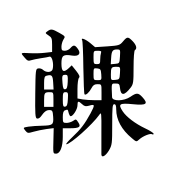
You Collection, Lower Volume
Radical: Carriage (chē)
Kangxi strokes: 15
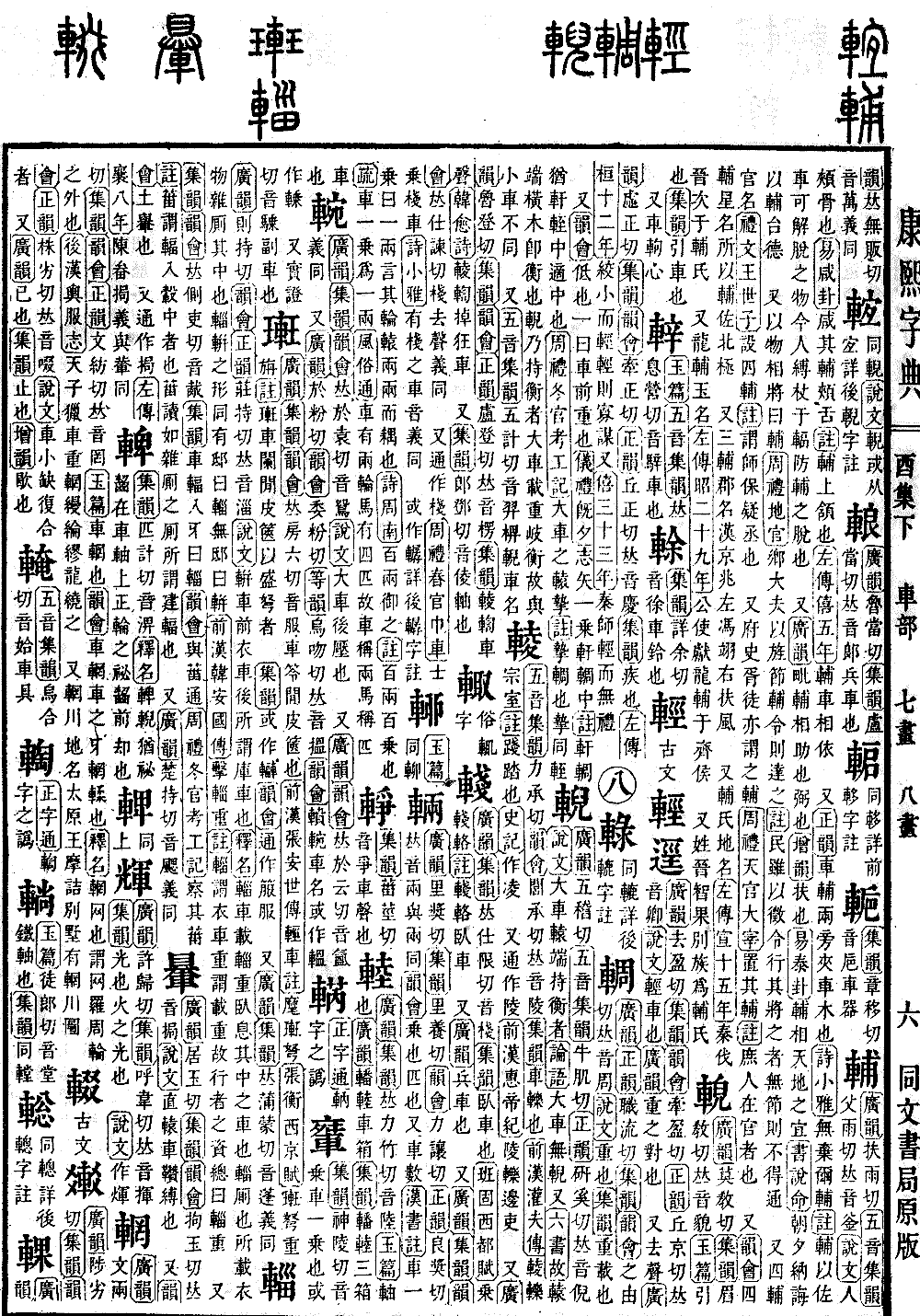
Page 1244, Entry 38
Pronounced huo.
Expanded Dictionary of Rhymes (Guangyun): Grease horn of a carriage.
Collected Rhymes (Jiyun): A tube. A container for carriage grease.
Compilation of Rhymes (Yunhui): When a carriage is in motion, the axle must be lubricated; thus, it is often loaded with grease to apply to the axle. This is the implement that holds the grease. People in the State of Qi compared Chunyu Kun to a roasted grease-container, meaning his words were profound and full of meaning, just like a container of roasted grease where the oil is not exhausted even after a long time.
Explaining Graphs and Analyzing Characters (Shuowen): Written as guo.
Collected Rhymes (Jiyun): Sometimes written as a variant form.
Pronounced guo. The meaning is the same.
Pronounced huai.
Expanded Dictionary of Rhymes (Guangyun): Appearance of a hub rotating.
Record of Rites (Liji), Miscellaneous Records: Shusun Wushu attended court and saw a wheelwright using his staff to pass through the hub and rotate the wheel.
Sub-commentary (Shu): Guan means to pierce. Guo means to rotate. This describes using his wooden staff to pass through the carriage hub to turn the wheel.
Pronounced hui. Pronounced kuai. Pronounced hui. The meaning is the same.
Textual research: In the Record of Rites, Miscellaneous Records, the text mentions Shusun Wushu attending court and seeing a wheelwright use his staff to pass through the hub and rotate the wheel. The commentary states that guan means to pierce and guo means to rotate. I have carefully corrected this to reflect the sub-commentary in accordance with the original book.