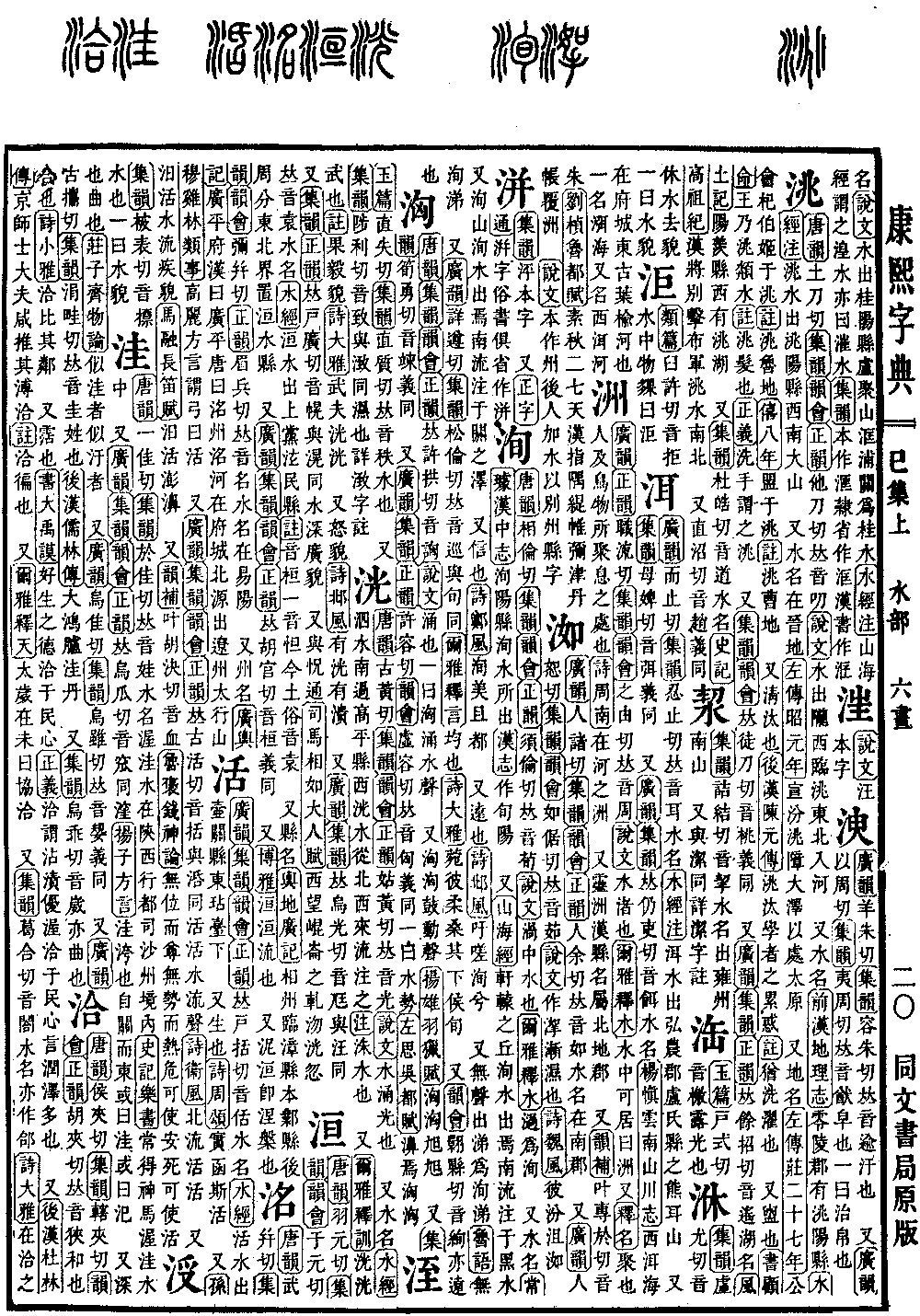
Si Collection, Upper Volume
Radical: Water (shuǐ)
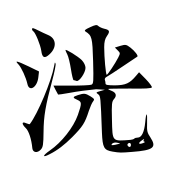
Guang
Kangxi Stroke Count: 10
Page 622, Entry 15
Tang Rhymes (Tangyun) and other standard phonological dictionaries state that the character is pronounced guang.
Explanation from Explaining Graphs and Analyzing Characters (Shuowen Jiezi): The appearance of water ripples as they surge and reflect light. It also refers to a river. The Commentary on the Classic of Water (Shuijing) records: The Si River flows south, passing west of Gaoping County; the Guang River flows from the north and west, pouring into it. The commentary explains that this is the Zhu River.
In the Erya (Erya): Explaining Teachings (Shixun), guang-guang denotes martial prowess, describing a courageous and determined appearance. The Book of Odes (Shijing), Greater Odes (Daya) contains the line: The martial men are fierce and bold.
It also describes the appearance of being angry. The Book of Odes (Shijing), Odes of Bei (Beifeng) contains the line: There is anger and there is clamor.
According to the Guangyun and Jiyun, it is pronounced wang. It has the same meaning as the character wang (a vast expanse of water).
According to the Jiyun and Zhengyun, it is pronounced huang. It has the same meaning as the character huang (deep and wide, as in a body of water).
It is also used interchangeably with the character huang. The Grand Master's Rhapsody (Daren Fu) by Sima Xiangru contains the line: Looking west toward the obscure and vast Kunlun Mountains.