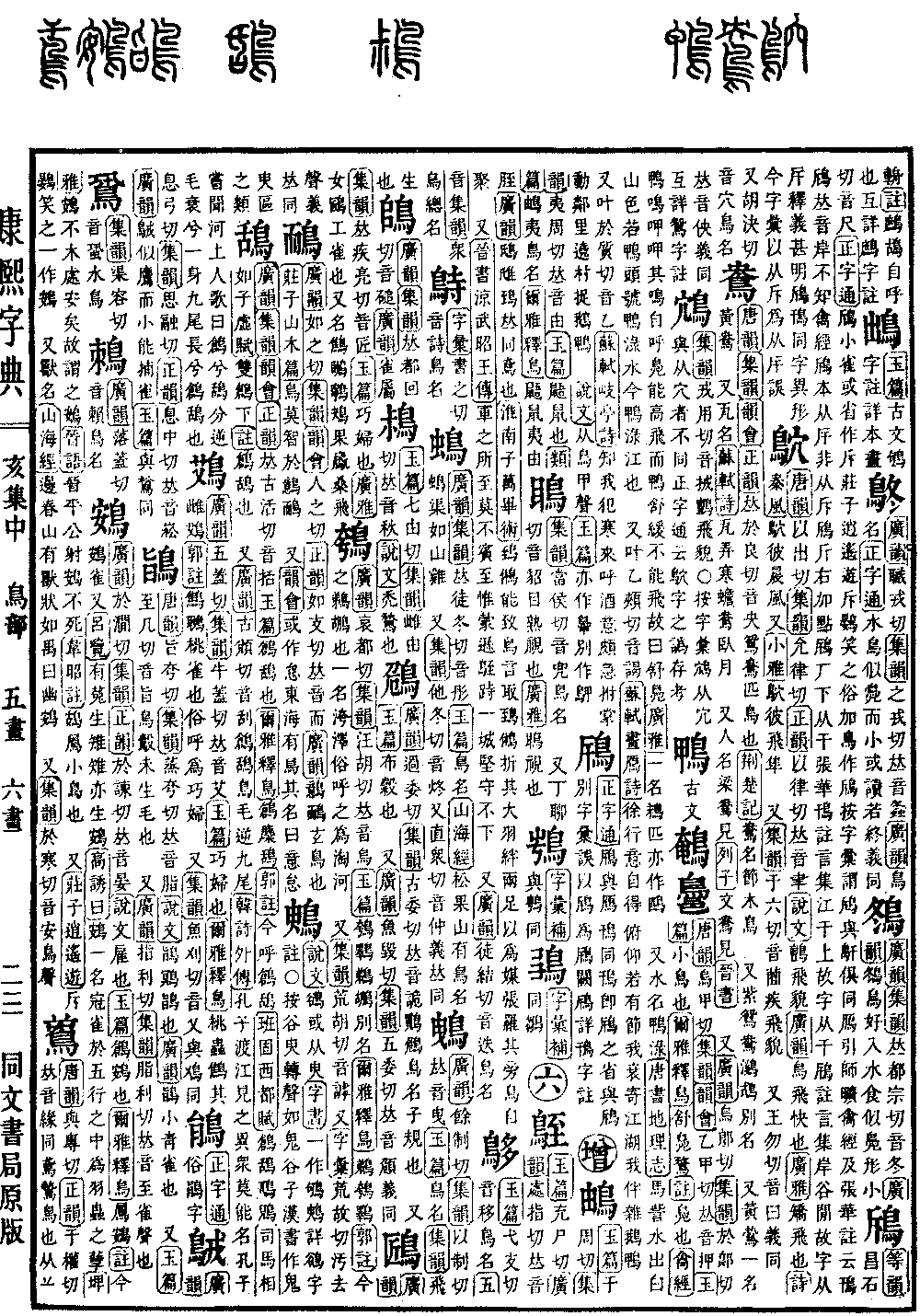
Hai Collection, Lower Volume
Radical: Bird (niǎo)
Character: guā
Kangxi Strokes: 17
Page 1487, Entry 28
Broad Rhymes (Guangyun), Collected Rhymes (Jiyun), Rhyme Meetings (Yunhui), and Correct Rhymes (Zhengyun): Pronounced kuò.
Jade Chapters (Yupian): The cāng is a guā.
Approaching Elegance (Erya), Explanation of Birds: The cāng is a míguā.
Guo commentary: Nowadays it is called cāngguā.
Ban Gu, Rhapsody on the Western Capital (Xidu Fu): The cāngguā, the yòu, and the yì birds.
Sima Xiangru, Rhapsody on Sir Vacuity (Zixu Fu): A pair of cāng descend.
Commentary: This refers to the cāngguā.
Also, in Broad Rhymes (Guangyun): Pronounced guā. The cāngguā is a bird with feathers growing in reverse and nine tails.
Outer Commentary of Han's Poetry (Hanshi Waizhuan): Confucius crossed the river and saw a strange bird that no one among the crowd could identify. Confucius had once heard a man by the river singing: Oh cāng, oh guā, with feathers turned back and hair worn thin, one body with nine long tails. This is the cāngguā.