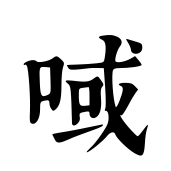
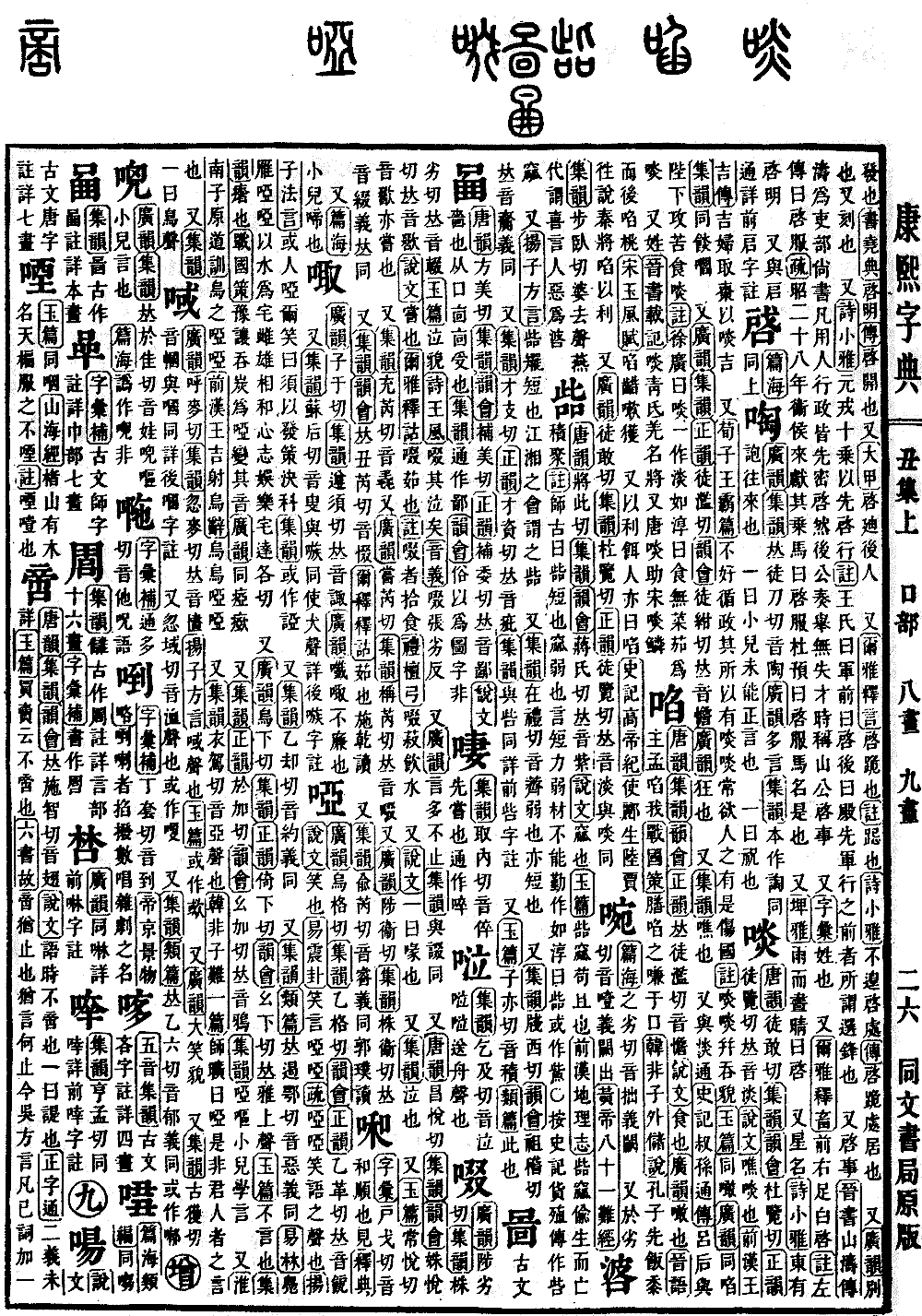
According to the Extended Rhymes (Guangyun), it is pronounced mai (falling tone). According to the Collection of Rhymes (Jiyun), it is pronounced mai (falling tone), and it has the same pronunciation as the character pronounced hua (entering tone). The Dialect (Fangyan) by Yang Xiong explains: It refers to a sound. The Jade Chapter (Yupian) records: Sometimes it is also written in a variant form (jie).
Also, according to the Extended Rhymes (Guangyun), it is explained as: describing the appearance of loud laughter.
Also, according to the Collection of Rhymes (Jiyun), it is pronounced huo (entering tone), and it has the same pronunciation as guo (entering tone). It is identical to the character pronounced guo. A detailed explanation can be found in the subsequent annotation for the character pronounced guo.
Also, it is pronounced xu (entering tone), and it has the same pronunciation as xu (entering tone). It refers to a sound. Sometimes it is also written in a variant form (zhuan).
Also, according to the Collection of Rhymes (Jiyun) and the Categorized Dictionary (Leipian), it is pronounced yu (entering tone), and it has the same pronunciation as yu (entering tone). The meaning is the same. Sometimes it is also written as the character pronounced yu (entering tone).