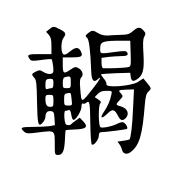
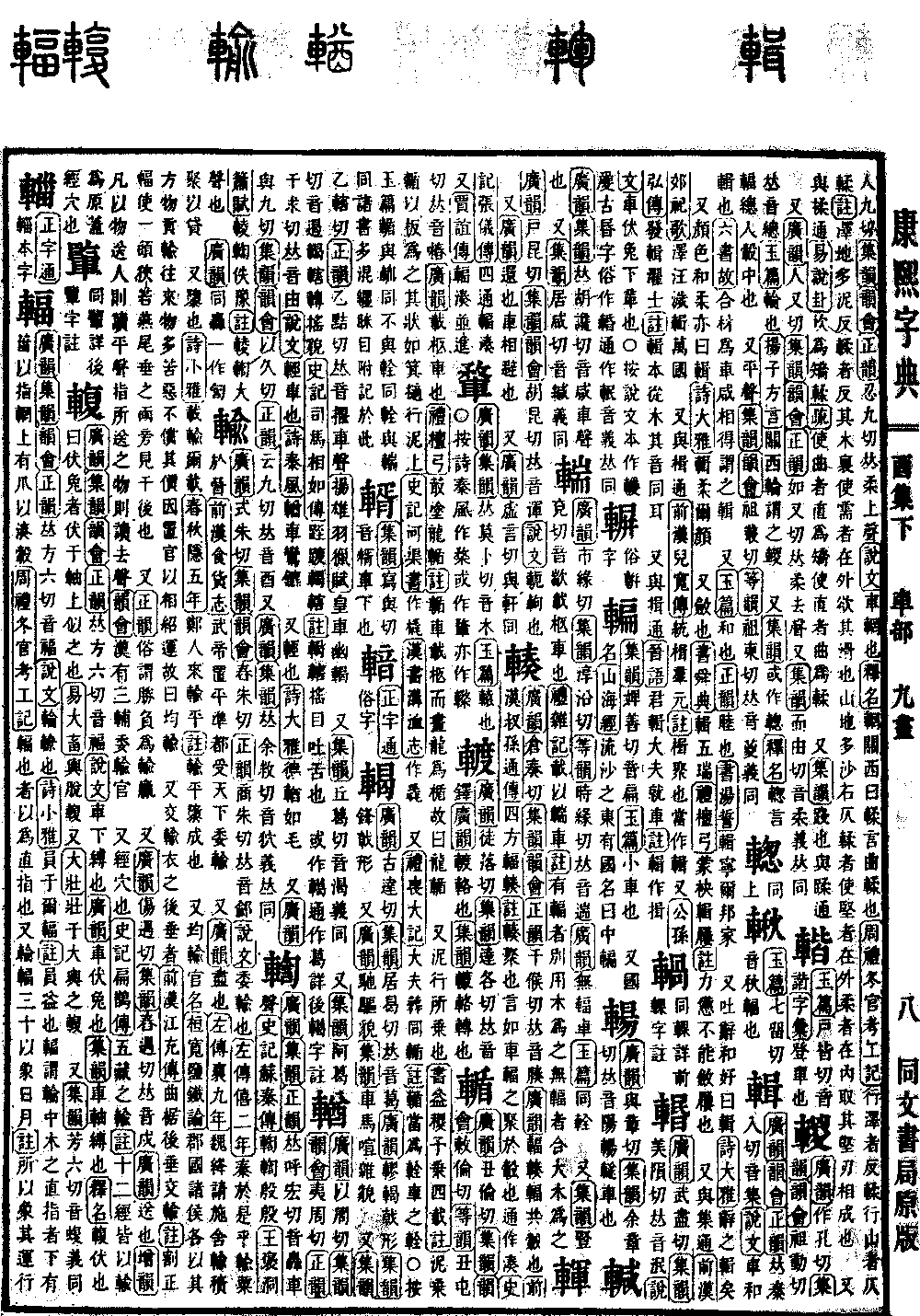
You Collection, Lower Volume
Radical: Carriage (chē)
Kangxi strokes: 16
Page 1246, Entry 20
Pronounced ge.
According to the Expanded Rhymes (Guangyun), it refers to jiao-ge, which describes the shape of a halberd.
According to the Collection of Rhymes (Jiyun), it refers to the shape of a sharp halberd.
Also, according to the Expanded Rhymes (Guangyun), it describes the appearance of galloping or rushing.
According to the Collection of Rhymes (Jiyun), it describes the noisy and chaotic sound of carriages and horses.
Pronounced ya.
Refers to the sound of a carriage.
In the Rhapsody on the Feather Hunt (Yulie Fu) by Yang Xiong, it is written: The imperial carriage is quiet and ge.
Pronounced ke.
Meaning is the same as above.
Pronounced e.
Ge-xia describes the appearance of rotating and swaying.
In the Biography of Sima Xiangru from the Records of the Grand Historian (Shiji): Zhi-duo ge-xia.
The commentary notes: Ge-xia refers to the appearance of rolling eyes and sticking out the tongue.
Sometimes written in a variant form (ga).
Used interchangeably with ge. For a detailed explanation, see the entry for the character ga.