You Collection, Upper Volume
Radical: Horn (jiǎo)
Kangxi Strokes: 13
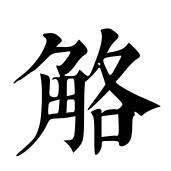
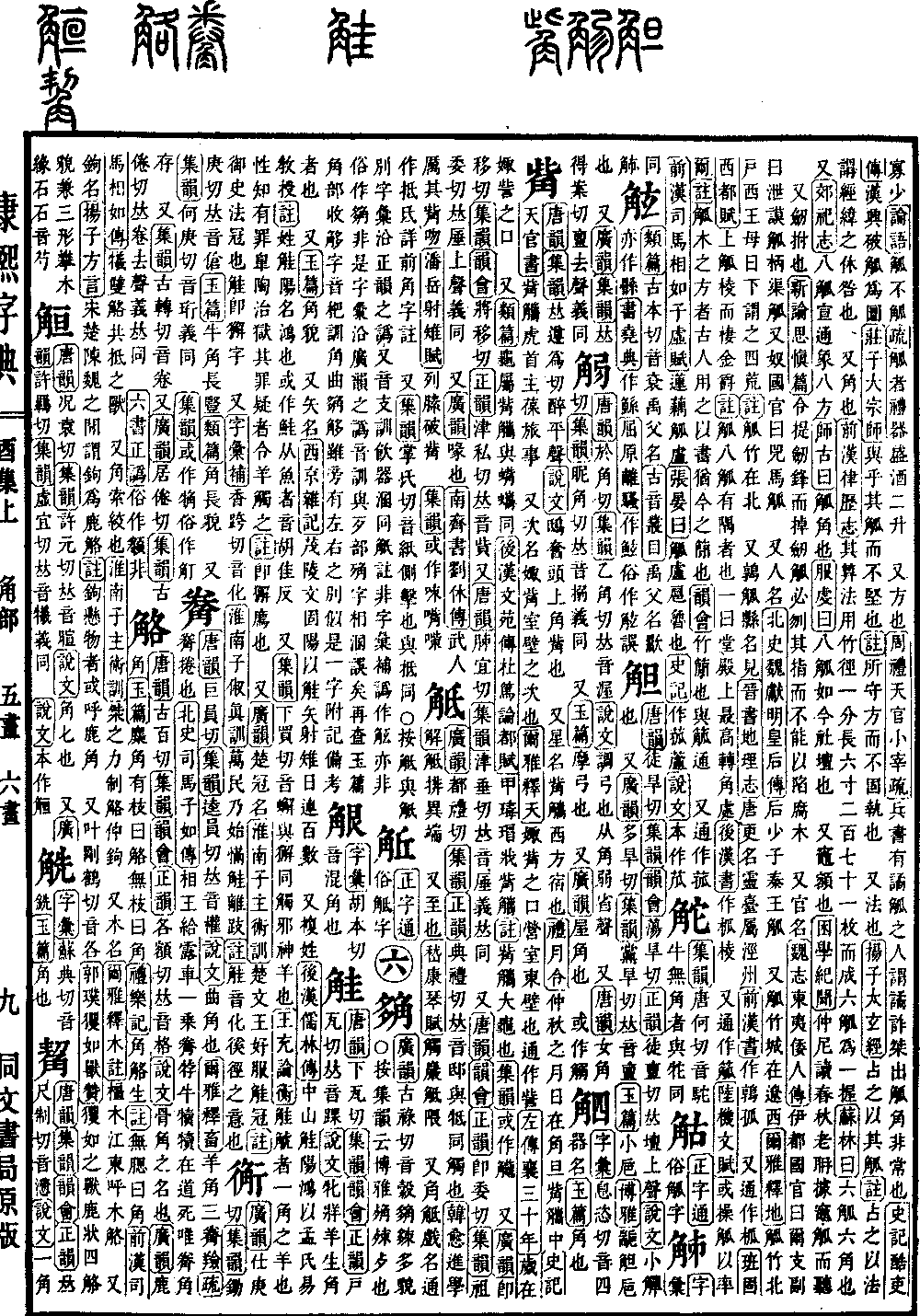
Page 1141, Entry 16
Pronounced ge (entering tone). In the Shuowen Jiezi (Explanation of Simple and Compound Characters), it refers to a classification of bones and horns. According to the Guangyun (Broad Rhymes), it refers to deer antlers. In the Yupian (Jade Chapter), it is noted that when the antlers of a milu deer have branches, they are called ge, and when they lack branches, they are called jiao. In the Book of Rites (Liji), in the chapter on Music, it states: Horns and antlers grow. The commentary explains that those without branches are called jiao. In the History of the Former Han (Qianshan Shu), Biography of Sima Xiangru, it refers to a beast with bifurcated antlers where the roots of the two horns are connected. Also, in the Huainanzi (Masters of Huainan), Treatise on the Arts of Rulership, it mentions the ability to break the horns of beasts and straighten iron hooks, to collect iron implements and gather metals. Gao You’s commentary explains: Ge means horn. It also refers to a type of tree. In the commentary to the Erya (Approaching Elegance), section on trees, it notes that the jiang tree is called muge in the Jiangdong region. It also refers to a type of hook. In the Fangyan (Regional Speech) by Yangzi, it is stated that in the regions between Song, Chu, and Wei, a hook is called luge. The commentary notes that a hook is a tool used for hanging objects. Some also call it lujiao. Also pronounced ganghe (entering tone), sounds like ge. In the praise for the jue-ru beast by Guo Pu, it is described that the jue-ru beast is shaped like a deer and has four horns. Its appearance combines three forms, and it can climb trees and scale rocks. Shi is pronounced shao.
Textual research: In the Book of Rites (Liji), Music chapter, it states: Horns and antlers grow. The commentary says: Those without gills are called jiao. I have carefully corrected this based on the original text to state that those without branches are called jiao. Also, regarding the phrase horn, cord, and twist: in the Huainanzi, Treatise on the Arts of Rulership, the text reads: The strength of Jie could break ge and straighten hooks. I have carefully corrected this based on the Huainan commentary to read: Huainanzi, Treatise on the Arts of Rulership, regarding breaking ge, straightening hooks, extracting iron, and gathering metal. Gao’s commentary states: Ge means horn. This explains that ge is horn, and it is not an explanation of ge as being a horn, a cord, or a twist. I have corrected it according to the original text.