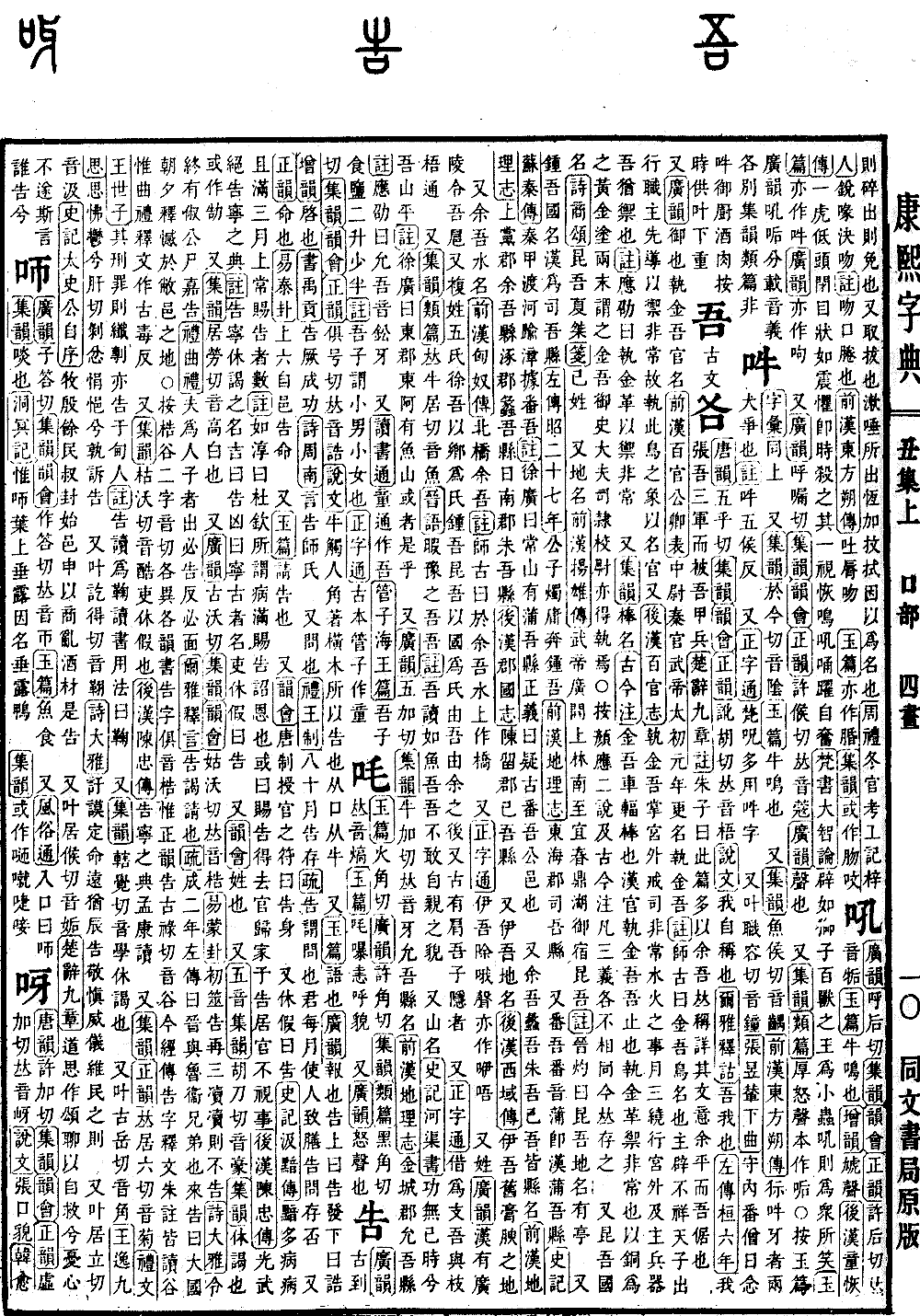
Chou Collection, Upper Volume
Radical: Mouth (kǒu)
Kangxi Strokes: 7
Page 180, Entry 06
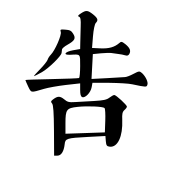
Pronounced gào. According to the Explaining Graphs and Analyzing Characters (Shuowen Jiezi), it refers to a cow bumping into someone, with a horizontal piece of wood attached to its horns, symbolizing a warning. It is formed from the components mouth and cow.
Also, according to the Jade Chapters (Yupian), it means to speak. According to the Broad Rhymes (Guangyun), it means to report. Reporting to a superior is called gào; issuing orders to a subordinate is called gào. According to the Augmented Rhymes (Zengyun), it means to inform. In the Book of Documents (Shujing) chapter Tribute of Yu (Yu Gong), it says, "Reported their success." In the Book of Odes (Shijing), chapter Zhou South (Zhou Nan), it says, "Speak and report to the teacher."
Also, to inquire. In the Book of Rites (Liji), chapter Royal Regulations (Wangzhi), it says, "At eighty, ask after their state of well-being every month." The commentary explains that gào means to inquire; the ruler would send someone every month to provide food and ask whether the person was still alive.
Also, according to the Correct Rhymes (Zhengyun), it means to command. In the Book of Changes (Yijing), hexagram Peace (Tai), it says, "The topmost six, from the city, proclaims orders."
Also, according to the Jade Chapters (Yupian), to request leave.
Also, according to the Rhyme Compendium (Yunhui), in the Tang dynasty system, the proof of appointment to an official post was called a gào body.
Also, rest or leave is called gào. In the Records of the Grand Historian (Shiji), Biography of Ji An, it notes that An was often ill, and when his illness lasted nearly three months, the emperor would often grant him leave. The commentary by Ru Chun says that Du Qin referred to the grace of being granted leave during illness. Others say that being granted leave meant the official could leave his post and return home, while granting leave while remaining in office meant the official did not attend to business. In the History of the Later Han (Hou Hanshu), Biography of Chen Zhong, it mentions, "Guangwu ended the practice of gào for rest." The commentary notes that gào-ning is the name for leave; auspicious leave is gào, and leave during bereavement is ning. In ancient times, the term for officials taking leave was gào.
Also, according to the Rhyme Compendium (Yunhui), it is a surname.
Also, according to the Five Sounds Rhyme Compendium (Wuyin Jiyun), pronounced háo. According to the Collection of Rhymes (Jiyun), it means leave of absence. Sometimes written in a variant form.
Also, according to the Collection of Rhymes (Jiyun), pronounced gāo. Means white.
Also, according to the Broad Rhymes (Guangyun) and the Collection of Rhymes (Jiyun) and the Rhyme Compendium (Yunhui), pronounced gù. In the Book of Changes (Yijing), hexagram Youthful Folly (Meng), it says, "The first time, the oracle gives an answer. If he asks again and again, it is importunate; if it is importunate, it will not answer." In the Book of Odes (Shijing), chapter Greater Odes (Daya), it says, "With a complete end there is a beginning; the duke's impersonator gives a happy report." In the Book of Rites (Liji), chapter Record of Rites (Quli), it says, "A son, when going out, must report, and upon returning, must present himself." According to the Elegant Glossary (Erya), chapter Explaining Words (Shiyan), gào means to request. The commentary notes that the Zuo Commentary (Zuozhuan) for the second year of Cheng says, "Jin, Lu, and Wei are brothers. They came to report, saying: 'The great state has morning and evening vented its anger on the soil of our humble state.'" Note: The characters for gù and gǔ have different pronunciations. In all rhyme books, gào is generally pronounced gù, except in Correct Rhymes where it is pronounced gǔ. Now, in the classics, gào is pronounced gǔ in all commentaries. Only in the Record of Rites (Quli) is it pronounced gǔ.
Also, according to the Collection of Rhymes (Jiyun), pronounced kù. Official leave of absence. In the History of the Later Han (Hou Hanshu), Biography of Chen Zhong, it refers to the practice of gào for rest, which Meng Kang reads this way.
Also, according to the Collection of Rhymes (Jiyun) and the Correct Rhymes (Zhengyun), pronounced jú. In the Book of Rites (Liji), chapter Heir of King Wen (Wenwang Shizi), it says, "As for penal crimes, they are meticulously handled, and also reported to the field officer." The commentary says gào is read as jú. To read books and apply the law is called jú.
Also, according to the Collection of Rhymes (Jiyun), pronounced xué. Leave of absence.
Also, as a rhyming word, pronounced jiǎo. In Wang Yi's Nine Regrets (Jiusi), "My thoughts are troubled and my liver is peeled; who can I tell my anger and frustration to?"
Also, as a rhyming word, pronounced jǐ. In the Book of Odes (Shijing), chapter Greater Odes (Daya), "Great plans to settle the mandate, distant strategies established and reported. Respectful and cautious in demeanor, a model for the people."
Also, as a rhyming word, pronounced jǐ. In the Records of the Grand Historian (Shiji), Author's Preface, "Herding the remaining people of Yin, Shu Feng was the first enfeoffed. Relying on the chaos of Shang, the liquor materials were thus reported."
Also, as a rhyming word, pronounced gòu. In the Chu Songs (Chuci), chapter Nine Declarations (Jiuzhang), "Thinking of the Way, I compose a eulogy, merely to save myself. My sorrow is unfulfilled, to whom can I report these words?"