Xu Collection, Middle Volume
Radical: Mound (fù)
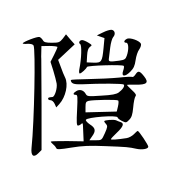
隑; Kangxi stroke count: 18; Page: 1358, entry 01
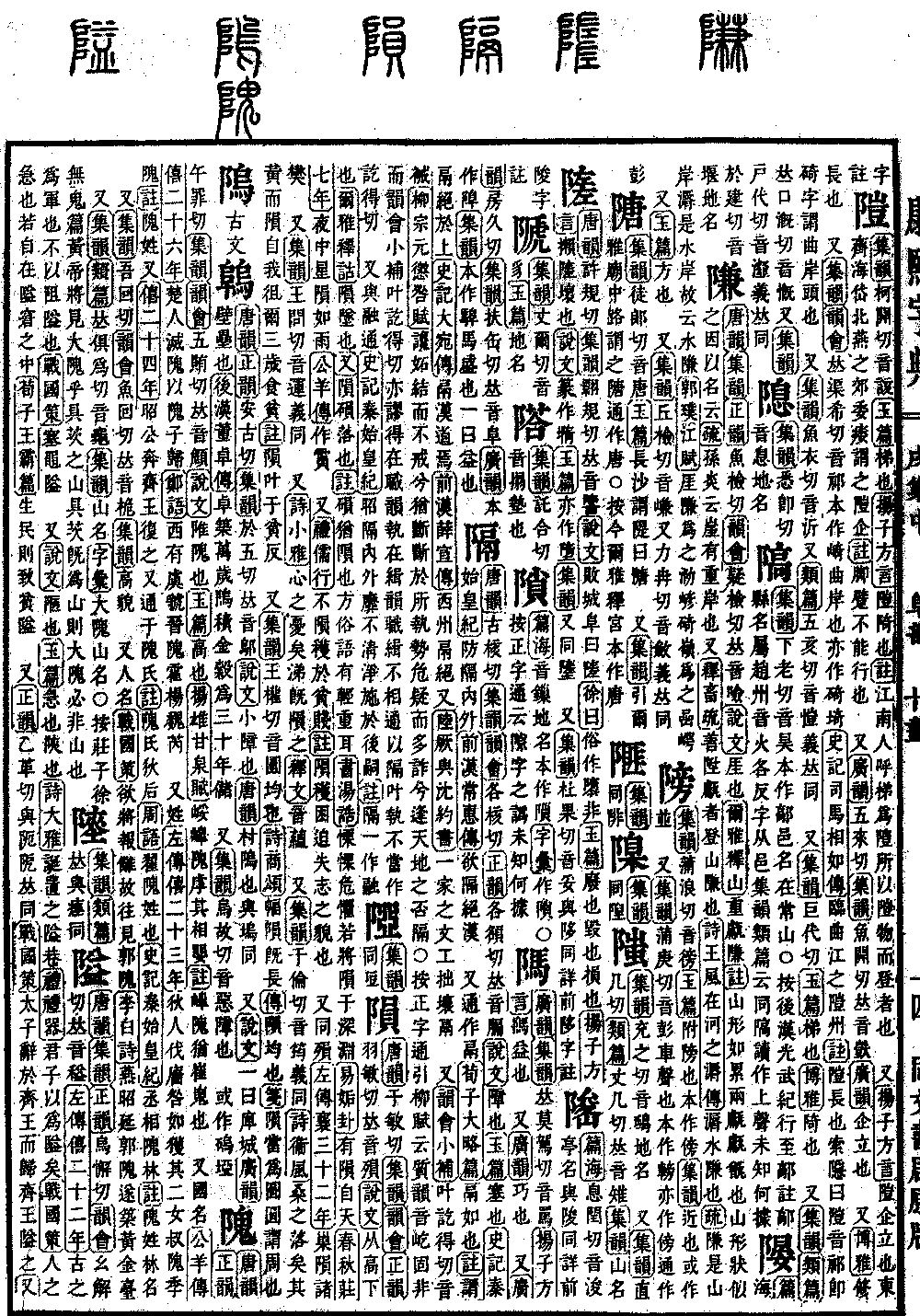
Jiyun (Jíyùn): pronunciation Kē kāi qiè, sound gāi. Yùpiān: ladder. Yangzi Fangyan (Yángzǐ Fāngyán): 隑 means to lean or rely on. Annotation: People in Jiangnan call a ladder 隑; it is an object used to ascend by leaning against something. Also, Yangzi Fangyan (Yángzǐ Fāngyán): 隑企 means to stand. In the rural areas of Eastern Qi, Haidai, and Northern Yan, wěiruò wúlì (weak and powerless) is called 隑企. Annotation: Refers to being lame in the foot and unable to walk. Also, Guangyun (Guǎngyùn): pronunciation Wǔ lái qiè. Jiyun (Jíyùn): pronunciation Yú kāi qiè, sound dāi. Guangyun (Guǎngyùn): to stand on tiptoe. Also, Boya (Bóyǎ): long and slender appearance. Also, Jiyun (Jíyùn), Yunhui (Yùnhuì): pronunciation Qú xī qiè, sound qí. Originally written as 崎 (qí). A winding riverbank. Also written as 碕 (qí) or 埼 (qí). Records of the Grand Historian (Shǐjì), Biography of Sima Xiangru: "Approaching the 隑-zhou (an islet) in the winding river." Annotation: 隑 means long. Suoyin (Suǒyǐn) states: 隑 is pronounced qí. It is the character 碕 (qí), referring to a winding bank. Also, Jiyun (Jíyùn): pronunciation Yú yī qiè, sound yí. Also, Leipian (Lèipiān): pronunciation Wǔ hài qiè, sound kǎi. The meaning is the same. Also, Jiyun (Jíyùn): pronunciation Jù dài qiè. Yùpiān: ladder. Boya (Bóyǎ): to lean or rely on. Also, Jiyun (Jíyùn), Leipian (Lèipiān): pronunciation Kǒu gài qiè, sound kài. Also, Jiyun (Jíyùn): pronunciation Hù dài qiè, sound xiè. The meaning is the same.