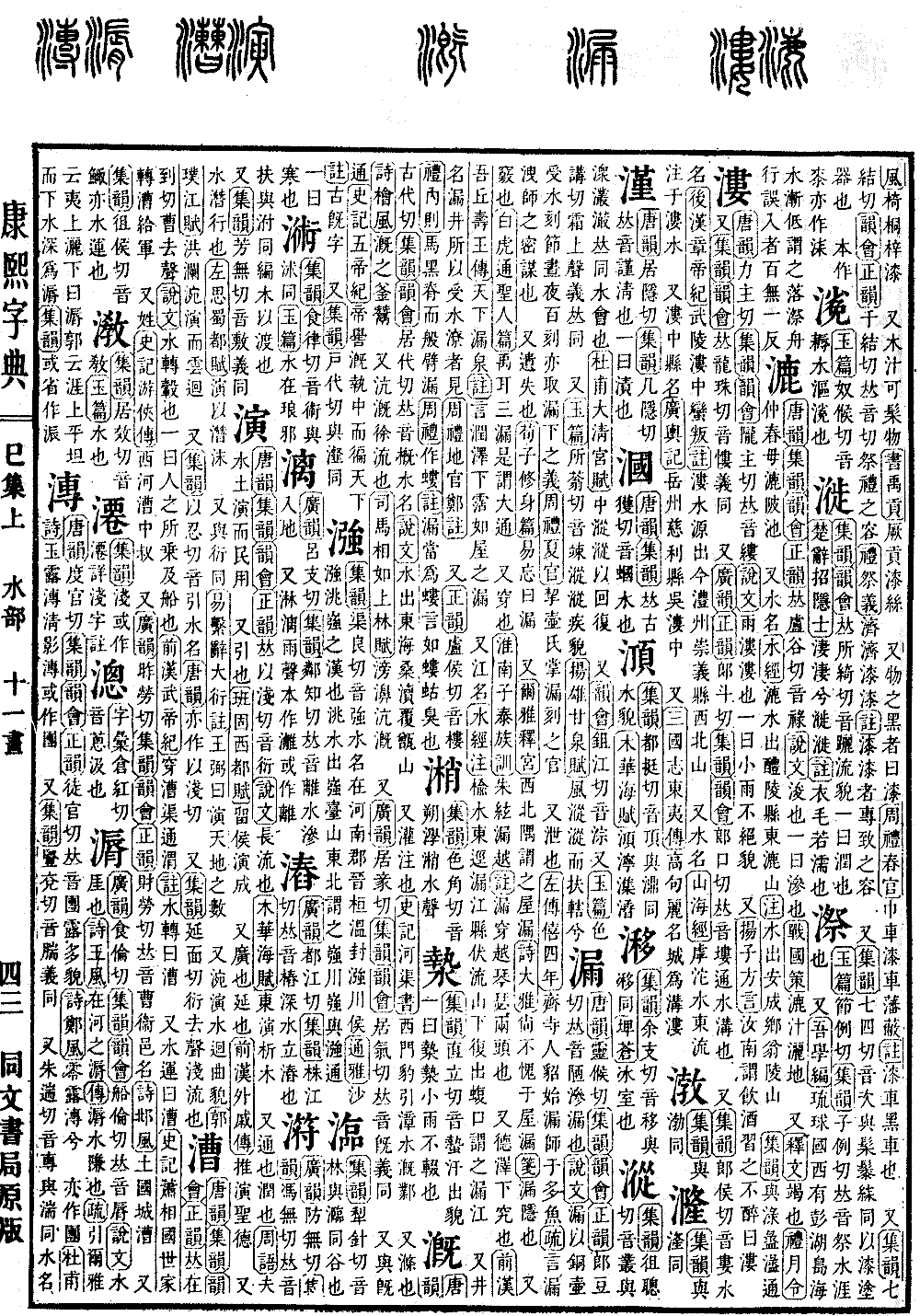
Si Collection, Upper Volume
Radical: Water (shuǐ)
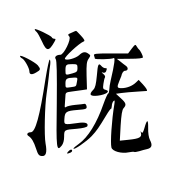
Gai
Kangxi stroke count: 15
Page 645, Entry 16
Tang Yun: Pronounced gai (falling tone).
Jiyun, Yunhui: Pronounced gai (falling tone), reads the same as gai.
Name of a river.
Shuowen: This river originates from Fuzeng Mountain at the Sangdu of the East Sea.
Also refers to irrigation.
Records of the Grand Historian (Shiji): Ximen Bao diverted the Zhang River to irrigate the land of Ye.
Also refers to washing.
Book of Odes (Shijing): Use it to wash the pots and cauldrons.
Also hang-gai, referring to slow flowing water.
Sima Xiangru, Rhapsody on the Imperial Park (Shanglin Fu): The water flows surgingly and then slowly.
Also Guangyun: Pronounced gai (falling tone).
Jiyun, Yunhui: Pronounced gai (falling tone), reads the same as ji.
Meaning is the same.
Also interchangeable with ji.
Records of the Grand Historian (Shiji): Emperor Ku upheld the path of impartiality and spread it throughout the world.
Commentary: This is an ancient form of the character ji.
Also Jiyun: Pronounced dai (falling tone). Same as xie.
Supplement: Pianhai Leibian: Pronounced gai (falling tone), reads the same as gai. Refers to plastering walls. Interchangeable with xi.