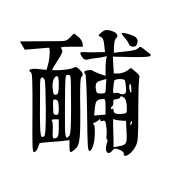
Pronounced fu (falling tone) according to "Guangyun" and feng fu according to "Jiyun," with the same pronunciation as "fu." "Shuowen Jiezi" explains it as the cheek. The character is formed from the "face" radical (miàn) with "fu" as the phonetic component. "Yupian" cites the sentence "che che xiang yi" from "Zuo Zhuan, Duke Xi, Year 2," which is now written as "fu." "Guangyun" explains it as the cheekbone, identical to the character "". "Chu Ci, Da Zhao" contains the phrase "ye fu qi ya." Zhu Xi annotates that some versions of the character "fu" are written as "", referring to the jawbone (i.e., the mandible). "Huainanzi, Shulin Xun" states: A dimple (referring to a cheek dimple) on the cheek is attractive, but on the forehead it is unattractive. "Jiyun" records that this character was originally written as "fu," or sometimes as "".
Additionally, "Tangyun" and "Jiyun" provide the pronunciation fu yu according to "Yuyun," with the same pronunciation as "fu." The meaning is the same. The character was originally composed of "face" (miàn) and "dislike" (yàn). "" is sometimes also written as "ye fu." Etymology: "Jiyun" originally wrote it as "fu," or sometimes as "". It has now been changed to "" in accordance with the original text.