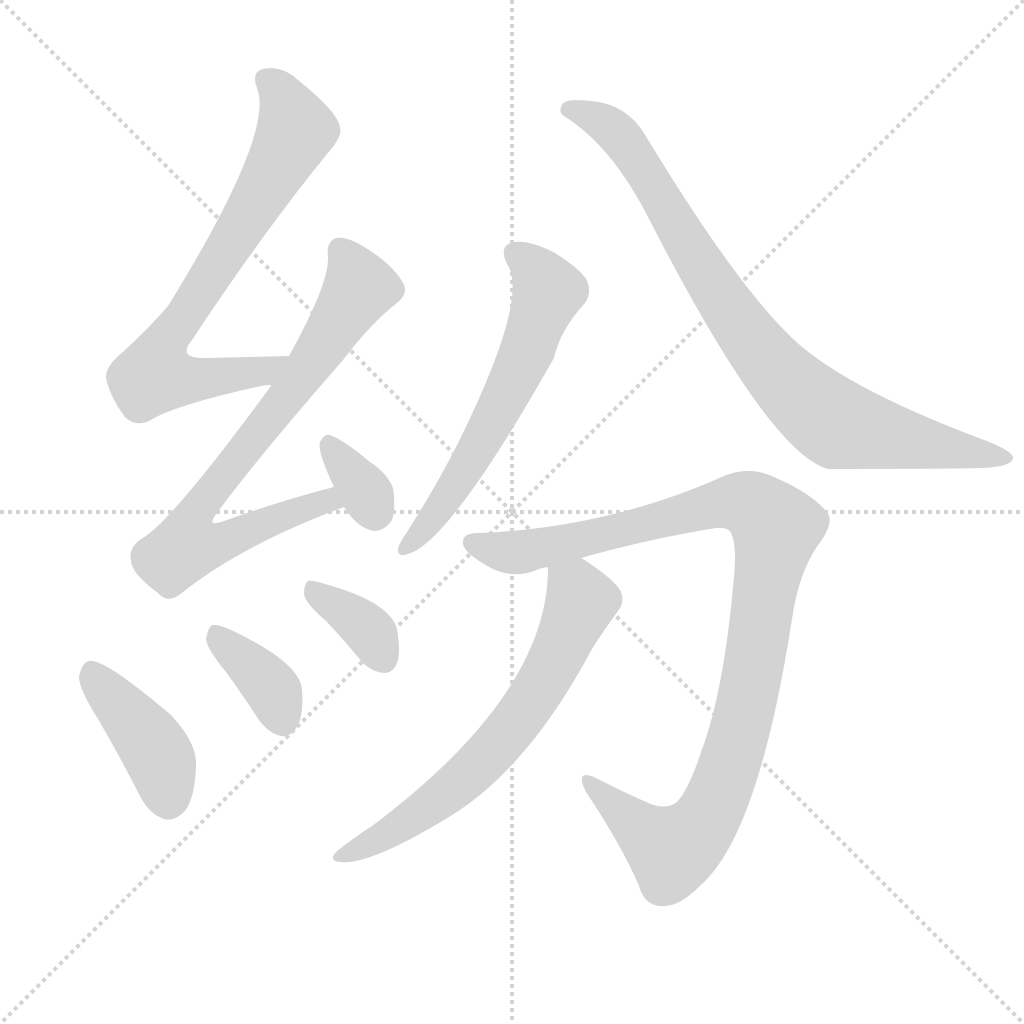
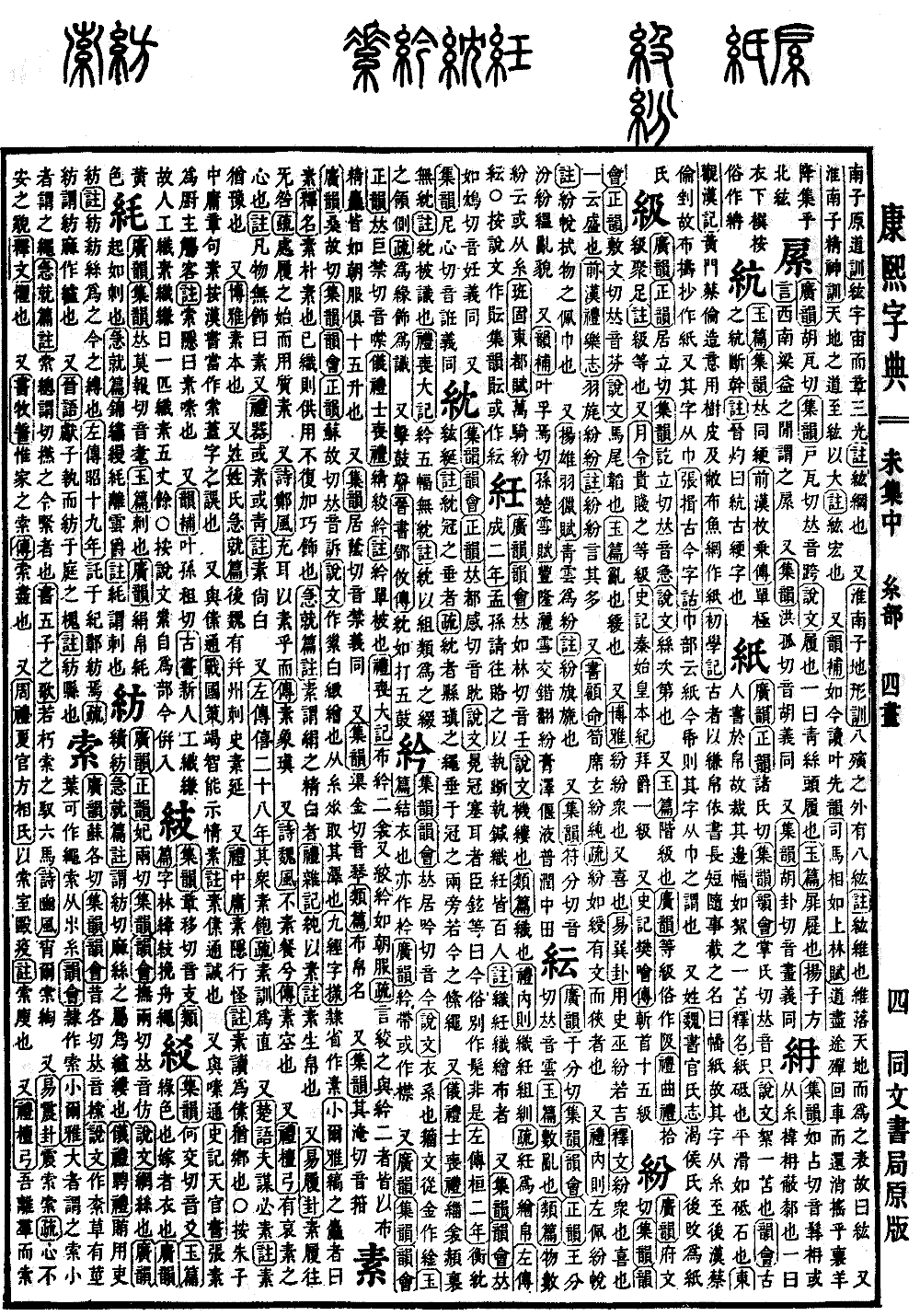
Guangyun states the pronunciation is fen. Jiyun, Yunhui, and Zhengyun state the pronunciation is fen; it is pronounced the same as fen. Shuowen Jiezi explains it as a sheath for wrapping horse tails. Yupian explains it as disordered or loose.
Also, Guangya records that fenfen means numerous, and also denotes joy. The I Ching (Yijing) hexagram text contains: use a shaman to divine, which is auspicious. The Shiwen explains fen as meaning numerous or joyful. One source says it means flourishing. The Book of Han (Qian Hanshu), Records of Rites and Music, contains: feathered banners are numerous. The commentary states that fenfen describes a large quantity.
Also, the Book of Documents (Shangshu), Gu Ming chapter, records: bamboo mats with decorative borders. The sub-commentary explains that fen is like a ribbon, having patterns and being relatively narrow.
Also, the Book of Rites (Liji), Inner Chapters, records: on the left side wear a fenshui. The commentary states that fenshui is a decorative cloth used for wiping items.
Also, Yang Xiong's Rhapsody on the Imperial Hunt (Yulie Fu) contains: blue clouds as decorative streamers. The commentary explains that fen refers to the streamers on a flag.
Also, Jiyun states the pronunciation is fen. It is pronounced the same as fen. Fenyun means the appearance of being disordered.
Also, Yunbu records the rhyming pronunciation as fu yan. Sun Chu, in Rhapsody on Snow (Xue Fu), writes: The god of thunder scatters snow, intertwined and swirling. The rich moisture flows down, universally nourishing the central fields.