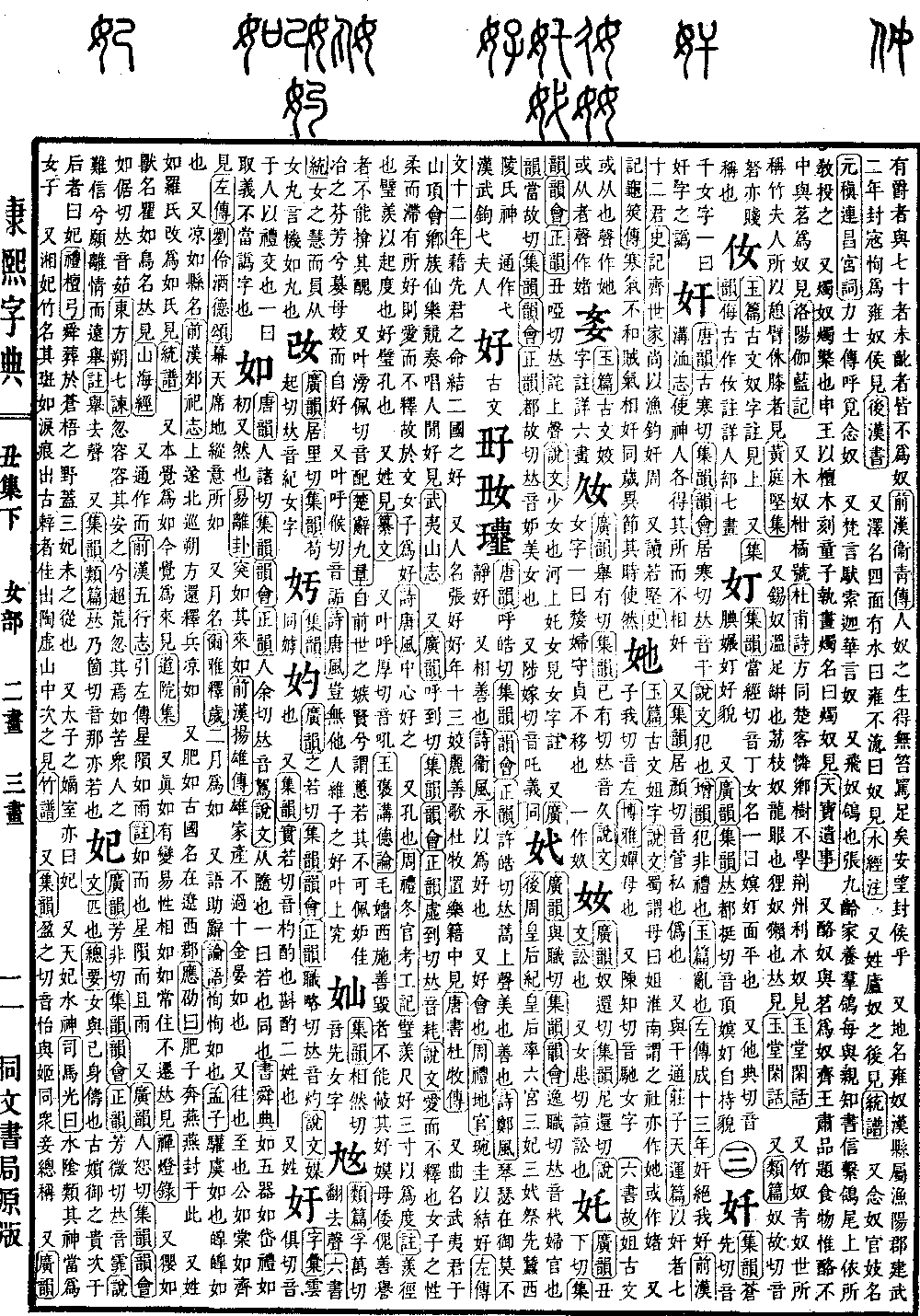
Chou Collection, Lower Volume
Radical: Woman (nǚ)
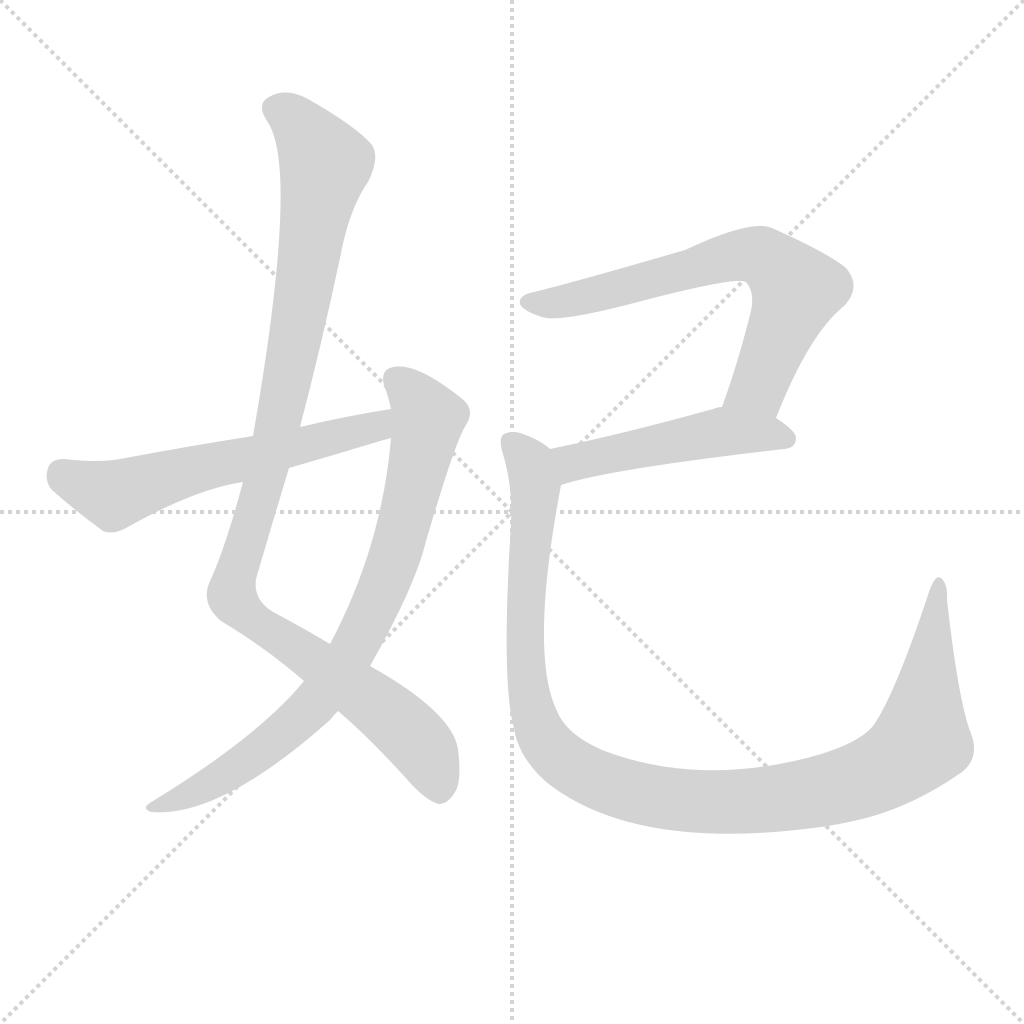
Fei
Kangxi Strokes: 6
Page 255, Entry 22
Broad Rhymes (Guangyun): Pronounced fei.
Collected Rhymes (Jiyun), Rhyme Meetings (Yunhui), Correct Rhymes (Zhengyun): Pronounced fei.
As defined in the Explanation of Simple and Compound Characters (Shuowen): To be a match.
As defined in the General Essentials (Zongyao): A woman who is a peer to oneself. In ancient times, the title for the noble consort whose rank was secondary to the empress was fei.
Book of Rites (Liji), Section on Tan Gong: Shun was buried in the wilds of Cangwu, and his three consorts did not follow him there.
Also, the principal wife of a crown prince is called fei.
Also, Heavenly Consort (Tianfei), a water deity.
Sima Guang stated: Water belongs to the yin class; therefore, its deity is a woman.
Also, Xiang Consort (Xiangfei), a type of bamboo. Its spots resemble tear stains. Those originating from Gula are the best; those from Mount Taoxu are second-best. Refer to the Bamboo Treatise (Zhupu).
Also, Collected Rhymes (Jiyun): Pronounced yi. Same as ji (a concubine). A general term for a group of concubines.
Also, Broad Rhymes (Guangyun), Collected Rhymes (Jiyun), Rhyme Meetings (Yunhui), Correct Rhymes (Zhengyun): Pronounced pei.
Book of Rites (Liji), Section on Qu Li: The consort of the Son of Heaven is called the empress (hou).
Commentary: Fei means to match.
Book of Poetry (Shijing), Preface to the Ode of Mang (Wei Feng): Lost his spouse (fei-ou).
History of the Former Han (Qianhan): During the humble period of the High Ancestor, his consort (fei).
Used interchangeably with match (pei). Sometimes written as a variant form. Also written as a variant form (qian).
Also, used interchangeably with fei. See the note under the character fei.