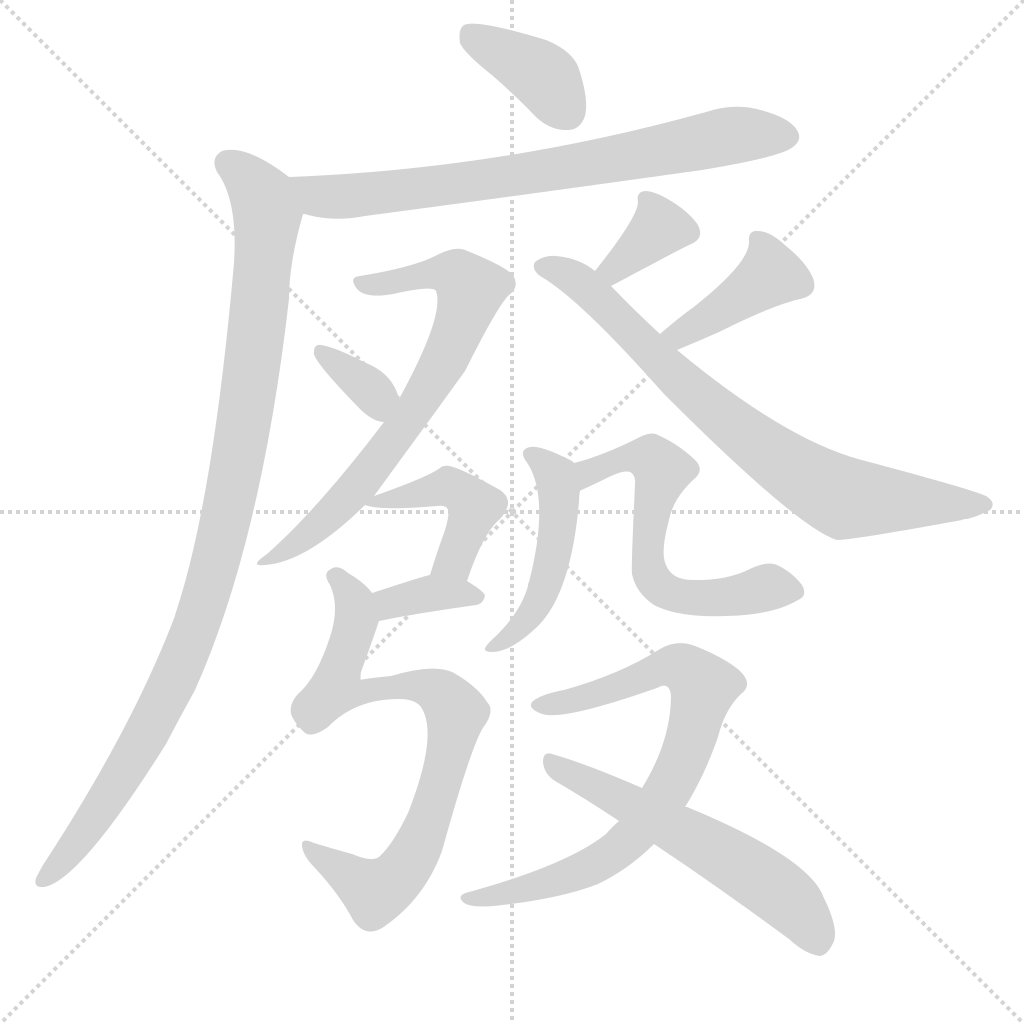
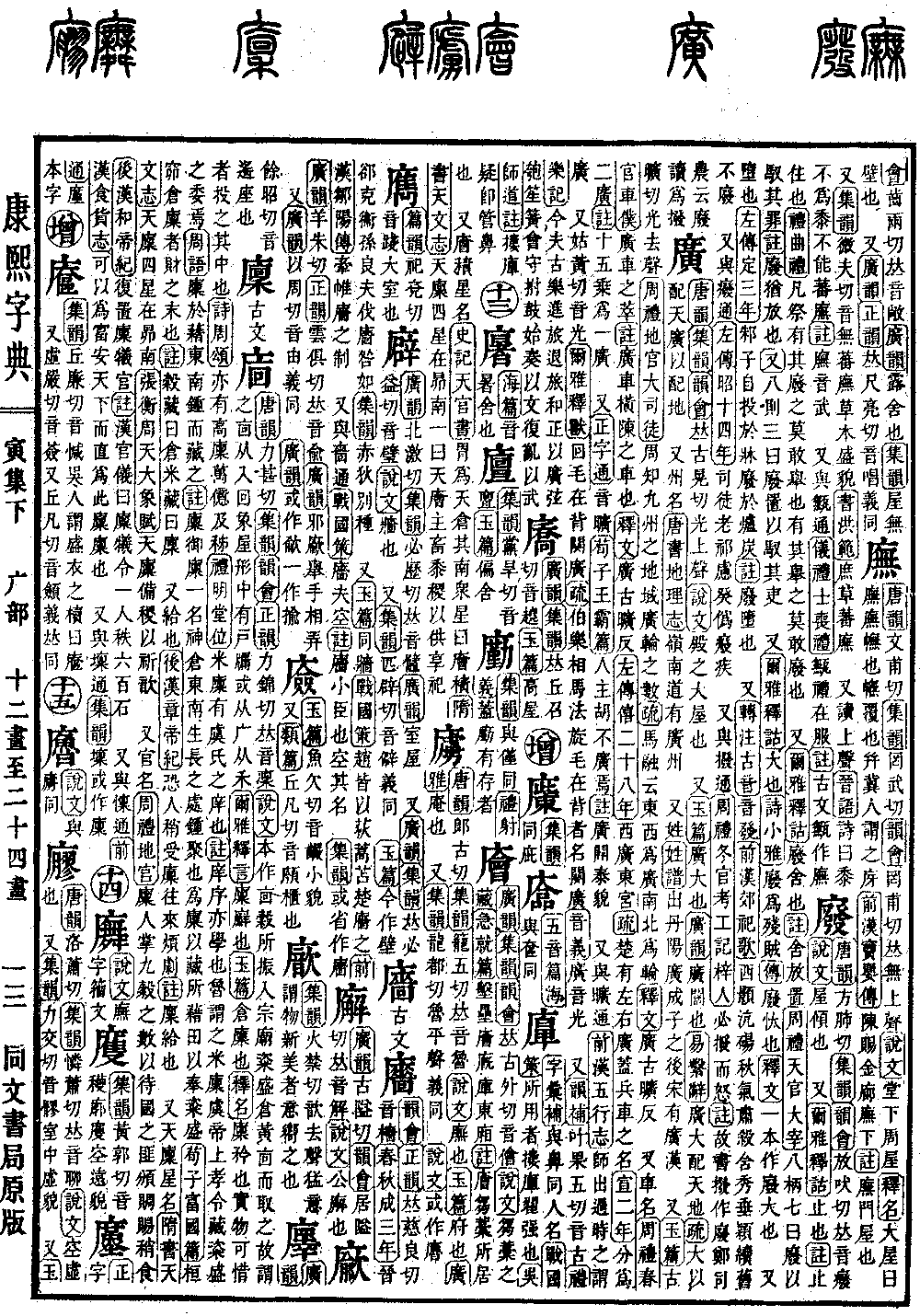
Yin Collection, Lower Volume
Radical: Wide (guǎng)
Kangxi Strokes: 15
Page 351, Entry 02
Pronounced fei (falling tone).
According to the Explaining Graphs and Analyzing Characters (Shuowen Jiezi), a house that has collapsed.
Also, according to the Approach to Elegance (Erya), section on the explanation of ancient terms, the meaning is to cease. Note: This means to stop.
According to the Book of Rites (Liji), in the section on the summary of the rules of propriety, whenever there is a sacrificial rite that has been ceased, one does not dare to hold it again; if it is being held, one does not dare to cease it.
Also, according to the Approach to Elegance (Erya), section on the explanation of ancient terms, to discard. Note: To discard means to set aside.
According to the Rites of Zhou (Zhouli), section on the officials of heaven, the great administrator: of the eight types of authority, the seventh is called fei, used to punish crimes. Note: fei is like to banish.
Also: of the eight laws, the third is to discard or appoint, used to manage officials.
Also, according to the Approach to Elegance (Erya), section on the explanation of ancient terms, the meaning is large.
According to the Book of Odes (Shijing), in the section on the lesser odes: it becomes an extravagant tax. Commentary: fei means extravagant. Explanation of the text: one version is written as a variant form. It also means large.
Also, it means to fall. According to the Zuo Commentary (Zuo Zhuan), in the third year of Duke Ding of Zhu, the Viscount of Zhu fell onto a bed and landed in the stove coals. Note: fei means to fall.
Also, according to the ancient sounds of modified meanings, pronounced fa (entering tone).
According to the History of the Former Han (Qianhan Shu), in the songs for the sacrifices to heaven and earth: the western sky is vast, the autumn air is severe, containing beauty and drooping ears of grain, continuing the old enterprise without ceasing.
Also, it is interchangeable with the character fei (denoting a chronic illness). According to the Zuo Commentary (Zuo Zhuan), in the fourteenth year of Duke Zhao, Situ Laoqi Lu Gui feigned a chronic illness.
Also, it is interchangeable with the character bo. According to the Rites of Zhou (Zhouli), section on the winter officials, the records of the examination of artisans: if one stirs it, it will become angry. Note: In ancient books, bo is written as fei. Zheng Sinong states: fei is read as bo.
Textual research: According to the Explaining Graphs and Analyzing Characters (Shuowen Jiezi), a house that has collapsed. We have corrected the original text from tilted to collapsed.
According to the Rites of Zhou (Zhouli), section on the winter officials, the records of the examination of artisans: it must be stirred and then it will become angry. According to the meaning of the original text, the word bi may be omitted, but the word er may not be omitted. It has been corrected to read: stir and it becomes angry.